The network for creativity
Join 1.25M professional creatives like you
Connect with clients, get discovered, and run your business 100% commission-free
Creatives on Contra have earned over $150M and we are just getting started
Back to feedPost

The Hidden Complexity Behind “Simple” APIs
A REST endpoint can look ridiculously simple:
POST /users
Send JSON.
Get JSON.
Done.
Except… it’s never just that.
Behind that tiny endpoint might be:
Authentication.
Authorization.
Validation.
Rate limiting.
Idempotency.
Transactions.
Database constraints.
Caching.
Retries.
Timeouts.
Concurrency.
Observability.
Distributed locks.
Message queues.
Eventual consistency.
Backward compatibility.
The API might expose one function while coordinating ten different systems.
That’s the weird thing about APIs.
The interface gets simpler as the implementation gets more complicated.
A good API hides complexity from the consumer.
But hiding complexity doesn't eliminate it.
It just moves it somewhere else.
Consider:
Looks easy.
But what happens if the client sends the request twice?
What if the database commits the transaction but the network connection dies before the response reaches the client?
The client retries.
Now you might have two payments.
Suddenly your "simple API" needs idempotency keys.
Then someone asks:
"Can we make it asynchronous?"
Now you need queues.
Then:
"Can we guarantee exactly-once processing?"
Now we're discussing distributed systems.
Then:
"Can users immediately see their updated balance?"
Congratulations.
We're discussing consistency models.
The endpoint never changed.
The complexity underneath it did.
This is why API design isn't merely about choosing between REST, GraphQL, gRPC, or some fancy new protocol.
The real question is:
What complexity are you choosing to expose, hide, or absorb?
Great APIs aren't necessarily the ones with the fewest endpoints.
They're the ones that make difficult things feel boring.
Because that's what abstraction is supposed to do.
Make the impossible-looking machinery underneath feel like:
The best APIs are simple at the surface precisely because someone was willing to wrestle with the complexity underneath.
Simple API ≠ simple system.
Sometimes the cleanest interface is sitting on top of the ugliest distributed system imaginable.
And that's the art of backend engineering.
The network for creativity
Join 1.25M professional creatives like you
Connect with clients, get discovered, and run your business 100% commission-free
Creatives on Contra have earned over $150M and we are just getting started





Related posts

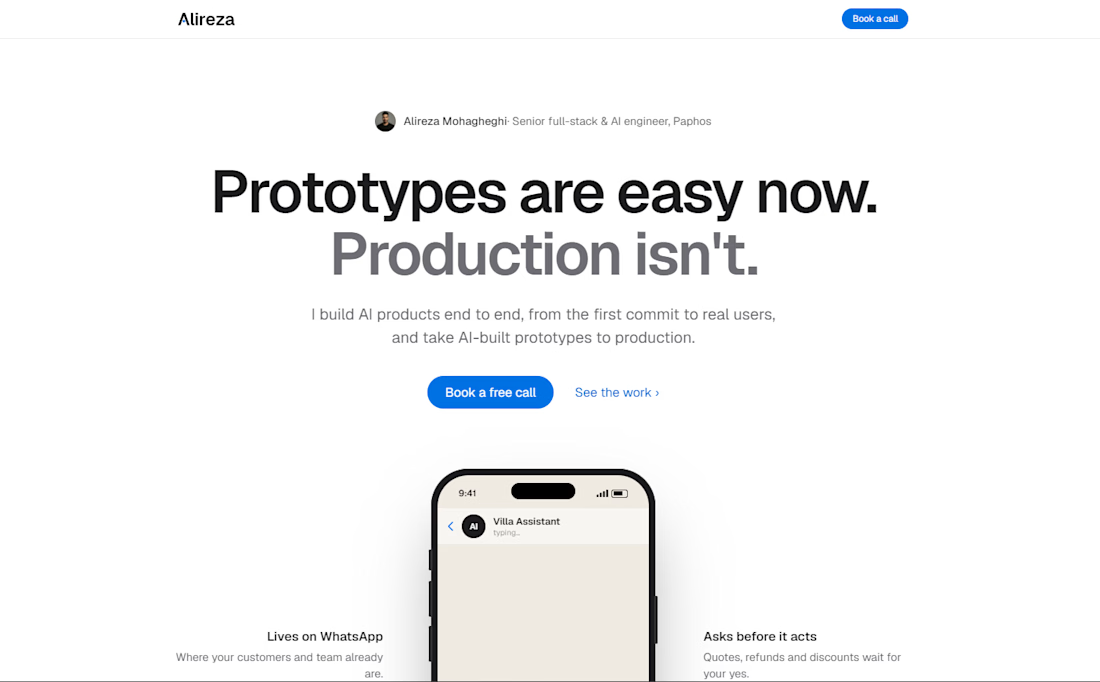
Prototypes are easy now. Production isn't.
I just relaunched my site, alireza.work, a one-page look at what I build and how I work.
I'm a senior full-stack & AI engineer in Cyprus. Over the last 7 years I've built:
→ a multi-tenant commerce platform running ~300 stores, with an AI operator on 100+ MCP tools
→ the backend of a crypto exchange with 100K+ users (as team lead)
→ open-source agent tooling for NestJS
What I help with now:
• AI products, built end to end, from architecture to real users
• Apps built with Lovable, Bolt, Base44 or Cursor, made secure and production-ready
• AI agents that plug into your existing business systems
If you have a prototype that works in the demo but you're nervous about real users, send me the repo. The first call is free.

so true, shipping to production is where the real work starts 💯
Built a booking app for Kang Dedi, a one-man AC technician in Bandung (fictional client, very real problem).
Every booking used to be a WhatsApp marathon: "how much?", "which day?", "what time?", "send your location". Around 10 messages per job, answered at night after work. Then his days zig-zag across the city, and sometimes he shows up to an empty house because the customer forgot.
So I turned the whole chat into one link:
✅ Pick your neighborhood, you only see days he's already around (mornings in your area, afternoons in the center)
✅ Price and time on site show up instantly, only slots where the whole job actually fits
✅ Booked in about a minute, with a ticket and the exact WhatsApp confirmation
✅ Reminder the evening before: still on, or reschedule? No reply gets flagged for him
✅ Someone cancels? The slot goes straight to the next person on that area's waitlist
✅ Review request goes out after the job, on its own
✅ His whole day on one map, plus the week, the waitlist and every message sent
Ngl the fun part was the scheduling rule. My first version literally put him in two places at once, took a couple of rounds to get it right (the process video shows the whole thing, bugs included).
Try it: ademservice.lovable.app
Owner view, no login: ademservice.lovable.app/demo
(Messages are simulat:ed in the demo, production would go through the WhatsApp Business API.)


A fully designed and developed Diamond website project showcasing luxury jewelry collections. Includes elegant UI design, smooth navigation, responsive layout, and interactive product sections to highlight each stone’s brilliance.