The network for creativity
Join 1.25M professional creatives like you
Connect with clients, get discovered, and run your business 100% commission-free
Creatives on Contra have earned over $150M and we are just getting started
Back to feedPost

The MVP stack I'd use if a founder hired me tomorrow
I've shipped 6 production platforms for founders in edtech, healthtech, and real-time marketplaces. Every one of them started with the same question: "What should we build this on?"
Here's my answer. No hedging.
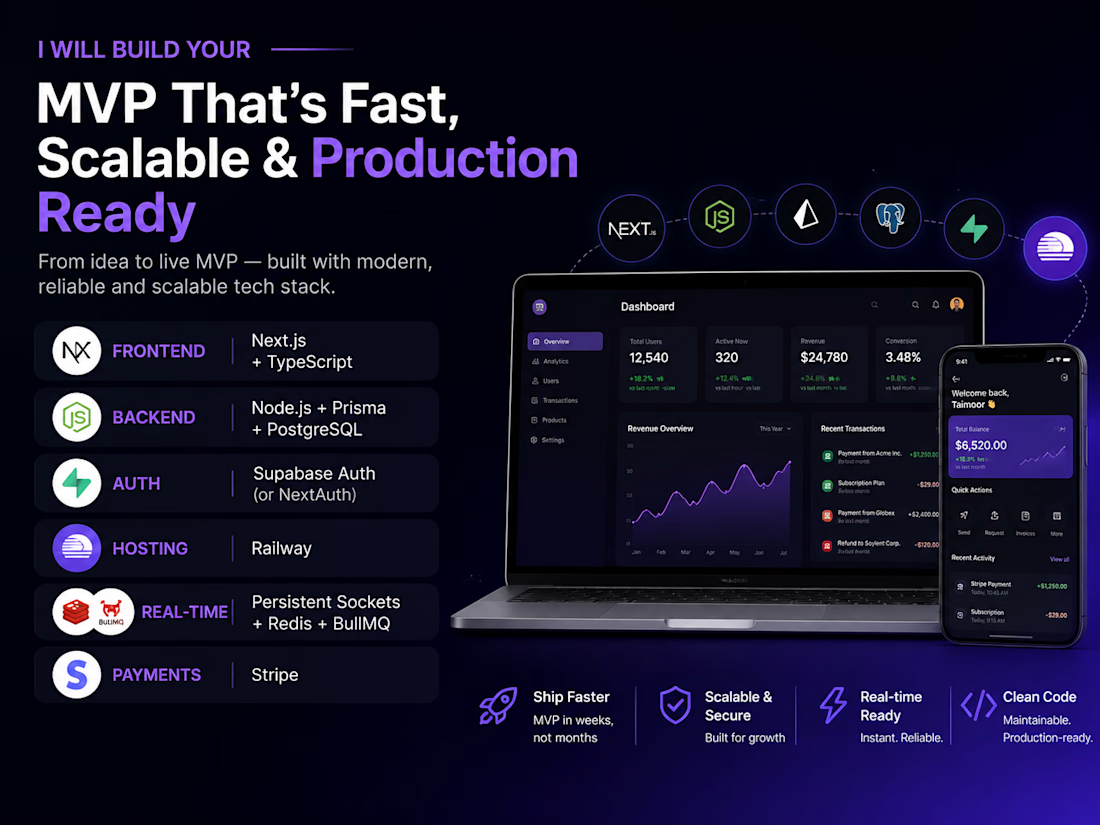
Frontend: Next.js + TypeScript
Every project I've shipped in the last 2 years runs on Next.js. EduPilotPro (500+ schools), Kismaa (real-time psychic sessions), Cosmeticure (healthcare booking). All Next.js.
Why: Server-side rendering for SEO when you need it. API routes for lightweight backend logic. App Router for layouts that don't fight you. TypeScript because I've never once regretted adding it and I've regretted skipping it every single time.
I don't use Remix. I don't use Nuxt. Not because they're bad. Because I've shipped enough Next.js to know exactly where it breaks and how to fix it fast. For an MVP, that matters more than theoretical framework advantages.
Backend: Node.js + Prisma + PostgreSQL
Node.js on the server. Prisma as the ORM. PostgreSQL as the database. This is the stack for every project I've built.
Why Prisma: Type-safe database queries that catch errors at build time. Schema migrations that don't make you sweat. For Kismaa, where we manage real-time session state, billing timers, and three user roles hitting the same tables concurrently, Prisma's transaction handling kept things sane.
Why PostgreSQL: It handles relational data, JSON columns, full-text search, and row-level security. For EduPilotPro's multi-tenant architecture, we use PostgreSQL with row-level isolation on self-hosted Supabase. Each school's data is logically separated without spinning up separate databases.
I don't reach for MongoDB. If your data has relationships (and it does), use a relational database.
Auth: Supabase Auth (or NextAuth if self-hosting)
For most MVPs, Supabase Auth handles email/password, magic links, OAuth, and row-level security out of the box. It's what I used for EduPilotPro.
If the project needs more control (custom session logic, multi-tenant auth with role hierarchies), I'll wire up NextAuth with a custom adapter. But I start with Supabase Auth until there's a reason not to.
Hosting: Railway
Not Vercel. Not AWS.
Railway gives you containers, databases, Redis, cron jobs, and environment management in one place. EduPilotPro runs entirely on Railway. Deployments take seconds. Scaling is a slider. The pricing is predictable, which matters when a founder is watching burn rate.
I'll move to AWS when the product needs it. For an MVP, Railway removes infrastructure decisions so you can ship features.
Real-time: Persistent sockets + Redis + BullMQ
If the product needs real-time (and more products do than founders realize), I use persistent socket connections with Redis for pub/sub and BullMQ for job queues.
For Kismaa, this meant session requests hitting psychics' phones in milliseconds, not seconds. For EduPilotPro, it meant queuing thousands of simultaneous attendance writes at 8:45 AM without the UI freezing.
If your MVP doesn't need real-time on day one, skip this layer. Add it when you do. The rest of the stack supports it cleanly.
AI layer: Google Gemini + structured output
If the MVP includes AI features (and most do now), I use Google Gemini with structured JSON output. Not because it's the best model for every task, but because the API is fast, the pricing is founder-friendly, and structured output means I can pipe AI responses directly into database writes without parsing gymnastics.
For EduPilotPro's AI Attendance Agent, a teacher types "All present except Ali who is sick" and the agent parses it into structured attendance records. That's Gemini with a well-defined output schema. No LangChain. No vector databases. Just a clean prompt, a JSON schema, and a database write.
Payments: Stripe
Stripe for everything. Subscriptions, one-time charges, metered billing, commission splits. I've built Stripe integrations across 5 platforms. I know where the edge cases hide (proration during plan changes, webhook retry logic, failed charge recovery flows).
If you're building a marketplace with commission splits (like Kismaa), Stripe Connect. If you're building SaaS with tiered plans, Stripe Billing. Don't roll your own payment logic.
What I deliberately leave out of an MVP:
Kubernetes (you don't need it yet)
Microservices (monolith first, split later)
GraphQL (REST is faster to ship, switch when you have a real reason)
Multiple databases (one PostgreSQL instance handles more than you think)
The full stack, one list:
Layer Tool
Frontend
Next.js + TypeScript
Backend
Node.js + Prisma
Database
PostgreSQL (self-hosted Supabase)
Auth
Supabase Auth / NextAuth
Hosting
Railway
Real-time
Sockets + Redis + BullMQ
AI
Google Gemini
Payments
Stripe
Mobile (if needed)
React Native
Why this stack works for founders:
Every tool here is something I've shipped to production, debugged at 2 AM, and scaled past the "it works on my machine" phase. The stack is boring on purpose. Boring means I spend your budget on features, not on fighting infrastructure.
If you're a founder with a SaaS idea and you want it built on a stack that's been proven across edtech, healthtech, and real-time marketplaces, that's what I do.


The network for creativity
Join 1.25M professional creatives like you
Connect with clients, get discovered, and run your business 100% commission-free
Creatives on Contra have earned over $150M and we are just getting started
Related posts

Built and launched a networking platform that reached 100+ users
I built this platform to solve a problem I personally felt: professional networking often feels noisy, transactional, and awkward.
The idea was simple: help founders, investors, and operators meet more relevant people through a cleaner, more intentional networking experience.
I designed and built the full product experience, including the landing page, positioning, responsive interface, pricing section, trust elements, testimonials, and user flow. The goal was to make the product feel credible from day one, even though it was an early-stage MVP.
The platform reached 100+ users, which gave me a real validation signal that the problem existed and that people were willing to try a better way to network.
But I eventually shut it down because of retention problems.
Users were interested enough to sign up, but the product did not create a strong enough repeat-use habit. That was an important lesson: getting users to try a product is not the same as building something they keep coming back to.
This project taught me how to move from idea to launch quickly, test demand in the real world, and make honest product decisions based on user behaviour rather than assumptions.
As a Bolt developer, this is exactly the kind of work I enjoy: taking an idea from concept to a polished, usable product fast enough to validate whether it deserves more investment.
What I worked on:
Landing page design and build
Product positioning and messaging
Responsive web experience
MVP structure and user journey
Conversion-focused sections
Early user acquisition and validation
Post-launch learnings from real users
The biggest takeaway: launch fast, learn from real usage, and don’t confuse signups with retention.




The 'intentional networking' angle only holds if the product itself resists the noise it reacts against; restraint in the interface becomes the proof of the positioning, not just the copy. Curious how you define a relevant match under the hood: self-declared intent, or behavior...

Just launched another SaaS website.
This one was built for a fast-growing platform helping businesses turn WhatsApp into a powerful marketing and customer engagement channel through seamless API integration.
At Framer Studio, we build websites that don't just look great—they help SaaS companies grow.
Building something amazing? Let's create a website that matches your vision.
📩 DM us to get started.
#FramerStudio #Framer #SaaS #SaaSDesign #WebsiteDesign #WebDevelopment #LandingPage #Startup #ProductDesign #UIUX #WebDesign #B2B #TechStartup #DigitalProduct #BuildInPublic




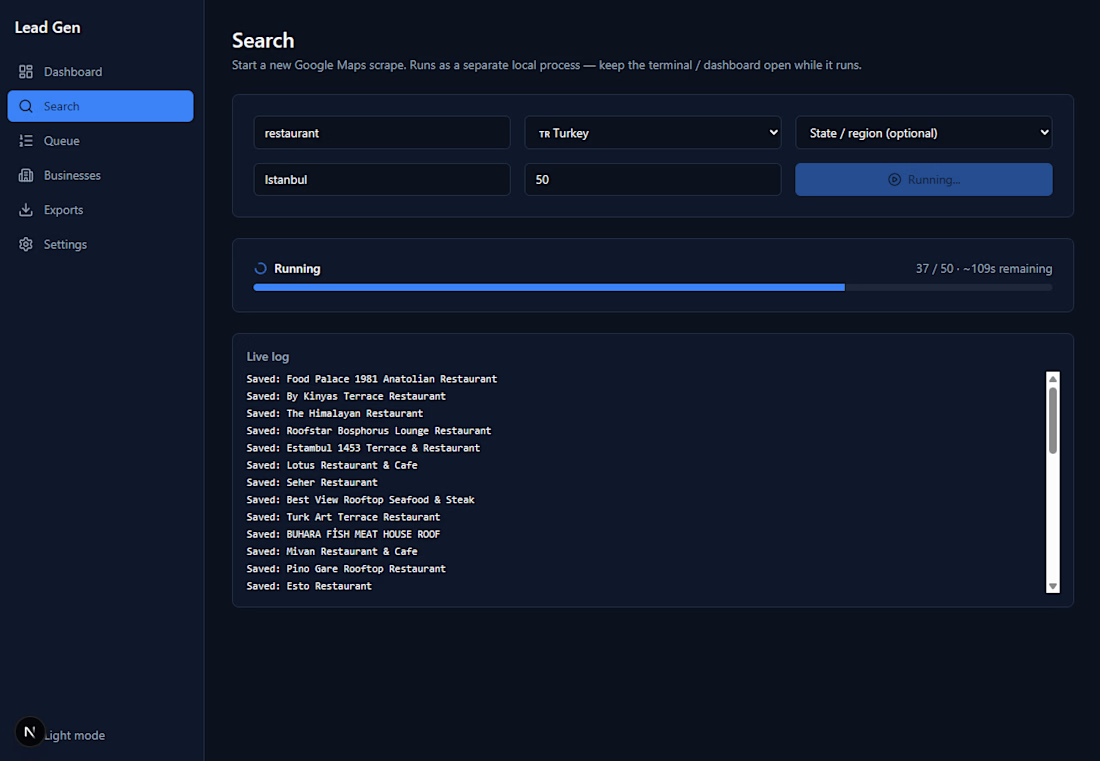
Got tired of dealing with clunky, rate-limited 3rd-party scrapers, so I built my own.
Just testing out my custom Google Maps lead generation scraper, built on Next.js, Playwright, and Supabase. It pulls business listings, finds public contact emails, and automatically dedupes everything before saving.
A few things that make it completely frictionless:
Search and initiate scrapes directly from the UI—no need to even open Google Maps.
Added a Queue system so you can run multiple scrapes simultaneously.
Real-time progress tracking (you can see the live log running in Screenshot 2026-07-07 173222.png).
I am thinking about open-sourcing the whole thing. Should I drop the code on my GitHub?
Also, I need a better name for it. My working title is "Glead", but I am completely open to suggestions. Let me know what you think!



Nice build. If you open-source it, I would prioritize making the architecture and queue system easy to extend, that's usually what gets developers to adopt and contribute.








Trending

Claude
Claude has entered the design space. How are you using Claude Design?

Contra University
Learn from expert creatives how to earn more using next-gen AI tools.
fifaworldcup2026
The World Cup is here and the whole world's watching. How are you designing for the world stage?
creativeaiflow
Creative AI workflows are evolving. What tools do you use, and what are their strengths and weaknesses?
freelancerlife
Freelancer life is wins, pivots, and everything in between. What’s yours right now?