The network for creativity
Join 1.25M professional creatives like you
Connect with clients, get discovered, and run your business 100% commission-free
Creatives on Contra have earned over $150M and we are just getting started
Back to feedPost

I built Song Architect because too many people are approaching AI music backwards.
They generate first, then try to figure out what the song is supposed to be.
That usually leads to generic results, inconsistent direction, and frustration with the tool.
So I created something to fix that.
Song Architect helps users define the creative foundation of a song before they generate it in Suno — concept, mood, structure, narrative, energy, and overall direction.
The idea was never to automate creativity.
It was to bring more intention into the process.
When the input is clearer, the output gets stronger.
For anyone using Suno seriously, that matters.
Because good songs don’t start with randomness.
They start with vision.
The network for creativity
Join 1.25M professional creatives like you
Connect with clients, get discovered, and run your business 100% commission-free
Creatives on Contra have earned over $150M and we are just getting started





Related posts


Hear the sound 🎧
An experimental exploration of bringing AI conversations to life through motion. ✨
Tool stack: Figma × Claude × After Effects


With sound on the motion really feels like it's reacting to the voice instead of just playing next to it. Did you key that by hand in After Effects or drive it off the audio amplitude?

“Can you build this?” is usually the first question.
I like to follow it with: “What should it make easier?”
Booking a service. Buying a product. Managing an order. Finding an answer without opening five tabs.
That’s where the interesting work starts. Not with choosing a framework, but with understanding what’s getting in the way.
The goal isn’t just a finished website. It’s a useful one.

"Spot on, James! A website should solve a real business problem first—whether it's simplifying checkout or streamlining bookings. Tech stack comes second, UX and efficiency come first."

Figma to lovable by connecting MCP
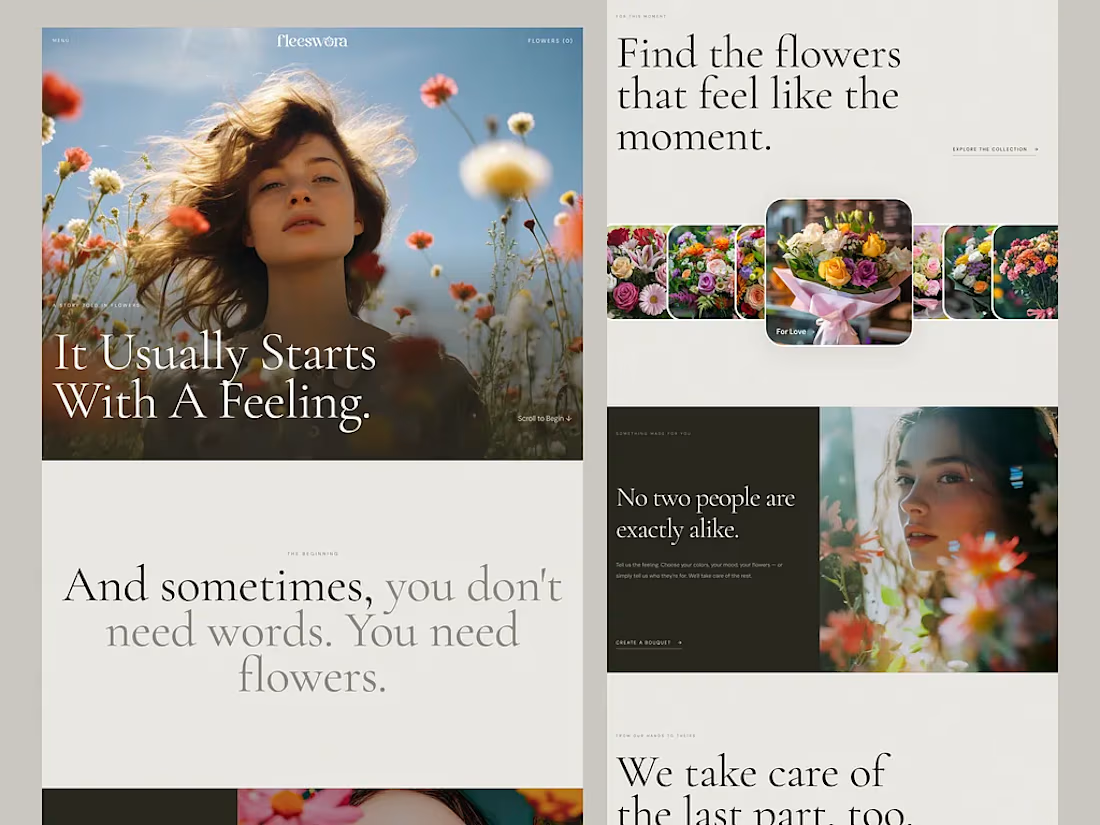
One prompt. One Figma file. A working website. 👀
So, what did I actually do here?
I analyzed how AI interprets UI designs, how it understands layer names, and how naming conventions affect the generated output.
Then I structured my Figma file accordingly and gave Lovable a single prompt.
And honestly? It nailed it.
No complicated back-and-forth. Just a better-structured design and a smarter workflow.
Live preview: https://fleeswora.lovable.app/
This experiment reminded me that AI-assisted design isn’t just about writing better prompts. It’s also about preparing our designs so AI can understand them.
Designers, are you optimizing your Figma files for AI yet?