The network for creativity
Join 1.25M professional creatives like you
Connect with clients, get discovered, and run your business 100% commission-free
Creatives on Contra have earned over $150M and we are just getting started
Back to feedPost

🚀 The Hidden Cost of Manual Work
Many businesses focus on increasing revenue, but few pay attention to the cost of inefficient processes.
Every time someone manually copies data between tools, follows up with leads by hand, or updates spreadsheets, valuable time is being lost.
Automation changes that.
✅ Leads are captured instantly
✅ Customer data stays synchronized across platforms
✅ Notifications are triggered automatically
✅ Teams spend less time on repetitive tasks and more time on meaningful work
The goal isn't to replace people—it's to free them from repetitive work so they can focus on growth, creativity, and customer relationships.
The best automation systems are the ones you barely notice because they simply work in the background, day and night.
What is one repetitive task in your business that you wish could be automated? 💭
The network for creativity
Join 1.25M professional creatives like you
Connect with clients, get discovered, and run your business 100% commission-free
Creatives on Contra have earned over $150M and we are just getting started
Related posts

TITAN Nexus — Enterprise AI Automation Platform
One Intelligence. Infinite Possibilities.
TITAN Nexus is an AI-powered automation platform designed to help businesses streamline workflows, coordinate intelligent AI agents, manage approvals, and monitor task execution from one centralized dashboard.
What TITAN Nexus Can Do
AI Agent Orchestration: Coordinate specialized AI agents for different business tasks.
Workflow Automation: Build and manage multi-step processes to reduce repetitive manual work.
Smart Task Execution: Plan tasks, execute authorized tools, track results, and handle errors.
Approval & Security Controls: Manage permissions and require approval for sensitive operations.
Real-Time Monitoring: Track workflow status, execution history, and system activity.
Data & Backup Management: Support persistent task records, backup exports, and recovery workflows.
Integration-Ready Architecture: Designed to support external business tools and services as connections are configured.
Our Mission
To make business automation more accessible, organized, secure, and scalable by bringing AI agents, workflows, and operational visibility together in one platform.
Built by Shubham Tripathi
TITAN Nexus — Smarter Workflows. Greater Control. Intelligent Automation.


Great 👍🏻

Most inbound bottlenecks aren't caused by low lead volume—they happen during triage.
When inquiries roll into a Google Sheet or CRM, operations teams often waste 10–15 minutes per submission reading through messy paragraphs, deciphering budget mismatch, and manually deciding who gets an immediate call vs. a standard rate sheet.
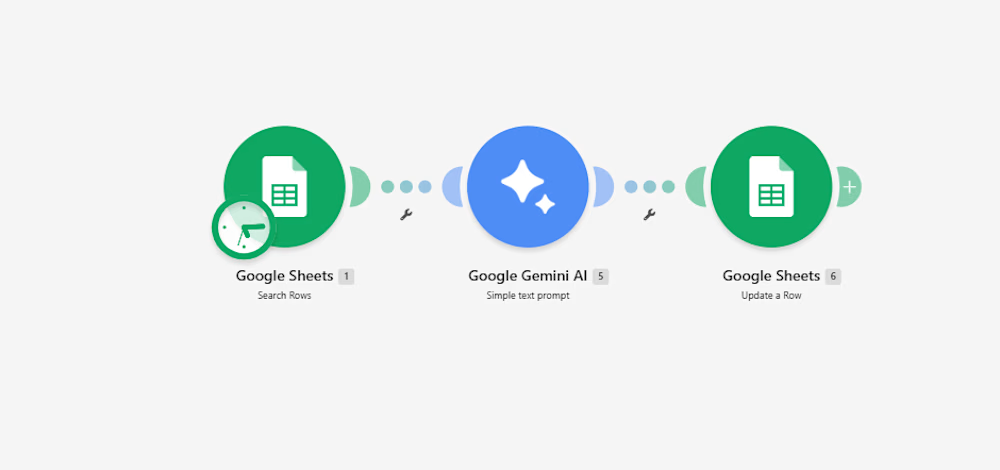
Instead of adding a bulky CRM add-on, I documented a lightweight 3-step automation pipeline built inside Make:
Intake & Extraction: An active listener triggers immediately upon a new submission, extracting core variables: client scope, target deliverables, timeline, and stated budget.
Context-Aware Evaluation (Gemini 2.5 Flash): The payload passes through an AI evaluation node with strict guardrails:
Evaluates budget against minimum agency criteria.
Assigns a triage score: Hot (immediate priority), Warm (nurture), or Cold (disqualified/template reply).
Generates a strict 15-word operational summary—no long paragraphs.
Determines an automated next step (e.g., routing to an account lead or flagging for asynchronous follow-up).
Data Return & Clean Pipeline: Appends the structured classification directly back to the master operational tracker, keeping the sheet filterable and clean.
The outcome: The sales and operations team can filter the entire board by priority status in two clicks, cutting first-touch response time to minutes without manually reading every single submission.
I’ve documented the full scenario map, execution logic, and data schemas below.
Curious how other agency operators and automation leads here handle their lead enrichment layer—are you doing AI scoring at the form level, or later in the CRM pipeline?:


For the budget gate, I'd keep an unstated budget separate from one explicitly below your minimum. Does the Make route ask for clarification when the amount or currency is missing, so a potentially suitable lead doesn't fall into Cold by default?

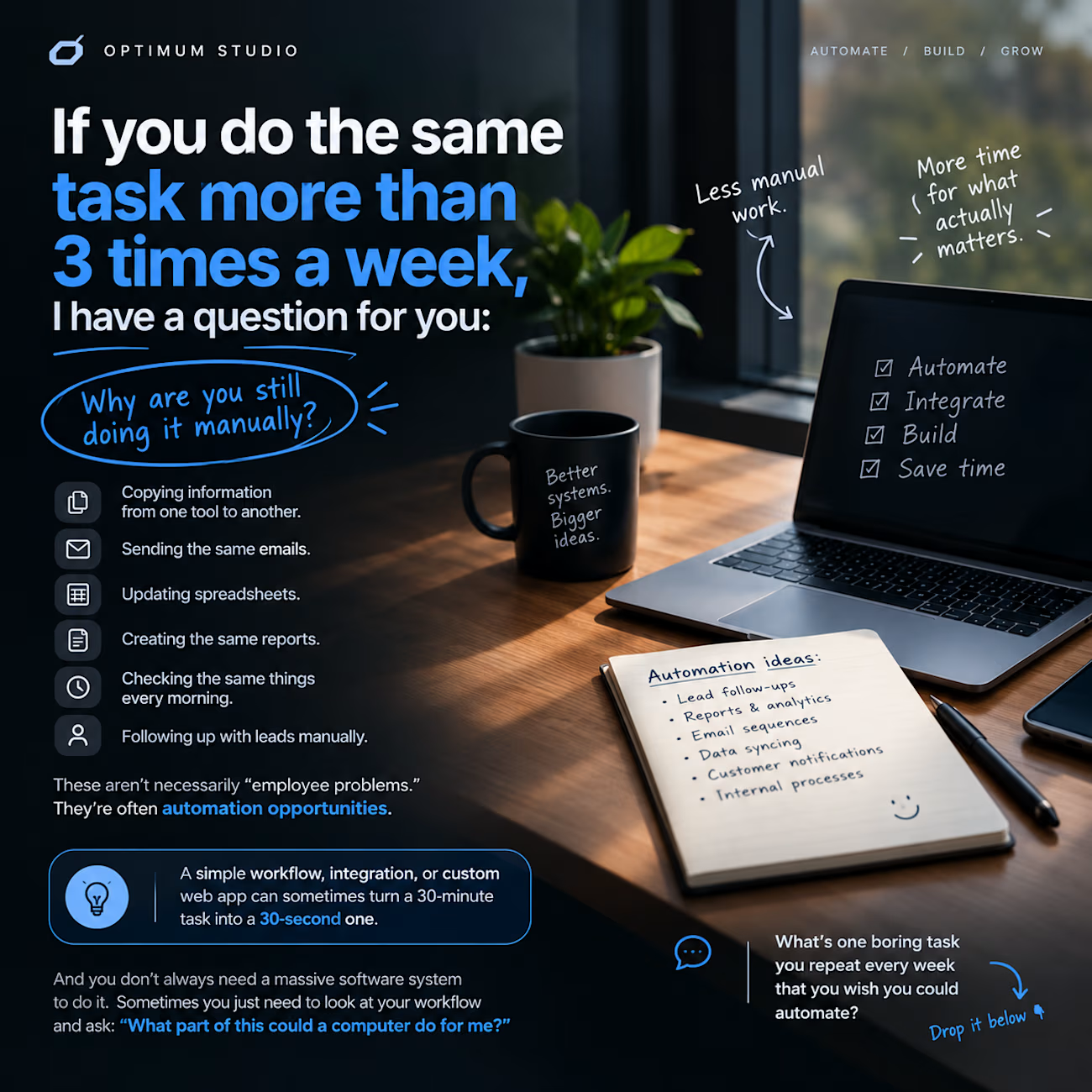
If you do the same task more than 3 times a week, I have a question for you:
Why are you still doing it manually? 👀
Copying information from one tool to another.
Sending the same emails.
Updating spreadsheets.
Creating the same reports.
Checking the same things every morning.
Following up with leads manually.
These aren't necessarily “employee problems.”
They're often automation opportunities.
A simple workflow, integration, or custom web app can sometimes turn a 30-minute task into a 30-second one.
And you don't always need a massive software system to do it.
Sometimes you just need to look at your workflow and ask:
“What part of this could a computer do for me?”
What's one boring task you repeat every week that you wish you could automate? 👇