The network for creativity
Join 1.25M professional creatives like you
Connect with clients, get discovered, and run your business 100% commission-free
Creatives on Contra have earned over $150M and we are just getting started
Back to feedPost

Project Title :
Project Description:
Most AI workflows are single-use machines. You feed them one input, you get one specific output, and the system dies with that one piece.
This one is different.
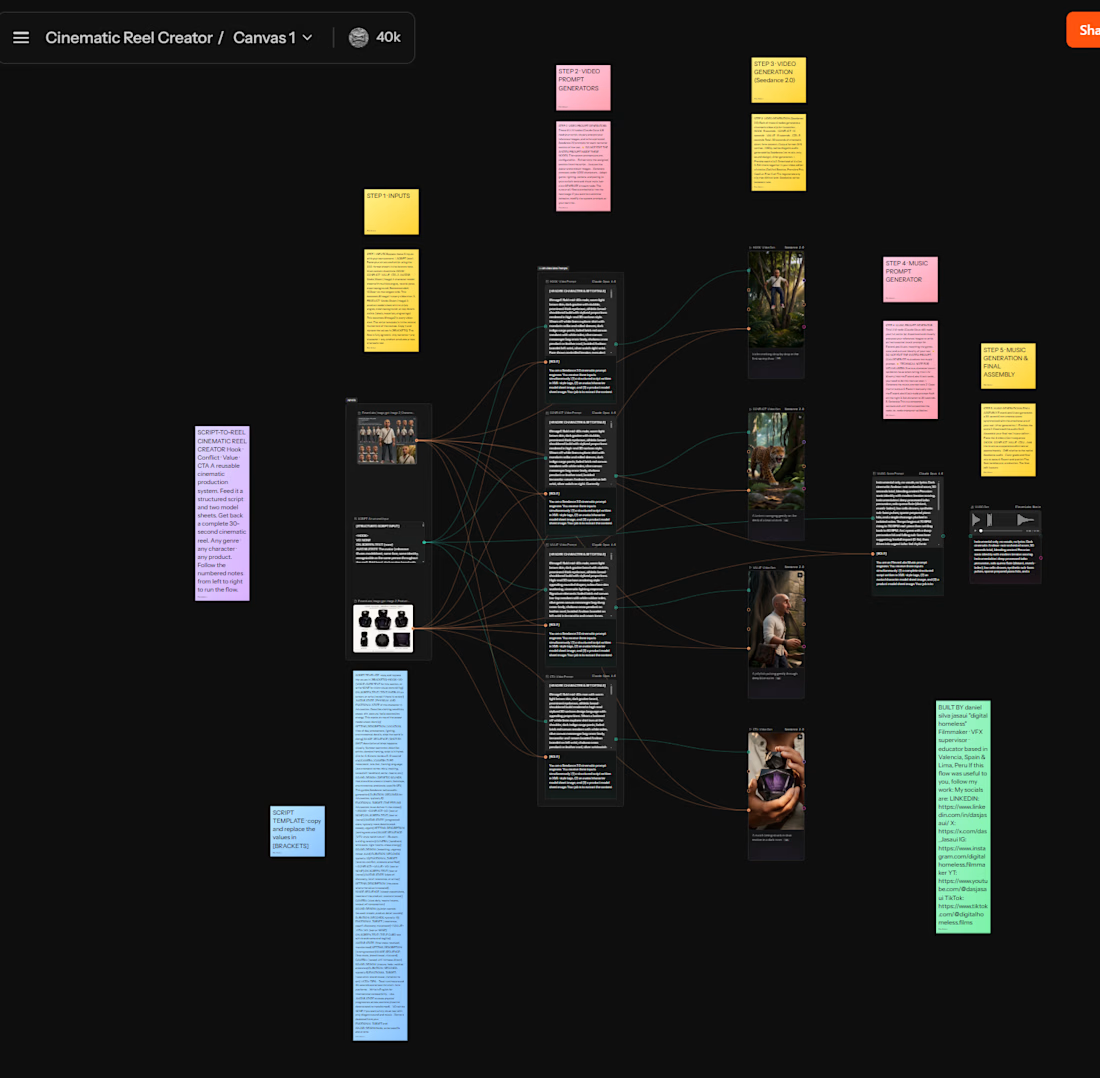
Script-to-Reel Cinematic Director is a reusable Melius flow that turns any structured 4-part script (Hook · Conflict · Value · CTA) plus two reference images (character model sheet + product model sheet) into a complete cinematic short-form reel with AI-generated video and a custom instrumental score.
I built it to be useful to the community, not just to me. Anyone with a script in the right format and two model sheets has a working cinematic reel generator. Replace the script. Replace the model sheets. The same flow produces a new reel in any genre: thriller, romance, horror, documentary, fantasy, action. The system prompts of each LLM are written to detect genre, tone, and visual style directly from the inputs and adapt cinematography, sound design, and music accordingly.
The included example produces a noir-adventure reel for "YANA by JASSA · away wasi", a fictional limited-edition perfume of 333 numbered units. An explorer parachutes into the Peruvian Amazon, survives the jungle, and discovers an ancient stone altar where the bottle waits. No voice-over. No dialogue. Pure visual storytelling, native diegetic sound generated by Seedance 2.0, and an Andean-noir orchestral score generated by ElevenLabs Music.
How the flow works:
3 inputs: structured script (text), avatar model sheet (image), product model sheet (image)
4 LLM nodes (Claude Opus 4.6) that read the script, visually analyze the reference images, and generate optimized prompts for each narrative section (Hook, Conflict, Value, CTA)
4 Seedance 2.0 nodes that generate the cinematic video clips using dual-image reference (@image1 = character, @image2 = product)
1 LLM node + 1 ElevenLabs Music node that read the full script and the reference images to generate a synchronized instrumental score
13 nodes total. Fully agnostic. Production-ready.
Process Steps + Melius Feedback:
[PROCESS STEPS]
Step 1 - Concept and architecture in Claude
I started by designing the flow architecture outside of Melius. I worked with Claude to define the narrative structure (Hook · Conflict · Value · CTA), the data schema for the script (XML-style tags with fields for VO, ON_SCREEN_TEXT, AVATAR_STATE, CITY_DESCRIPTION, IMAGE_SEQUENCE, CAMERA, SOUND_DESIGN, DURATION, EMOTIONAL_TARGET), the role of each LLM, and the system prompts for each node. This gave me a complete blueprint before touching the canvas.
Step 2 - Building the flow with the Melius agent
I gave the Melius agent the blueprint and asked it to build the canvas. The agent created the 13 nodes, organized them visually, and wired the connections. I had follow-up consultations with the agent about available video and music models, node capabilities, and how to handle the absence of a composition/editing node.
Step 3 - Creating the reference images
I generated the character model sheet (an explorer version of my "digital homeless" avatar with Peruvian identity elements: braided Andean bracelet, chakana pendant, signature red sneakers) and the product model sheet (the YANA perfume bottle: hand-shaped faceted black obsidian, ghost engraving "YANA by JASSA 001/333", deep violet liquid inside) using Nano Banana 2 inside Melius.
Step 4 - Writing the script
I wrote the structured XML script for "YANA by JASSA · away wasi" iteratively with Claude, refining the narrative arc, the visual progression of the avatar (clean to battered to reverent to resolved), and the diegetic sound design. The script is fully reusable: anyone can replace it with their own narrative.
Step 5 - Pasting the system prompts and running the flow
I pasted the 5 system prompts (4 video + 1 music) into the LLM nodes, connected the inputs, and ran the flow. The 4 Seedance 2.0 nodes generated the cinematic video clips. The ElevenLabs Music node generated the instrumental score.
Step 6 - Manual post-production
Because Melius does not yet have a composition node that supports multi-track audio mixing or video editing inside the canvas, I downloaded the 4 video clips and the score, then assembled the final reel in an external editor (DaVinci Resolve) to mix the native Seedance audio with the ElevenLabs Music at the right levels.
[FEEDBACK ON MELIUS]
What worked well:
The agent-driven canvas construction is a real productivity unlock. Describing the flow conversationally and watching the agent build it is faster than dragging nodes manually.
Having Claude Opus 4.6 available as the LLM was critical for the quality of the generated prompts.
The visual canvas is clean and the node connections are intuitive once you understand the data types.
Seedance 2.0 with dual-image reference (@image1 + @image2) produced consistent character and product identity across multiple clips, which is what I needed for a coherent reel.
What I would love to see improved:
Composition / editing node. Right now Melius generates great assets but cannot assemble them inside the canvas. A node that combines multiple video clips, supports multi-track audio mixing (voice-over + music + diegetic sound), allows simple cuts and crossfades, and exports a final reel would close the loop and make Melius end-to-end. Today the workflow still requires DaVinci Resolve or similar for the final assembly.
Character count handling in node-to-node connections. I connected the music LLM output to the ElevenLabs Music input, but the receiving node read the prompt as having more characters than it actually had, causing rejection. I had to manually copy the LLM output and paste it into the music generator to make it work. This breaks the agentic flow promise. Either the validation should match the real character count, or the system should auto-trim if the source exceeds the limit.
Audio reference input on Seedance nodes. I originally designed the flow to include voice-over generation feeding into Seedance as audio reference (for lip-sync or guided performance). Seedance in Melius did not accept the external audio reference, so I had to simplify the flow and drop the voice-over generation entirely. Supporting audio reference inputs on video generation nodes would unlock a much richer narrative pipeline.
Despite these gaps, the flow I built is production-ready and reusable. Melius made it possible to ship a working cinematic pipeline in one afternoon instead of weeks, which is exactly the promise of the platform.


The network for creativity
Join 1.25M professional creatives like you
Connect with clients, get discovered, and run your business 100% commission-free
Creatives on Contra have earned over $150M and we are just getting started
Related posts

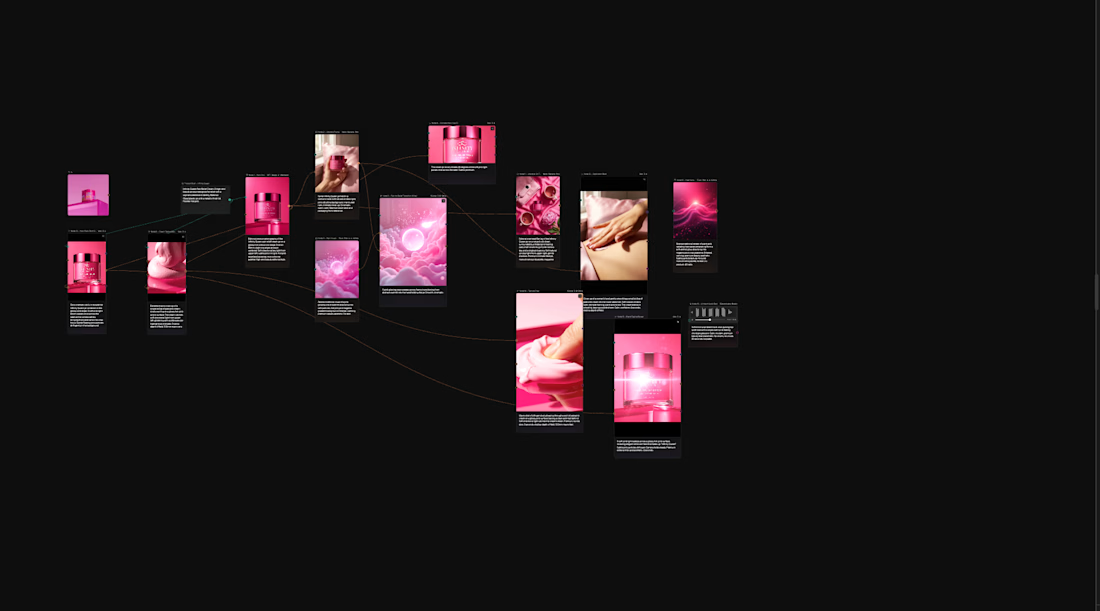
What if there was a pink, magic cream designed to stop all body aches and pain?
Well, I created an advertisement for a product designed to do exactly this. I used
Melius made it so easy, literally just prompted it with exactly what i wanted for each of the visuals. Definitely will be using it again. I like how it sets up the nodes for you. Saved me a ton of time, which i usually would spend in Google Veo 3 manually inputting images.

wow, so so so....


PROJECT NAME
AION PYR — The Aitherioi
CONCEPT / PROJECT DESCRIPTION
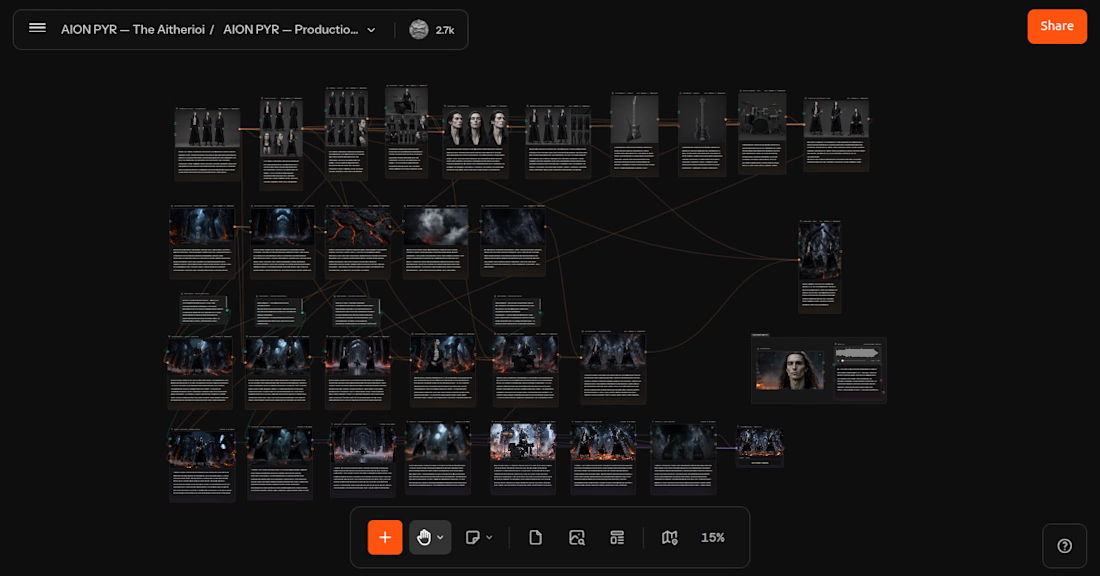
AION PYR is a one-minute instrumental progressive-rock film by The Aitherioi, a fictional trio of pale pre-terrestrial beings older than Earth.
They were here when the planet was born from heat, basalt, and lava, and they remain calm as that world dissolves into stardust. The film follows them performing inside a collapsing volcanic cathedral while lava, steam, lightning, and stone slowly give way to void.
The music is built only from guitar, bass, and drums: slow, heavy, repetitive, bass-led, and cathartic.
PROCESS
I started by defining The Aitherioi: a fictional pre-terrestrial trio with a shared visual identity, pale ethereal bodies, severe faces, long dark hair, and calm expressions.
Then I built the visual system around contrast: fossil-dark basalt, living lava, white steam, lightning, and their stillness inside collapse.
I created character assets, face studies, wardrobe references, instrument references, environment plates, keyframes, and individual video scenes.
The music was built first as a strict one-minute instrumental progressive-rock track using only guitar, bass, and drums. The video was then structured to follow the track: bass opening, wide trio, basalt corridor, guitar catharsis, drummer pulse, matter dissolution, and final void.
Finally, I stitched the scenes together with clean cuts so the film follows the music without extra transitions or title cards.
FEEDBACK ON BUILDING WITH MELIUS
Melius worked best as a production canvas rather than a single-prompt generator.
The node-based workflow made it possible to build the project in layers: character identity, environments, audio, keyframes, video clips, and final assembly. That helped keep the concept coherent while still allowing corrections when individual shots needed refinement.
The biggest challenge was visual continuity, especially keeping The Aitherioi consistent across scenes. The most useful approach was creating strict reference assets first, then using them as anchors for keyframes and video generation.



This is raw power, like it so much!


Hey Contra creators!
We’ve loved seeing the creativity from your templates so far.
Tips before submitting:
1. don’t forget to include your published Template link in your submission so we can validate your entry.
2. we strongly encourage using the full integrated ElevenCreative stack inside your Templates, including voice, music, image, video, and SFX tools. End-to-end workflows built fully within ElevenCreative will stand out most!
FYI, we’re currently hiring an AI Creative Producer at ElevenLabs, and standout submissions are definitely getting noticed by the team!
Last 4 days to enter, good luck everyone!

Hi Matthieu! Is there a place to get a consultation on some prompts on 11 LAbs? Though I watched all the tutorials and re-made a lot of prompts I always get the generation failed. Even when I overcome it in the flow, it appears again the template. Would be great to talk to someone



Trending

Claude
Claude has entered the design space. How are you using Claude Design?

Contra University
Learn from expert creatives how to earn more using next-gen AI tools.
creativeaiflow
Creative AI workflows are evolving. What tools do you use, and what are their strengths and weaknesses?
portfolioreview
The best portfolios tell a story, not just show a grid. Share yours for feedback.
freelancerlife
Freelancer life is wins, pivots, and everything in between. What’s yours right now?