The network for creativity
Join 1.25M professional creatives like you
Connect with clients, get discovered, and run your business 100% commission-free
Creatives on Contra have earned over $150M and we are just getting started
Back to feedPost

1. What it is: An advanced e-commerce web app that combines Graph Neural Networks (GNNs) and Generative AI to identify "toxic inventory"—products, sizes, or suppliers driving high customer returns.
2. GNN Predictive Modeling: Built a heterogeneous GNN using PyTorch Geometric to model relationships between customer demographics and product features to predict future return risks.
3. AI Attribute Enrichment: Automated a metadata extraction pipeline using the Gemini API with local caching to parse raw HTML product descriptions into structured product features (fabric, fit, pattern).
4. Interactive Dashboard & Reporting: Developed a Streamlit dashboard with Supabase Auth and integrated ReportLab to generate boardroom-ready PDF return audit reports.
5. Tech Stack: Python, PyTorch Geometric, Streamlit, Gemini API, Supabase, ReportLab.


The network for creativity
Join 1.25M professional creatives like you
Connect with clients, get discovered, and run your business 100% commission-free
Creatives on Contra have earned over $150M and we are just getting started
Related posts


ThisDay 3.0 is live on the App Store
Pay-once day planner for iPhone, iPad, Watch and Mac:
- New UI and D / W / M / Y zoom slider
- New Library
- Native split layout for iPhone Duo
- On-device SiriAI for charts and day planning
- Tasks, events, habits, notes, voice memos, photos and places on one timeline


pay once in 2026, respect 🙌 everyone pushes subscriptions now. the zoom slider from day to year is a really nice way to move through a planner

Finwise: Smart Money Dashboard with AI Assistant

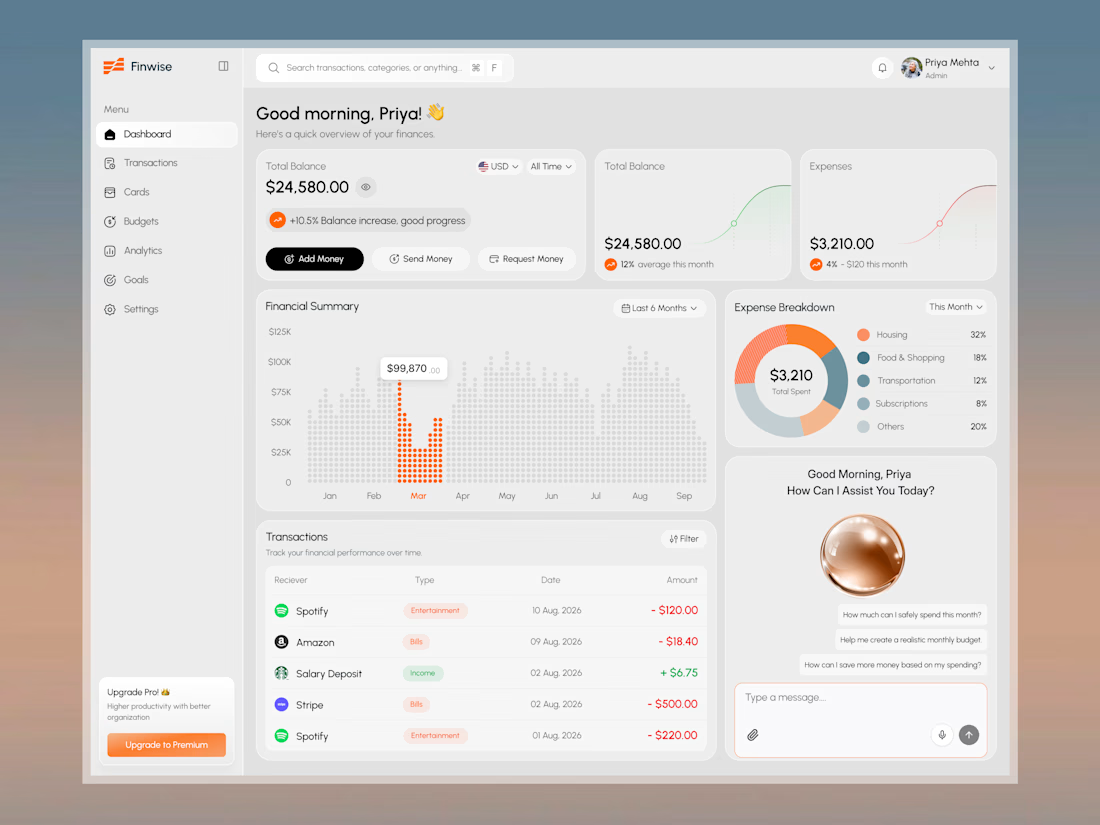

this is amazing . love the visual


We’re choosing the motion for an AI analytics product demo, and I can’t decide.
Both clips show the same flow. Someone asks a question in plain English. The agent checks permissions, plans the query, runs it past guardrails and builds the dashboard.
1. A walks you through each step as it happens.
2. B skips the steps and drops you straight onto the result.
A shows the work. B shows the speed. For a landing page I keep going back and forth.
Which one would make you trust the product more? Comment A or B, and tell me why.
3 voted
100%
0 voted
0%
3 votes
Closed

I think according to your query the output should consist on a list of clients with late invoices rather then showing charts etc,