The network for creativity
Join 1.25M professional creatives like you
Connect with clients, get discovered, and run your business 100% commission-free
Creatives on Contra have earned over $150M and we are just getting started
Back to feedPost
Your shipment is moving. But is your operations team still chasing updates across five different systems? 🚢
For freight forwarders and 3PL companies, managing cargo is only half the challenge. The other half is keeping shipment information, documentation, customer communication, and billing synchronized.
Common operational problems:
Shipment updates scattered across emails and spreadsheets.
Teams manually checking carrier websites for milestones.
Missing or delayed bills of lading and customs documents.
Customers repeatedly requesting shipment status.
Disconnected quotations, invoices, and shipment records.
Limited visibility into delayed or exception shipments.
The Solution: Custom Freight Forwarding Management Software
I can build a centralized logistics operations platform using Django that connects shipment management, customer communication, documentation, and reporting.
Core Features:
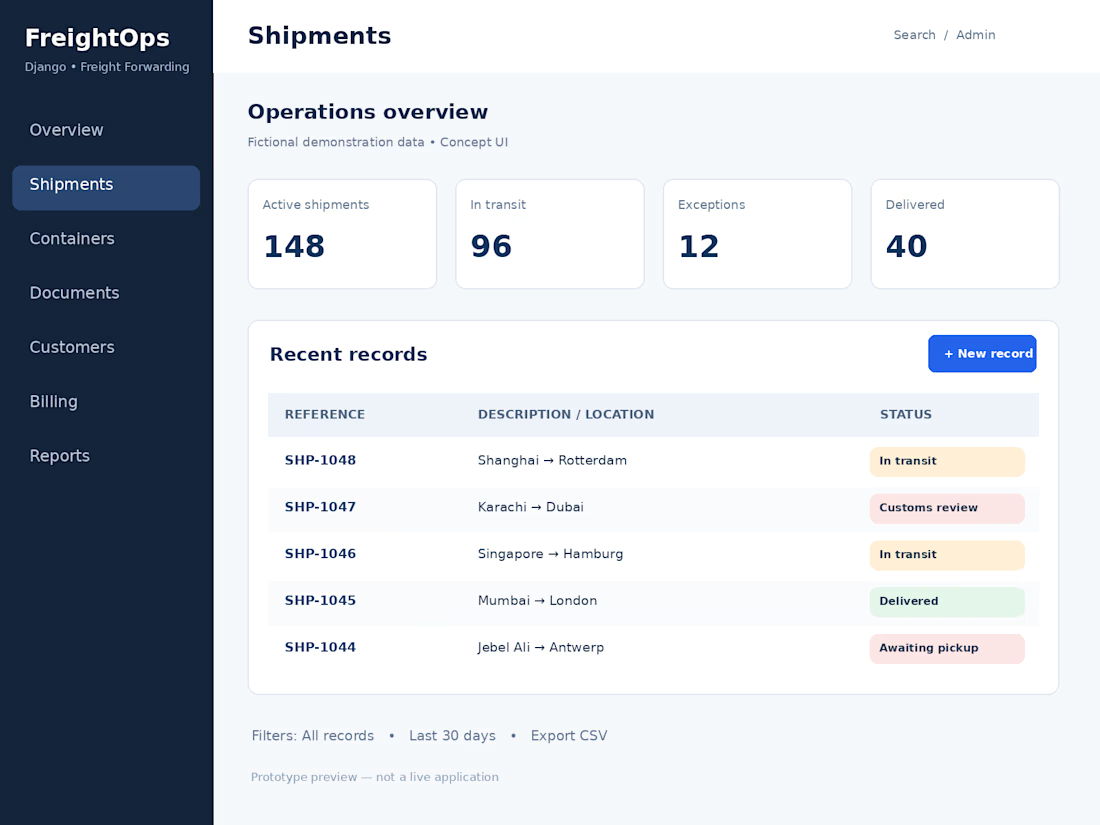
🚢 Shipment Management: Track bookings, containers, carriers, routes, milestones, and delivery status.
📍 Tracking Integrations: Retrieve shipment milestones from supported carrier APIs or tracking providers.
📁 Document Management: Organize bills of lading, commercial invoices, packing lists, and customs documents.
🔔 Automated Notifications: Send customer updates when verified shipment events or exceptions occur.
💰 Quotation & Billing: Manage freight quotations, approved rates, invoices, and payment status.
📊 Operations Dashboard: Monitor active shipments, overdue milestones, documentation tasks, and carrier performance.
Technical Workflow
Operations creates a shipment record.
Django validates and stores shipment, customer, and routing details.
Carrier integrations retrieve available tracking events.
Background workers process milestones and identify exceptions.
Authorized customers receive updates and view shipment progress.
Operations teams review documents, invoices, and delivery completion.
Business Benefits
✓ Reduce repetitive tracking and status-update work.
✓ Improve visibility across active shipments.
✓ Keep customer communication more consistent.
✓ Reduce missing-document follow-ups.
✓ Create a more organized operational audit trail.
Two Ways We Can Start
Already know your requirements? Share your current logistics workflow and integration requirements, and we can plan your custom platform.
Not sure what needs automation? Describe your biggest shipment management bottleneck, and I can help identify the right starting point.
Expected Result: A connected freight operations workspace that helps teams manage shipments, documentation, customer updates, and billing with fewer manual handoffs.
SEO Keywords
freight forwarding software • freight management system • Django logistics application • shipment tracking software • 3PL management software • logistics automation • custom freight software • freight forwarding ERP • cargo tracking dashboard • shipment management platform • logistics SaaS development • Django web development • freight operations automation • carrier API integration • container tracking software • shipping document management • bill of lading management • freight quotation software • freight invoice automation • customs document tracking • logistics customer portal • shipping milestone alerts • cargo management system • supply chain software • freight booking system • Django REST API • logistics workflow automation • freight forwarding CRM • 3PL customer portal • freight operations dashboard • shipment exception management • shipping API integration • container milestone tracking • freight document automation • logistics reporting dashboard • custom logistics software developer • freight rate management • shipping operations platform • freight forwarding digital transformation • logistics data integration • shipping notification automation • freight billing software • transport management software • logistics backend development • cargo status notifications • logistics database development • freight tracking integration • international shipping management • Django logistics developer • B2B logistics software • freight customer communication • shipment visibility platform • logistics process optimization • multi-carrier tracking • shipment document portal
Hashtags
#FreightForwarding #LogisticsSoftware #Django #PythonDevelopment #ShipmentTracking #LogisticsAutomation #FreightManagement #SupplyChainTech #3PL #FreightTech #ShippingSoftware #CargoTracking #CustomSoftware #SaaSDevelopment #DjangoDeveloper #LogisticsTechnology #SupplyChainAutomation #CarrierIntegration #APIIntegration #BusinessAutomation #ShipmentManagement #FreightOperations #DocumentAutomation #B2BSoftware #EnterpriseSoftware #LogisticsSaaS #WorkflowAutomation #DigitalTransformation #FreightSoftware #SoftwareEngineering #WebDevelopment #LogisticsDashboard


The network for creativity
Join 1.25M professional creatives like you
Connect with clients, get discovered, and run your business 100% commission-free
Creatives on Contra have earned over $150M and we are just getting started
Related posts

From packed boxes to a shipment the client can track.
This TechFoundry IMS demo reuses box details, retrieves UPS rates, creates shipping labels, and keeps tracking connected to the client order. A practical example of the AI and automation workflows we build into business software.
Watch the client shipping demo:
https://www.youtube.com/watch?v=8ohniU08JAA
#AI #Automation #SoftwareDevelopment #Shipping

I like that the shipment stays tied to the client order instead of living in a separate carrier tab. When box details get edited after the UPS rate is retrieved, does the system re-quote before creating the label, or lock the original rate? I'd be curious how you handle that mismatch on the tracking side.

We built a freight forwarder that doesn't exist. Then we made its website actually work.
Halyard is a concept project — no client, no brief. We wanted to see what happens when a corporate site stops describing its product and just runs it.
So on the site you can:
→ Hover a live route map — 16 real ports, containers moving along their trade lanes, each port showing its local time and weekly sailings.
→ Track a container — type a number and it's checked against the real ISO 6346 check digit. Mistype one and it suggests the correction. You get the vessel, voyage, arrival date and every milestone from booking to delivery.
→ Price a lane — Shanghai to Rotterdam, 40ft reefer, pick a weight. Out comes transit time, sea distance, an indicative rate range and that container's CO₂e.
Five pages, built in Framer. The route map, tracker, estimator, counters and clocks are custom React code components. Open roles on the Careers page come from the CMS.
The part we keep coming back to: most corporate sites make you book a call to see the product. This one hands it to you on the homepage.
Try it → halyard.site
Case study → Find more


The same generator cannot be on two construction sites tomorrow.
But when equipment bookings arrive through calls, messages, and spreadsheets, conflicting promises become easy to make.
For construction equipment rental companies, availability means more than checking whether a machine is in the yard.
→ Reservations overlap across booking channels.
→ Maintenance blocks aren’t visible to the sales team.
→ Late returns affect the next customer’s booking.
→ Depot and office records show different equipment statuses.
→ Returned machines become “available” before inspection.
I can build custom equipment rental management software that connects reservations, dispatch, returns, and maintenance.
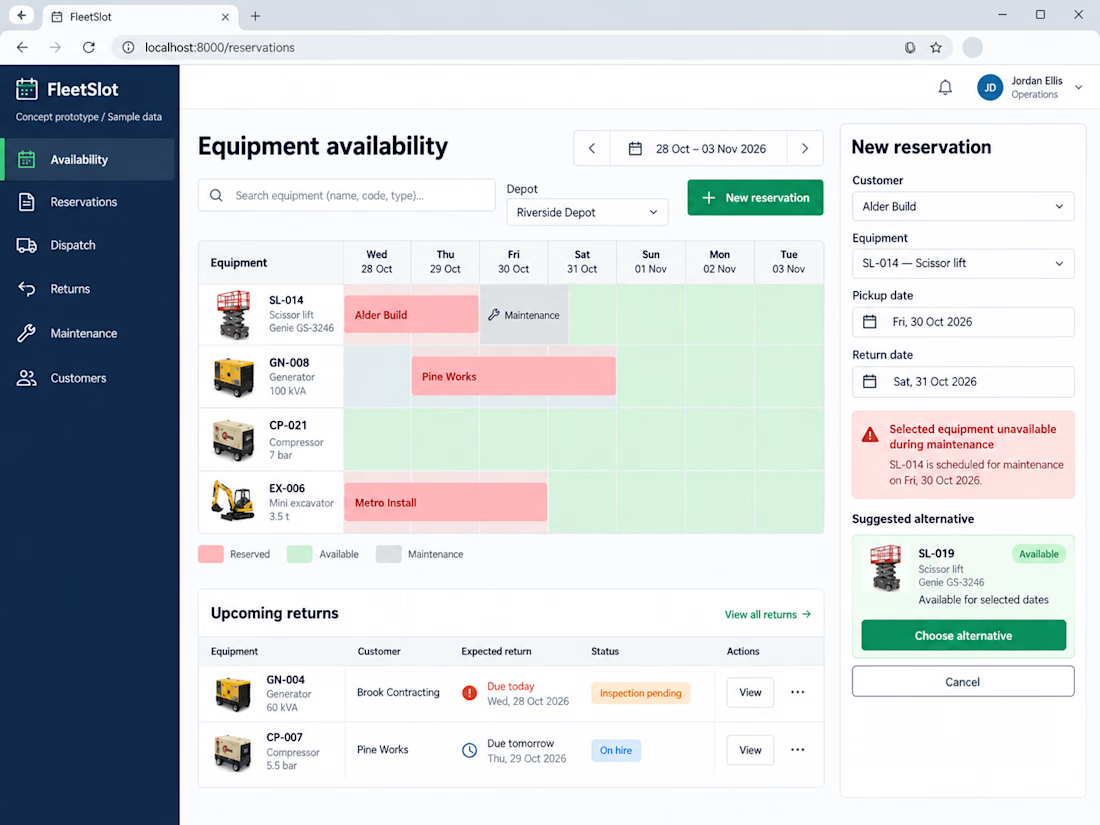
Your team could check equipment availability by date and depot, reserve individual assets, and catch booking conflicts before confirming a rental.
If a machine is unavailable, the rental booking portal could show alternatives that meet your configured equipment requirements.
Returned equipment would pass through inspection before becoming available again.
Workflow:
Select rental dates → Check bookings and maintenance blocks → Reserve equipment → Record dispatch → Track return → Inspect → Release availability.
Server-side availability checks and database locking would protect against simultaneous conflicting reservations.
Benefits:
✅ Clearer equipment availability.
✅ Visible maintenance restrictions.
✅ Better coordination across depots.
✅ Traceable dispatch and return records.
✅ Fewer manual status updates and booking surprises.
Expected result: One operational view of equipment that is reserved, dispatched, overdue, under maintenance, or ready to rent.
Already have your requirements mapped out?
Send me your booking rules, depot structure, and integration needs, and let’s define your rental management system.
Still coordinating rentals through spreadsheets and messages?
Walk me through one booking from inquiry to return, and I’ll help identify the first useful improvement.
Skills: Fullstack Engineer • Backend Engineer • Frontend Engineer
Tools: Django • Vue.js • PostgreSQL
Visual: Concept prototype with fictional sample data.
SEO Keywords
equipment rental management software • construction equipment rental software • machinery hire management system • rental booking portal • equipment availability calendar • asset reservation software • generator rental software • compressor rental management • access equipment hire software • plant hire booking system • rental double-booking prevention • equipment dispatch tracking • rental returns management • equipment inspection workflow • maintenance availability blocking • multi-depot rental software • rental fleet management • equipment hire customer portal • rental contract management • rental extension workflow • equipment turnaround scheduling • rental inventory tracking • individual asset tracking • rental operations dashboard • equipment booking automation • Django development services • Vue.js development services • PostgreSQL development • custom rental software development • rental software developer • construction rental portal • equipment reservation API • rental accounting integration • equipment status tracking • overdue rental tracking • asset utilization reporting • provisional booking holds • rental availability checker • equipment maintenance scheduling • digital dispatch records • rental return inspection • equipment handover records • B2B rental software • rental business automation • machinery booking calendar • depot coordination software • custom equipment hire platform • rental workflow automation • equipment booking conflict detection • rental management system development
#EquipmentRental #ConstructionEquipment #PlantHire #MachineryRental #RentalManagement #EquipmentHire #FleetManagement #AssetManagement #RentalSoftware #BookingSoftware #EquipmentAvailability #ReservationManagement #GeneratorRental #AccessEquipment #ConstructionTechnology #DepotManagement #DispatchManagement #ReturnsManagement #EquipmentInspection #MaintenancePlanning #BusinessAutomation #WorkflowAutomation #CustomSoftwareDevelopment #Django #VueJS #PostgreSQL #WebApplicationDevelopment #B2BSoftware #RentalOperations #DigitalTransformation