The network for creativity
Join 1.25M professional creatives like you
Connect with clients, get discovered, and run your business 100% commission-free
Creatives on Contra have earned over $150M and we are just getting started
Back to feedPost

The Oriol Paulo Formula: How to Make the Audience Doubt Everything
Are We Witnessing the Fall of Hollywood's Monopoly?
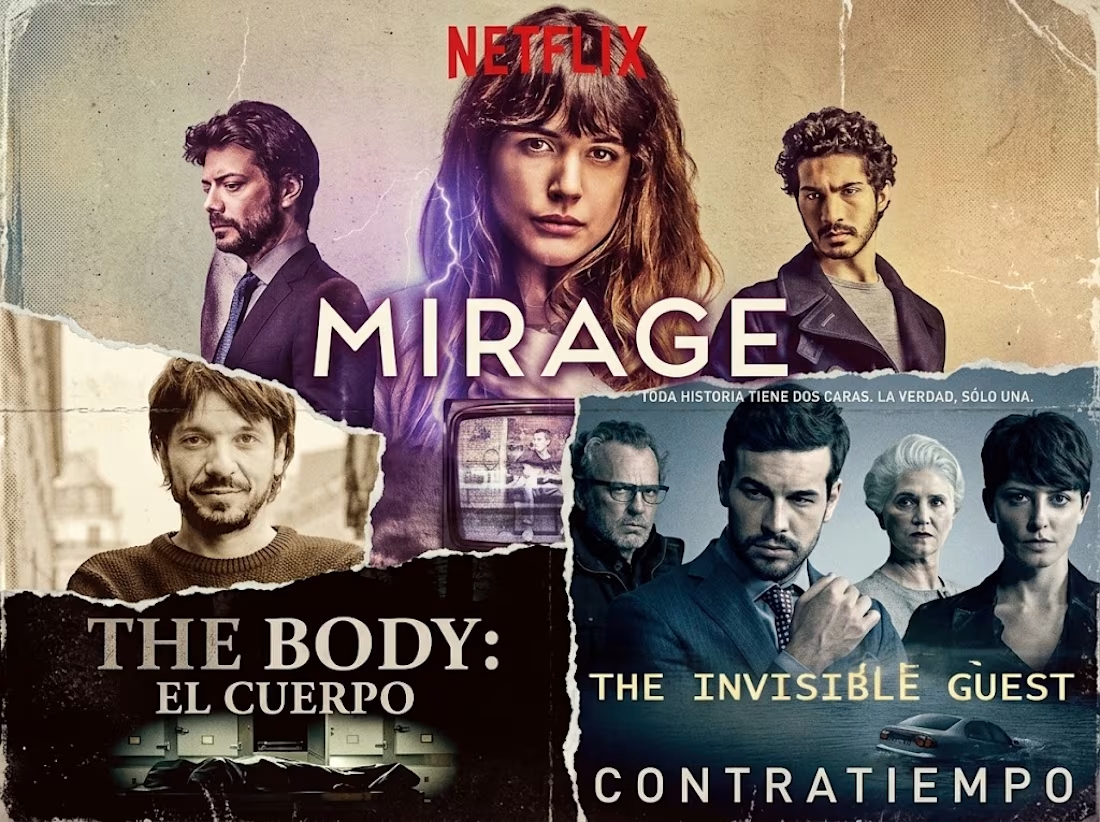
Picture this: You are sitting in a dimly lit room, your pulse racing, convinced you have figured out the twist. Seconds later, the narrative shifts on its axis, shattering your theory entirely. For decades, Hollywood has held a tight grip on our screens, dictating the rhythm of global cinema. But what if the true masterclass in psychological tension and intricate storytelling isn't coming from Los Angeles at all, but from Spain? Welcome to the brilliant, mind-bending world of Spanish thrillers—specifically through the lens of visionary writer-director Oriol Paulo. Today, we are breaking down three modern masterpieces: The Invisible Guest, The Body, and Mirage. We will uncover the hidden threads connecting them, examine how a modest budget outshines blockbuster formulas, and explore whether European cinema is quietly dismantling Hollywood's throne.
The Common Thread: The Anatomy of Oriol Paulo's Labyrinth
If you line up The Invisible Guest (Contratiempo, 2016), The Body (El Cuerpo, 2012), and Mirage (Durante la tormenta, 2018), a distinct DNA binds them together. What is the common thread? It is the mastery of multi-layered psychological manipulation, structural precision, and the weaponization of perspective.
Unlike standard Hollywood whodunits that rely on chaotic editing and last-minute deus ex machina reveals to shock the audience, Paulo treats his films like clockwork. Every single scene, costume detail, prop, and shifting timeline serves a structural purpose. There are no wasted minutes or forgotten subplots. Whether it is a high-stakes interrogation in a secluded apartment, a morgue missing a corpse on a stormy night, or a time-bending anomaly triggered by a 25-year-old video tape, Paulo builds his stories like a house of cards where every single tier depends on the last.
1. The Invisible Guest (2016): The Art of the Interrogation Room
The Invisible Guest drops us into a high-stakes, single-room cat-and-mouse game between wealthy businessman Adrián Dórián (Mario Casas) and high-powered defense attorney Virginia Goodman (Ana Wagener). Accused of murdering his lover Laura Vidal (Bárbara Lennie), Adrián must piece together a narrative that will hold up in court.
What makes this film an absolute triumph of pacing and design is its rigorous structural architecture. The narrative unfolds like a journey through distinct railway stations, where each narrative checkpoint forces us to unpack layered flashbacks-within-flashbacks. Every detail matters—from Virginia Goodman's sharp, formal posture and cropped hair to Laura Vidal's artistic, eclectic wardrobe that shifts as the psychological tension mounts. Operating on a modest budget of around 4 million euros, Paulo manufactured a cinematic masterclass that grossed over $30 million globally. It proves that you do not need billion-dollar CGI or foreign studio experts to captivate an audience; you just need airtight writing, pitch-perfect acting, and a score that breathes alongside the mounting dread.
2. The Body (2012): Psychological Depth and the Missing Corpse
Moving backward to 2012, The Body sets up a chilling premise: the corpse of a notorious businesswoman mysteriously vanishes from a morgue before an autopsy can take place. Inspector Jaime Peña (José Coronado) steps in to investigate the grieving, yet suspicious, widower Alex Ulloa (Hugo Silva).
While the film shares Paulo's signature DNA of complex plotting and shifting perspectives, it leans heavily into deep psychological drama. The tension is fueled not just by the physical mystery of the missing body, but by the emotional ghosts, trauma, and hidden pasts of the characters. José Coronado delivers a powerhouse performance as a hardened investigator battling his own inner demons, anchoring the film with undeniable on-screen charisma. Though it arguably could have benefited from a more resonant musical score, The Body remains a masterclass in atmosphere, utilizing heavy rain, cigarette smoke, and claustrophobic staging to keep viewers guessing until a final twist that only a real-life Sherlock Holmes could anticipate.
3. Mirage (2018): Sci-Fi, Time Loops, and Emotional Stakes
With Mirage, Paulo expands his canvas into the realm of science fiction and multi-timeline manipulation. The story kicks off during a fierce electrical storm, echoing the fall of the Berlin Wall. A young boy named Nico records a guitar video, witnesses a murder next door, and tragically dies in a car accident. Twenty-five years later, a new family moves into the same house and discovers Nico’s old television set and camcorder, bridging a temporal gap that allows Vera (Adriana Ugarte) to save the boy's life.
The consequence? A terrifying butterfly effect that rewrites Vera's entire reality, forcing her to untangle a temporal puzzle within a grueling 72-hour window. Mirage excels by anchoring its complex sci-fi mechanics in raw emotional weight. Backed by stellar performances from Adriana Ugarte, Álvaro Morte (globally beloved as "The Professor" from Money Heist), and the magnetic Ana Wagener (reprising her commanding presence with the unforgettable line, "If you don't remember me, I remember you"), the film demonstrates how genre cinema can blend intellect with heart. Despite suffering from slightly dated background storm graphics, the film's sheer narrative ambition positions it as a timeless piece of European sci-fi art.
Why Hollywood Missed the Mark on Spanish Thrillers
One of the most fascinating patterns across these three films is their international reception. Despite rivaling or even surpassing the structural brilliance of modern Hollywood blockbusters, these Spanish gems often fly under the radar of major global award shows. If a film of this caliber carried a Hollywood studio label, IMDb ratings would likely soar past 8 out of 10, accompanied by massive promotional campaigns. Instead, institutional bias and the commercialization of global cinema often lock these brilliant non-American productions out of the spotlight they genuinely deserve.
Conclusion & Discussion
Oriol Paulo and contemporary Spanish cinema have proven that storytelling does not need a Hollywood budget to leave a lasting impact. By prioritizing intricate plotting, authentic human psychology, and meticulous detail over empty spectacle, European creators are redefining what global audiences expect from a thriller.
Now it's over to you. Drop your thoughts in the comments below to keep the conversation going:
Do you think European cinema is truly writing the end of Hollywood's monopoly over the last five years?
What is your all-time favorite mystery film that completely broke your brain?
Let's discuss below!


The network for creativity
Join 1.25M professional creatives like you
Connect with clients, get discovered, and run your business 100% commission-free
Creatives on Contra have earned over $150M and we are just getting started








Related posts

AI cinematic short film: Hide and Seek


Top notch

A slow fall weekend: pine smoke, golden hour, gear as the hero. Shot entirely faceless, this cinematic camping reel is a portfolio piece for outdoor and lifestyle brands, proof that product can carry the story without a face on camera.
Concept, filming, and edit by Elique Content. Available for gifted and paid collaborations.


Evening Star is a five-minute escape room where you have to relight the lighthouse before the Evening Star, (wrecked a hundred years ago), hits the rocks again and the ghosts drag you into the dark sea with them.
Best with headphones! 🎧
🎃🎃🎃🎃
The whole game was built from the terminal using the Rive CLI with Claude Code: the scene in RML and the game logic in Luau.
GPU Canvas: two shaders do all the atmosphere, one for the sky and the sea (sunset to storm, rain, lightning, the lighthouse beam) behind the tower, and a pass over it with procedural flames and smoke for the lamp, the candle and the stove, the water rising through the room, the vignette that closes in and the red flash of the scares.
One Luau script runs the timeline, 18 interactive objects, the inventory, the close-ups and the puzzles.
As for the Data Binding, a view model connects the script to the markup: subtitles, messages near the click, the timer, the hover label, the mission card and the native cursor.
Human touch: Claude Code wrote the code, while I chose the art direction (the lighthouse modelled and rendered in Cinema 4D in two states, 1926 and 2026, and a period typeface instead of the usual blood fonts) and made the creative decisions: making the story hold together, aligning the style of the objects and opening with a few cozy seconds.
Then I playtested it through more than a dozen rounds (I even lost the first few times because the game wasn't finished yet!), and each round reshaped the game. Many of the moments players remember came out of those notes: the stuck cabinet that takes three shoves and scares the cat, the portrait that falls after three clicks, the key that drops out of the melting candle and bounces onto the table, the music box whose crank breaks off in your hand and becomes the lighthouse handle, the bell you ring to answer her lantern.

I loved this so so much. However wasn't able to open the safe, what's the correct Date and Month for that? I tried 31st Oct. This is the kind of stuff I like. Well done!