The network for creativity
Join 1.25M professional creatives like you
Connect with clients, get discovered, and run your business 100% commission-free
Creatives on Contra have earned over $150M and we are just getting started
Back to feedPost

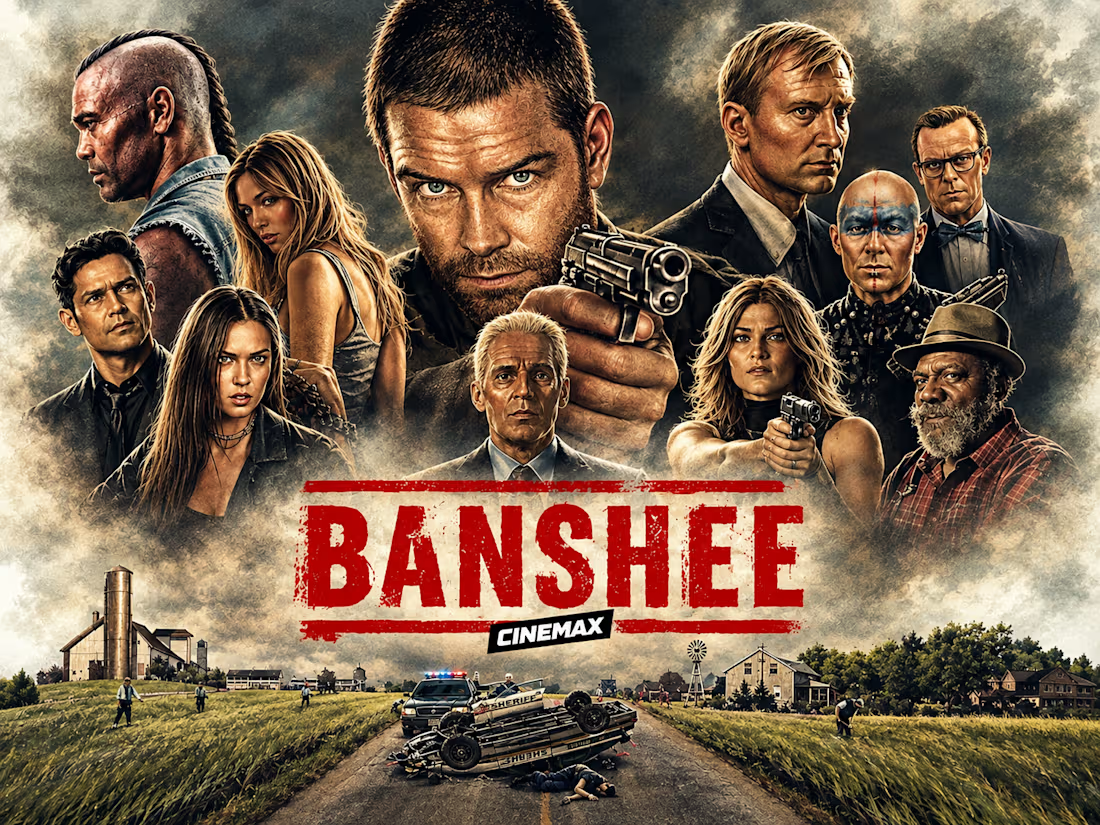
BANSHEE (Seasons 1–2)
A Critical Analysis of Writing, Direction, Visual Language & Performance
TV Series | 2013–2014 | Crime / Action / Drama
A simple premise can become surprisingly complicated when almost everyone has something to hide.
The Story
On paper, Banshee has a relatively simple premise: an unidentified professional thief is released from prison after fifteen years and returns to the life he left behind. He is searching for his former lover, the daughter of a Ukrainian crime boss, and for the diamonds connected to their last heist.
He eventually arrives in Banshee, Pennsylvania, only to discover that the woman he once loved has built a completely different life. He also reconnects with Sugar Bates, the owner of a local bar who gives him a place to stay.
Then, in a bizarre turn of events, the town's newly appointed sheriff, Lucas Hood, walks into the bar.
A confrontation follows. By the end of it, the real Lucas Hood is dead—and our protagonist makes an impulsive decision that changes everything: he assumes the sheriff's identity.
That decision becomes the foundation of the series.
Writing: Simple Premise, Complicated Construction
The writing is probably Banshee's greatest strength.
The basic premise is straightforward, but the way the writers construct the story around it is considerably more ambitious. Instead of presenting the protagonist's history in a conventional chronological structure, the series gradually reveals who he was through flashbacks, fragmented memories, parallel events, intersections between timelines, and carefully timed pieces of information.
Sometimes the flashback takes us years into the past. Sometimes it takes us only a few minutes back.
The result is a story that frequently asks the audience to reconsider what they already know.
The series also uses parallel editing and narrative intersections particularly well at the beginning and end of important episodes. Events that initially appear unrelated can suddenly become connected, while the protagonist's impersonation of Lucas Hood constantly creates situations in which his identity could potentially be exposed.
This gives the narrative a sense of controlled chaos. At times it feels random, but the randomness usually comes from the characters' decisions and the increasingly complicated situations they create.
Characterization
One of the boldest decisions is making the protagonist almost completely anonymous.
For a significant portion of the story, we know him primarily through the identity he has stolen rather than through his real name or complete history. The series gradually reveals his past instead of handing us a biography.
That approach works surprisingly well.
The same attention can be seen in characters such as Kai Proctor, a powerful criminal rejected by his Amish family, and Clay Burton, his almost silent enforcer.
Burton is particularly interesting. He barely needs dialogue to establish his personality. His movements, expressions, physical presence, and behavior do most of the work.
The series also deserves credit for creating different criminal groups with distinct identities. One gang rarely feels like a recycled version of another. Their appearance, behavior, social background, and methods all contribute to making them feel like separate worlds.
The same applies to the supporting cast. Job, for example, could have easily become a one-note eccentric character, but Hoon Lee gives him enough personality to become one of the show's most memorable characters.
Dialogue
The dialogue is another strong point.
Banshee can move from dark comedy to philosophical conversations about religion, morality, love, good and evil, and human nature without completely losing its identity.
Not every line works equally well, but the series often understands that dialogue can reveal character rather than simply move the plot forward.
Direction: Brilliant... and Occasionally, Well, Confusing
The direction is where Banshee becomes particularly interesting.
The directors frequently use the same structural ideas found in the writing, but translate them from the page into visual language.
There is one recurring technique that is difficult to categorize neatly as either flashback, parallel editing, or a conventional transition.
A conversation might begin in a restaurant, while the image suddenly cuts to one of the characters parking outside, entering the building, or walking toward the restaurant—before returning to the conversation.
Then it does it again.
And again.
When it works, it is clever and efficient. It compresses time, provides context, and eliminates unnecessary scene introductions.
When it does not work, however, it can feel like the editor and the director had a disagreement and decided to let the audience settle it.
The technique also depends heavily on execution. Since different episodes were directed by different filmmakers, its effectiveness varies considerably from episode to episode.
Visual Language
The cinematography is one of the show's strongest technical achievements.
Banshee makes extensive use of different framing choices, camera movement, shallow focus, wide compositions, close-ups, and visual distortion to communicate character psychology.
Blur, for example, is sometimes used not simply as an aesthetic choice but to place the viewer inside a character's physical or psychological state.
The series also pays considerable attention to establishing environments. A house may be introduced through several exterior and interior shots before the actual scene begins, allowing the location itself to become part of the storytelling.
At other times, the aforementioned editing technique compresses all of this information into a few seconds.
That is one of the reasons the show can fit a surprising amount of story into its runtime.
There are technical inconsistencies, however.
The use of different camera systems is sometimes very noticeable, particularly in the earlier seasons. Differences in image quality, frame rate, motion, and focus can become distracting.
Some action sequences also suffer from unnecessary cutting. A character walking down a corridor toward a door does not always need to be divided into four different shots while the camera follows every step.
Sometimes the camera can simply... let the man walk.
Fortunately, the visual language becomes increasingly confident as the series progresses.
Music
The music is one of Banshee's most consistently successful elements.
The original score, combined with carefully selected tracks, frequently reinforces the tone of a scene without overpowering it.
Rock and metal work naturally with the show's action sequences, blues fits the bar environment, and romantic tracks are used to shape more intimate moments.
The songs at the end of episodes are particularly effective, often functioning almost like a final statement about what we have just watched.
The lyrics are frequently as important as the music itself.
Pacing
The pacing is surprisingly flexible.
Some scenes are deliberately slow, particularly emotional or dialogue-heavy sequences, but the slower rhythm usually serves a purpose.
The series is also good at accelerating when the story requires it and slowing down when the characters need room to breathe.
That balance is one of the reasons the show can move between crime, action, drama, romance, and philosophical conversations without constantly feeling like it is changing genres.
Violence, Sex & Excess
This is probably where Banshee loses some of its restraint.
The violence is integral to the show's identity, and most of the action feels justified by the world being portrayed.
The sexual content is a different story.
There are simply too many explicit scenes, and several of them contribute very little to the narrative.
The problem is not the existence of sexual content itself. Television can absolutely use sexuality as characterization, symbolism, or dramatic storytelling.
The problem is that Banshee occasionally seems to confuse "this character is sexually active" with "the audience needs to watch the entire process."
Some scenes add emotional information. Others feel like they were included because someone in production really, really liked the idea.
Acting
The performances are consistently strong.
Antony Starr carries the difficult task of portraying a protagonist who is simultaneously living as two different people: the man he really is and the sheriff he has stolen the identity of.
Ulrich Thomsen gives Kai Proctor a particularly compelling mixture of authority, intelligence, cruelty, and vulnerability.
Hoon Lee's Job is one of the show's most entertaining performances, while Matthew Rauch's Clay Burton proves how much an actor can communicate without relying on dialogue.
Matt Servitto's Brock Lotus is also notable for the way the character develops beyond a simple law-enforcement archetype.
The casting deserves credit for using physical appearance and voice as part of characterization rather than treating them as secondary details.
Final Thoughts
The first two seasons of Banshee demonstrate why the series is more than an action-and-crime show.
Its greatest achievement is the combination of narrative experimentation, strong characterization, visual storytelling, and an unusually confident approach to violence and genre.
It also presents a darker side of American small-town life: organized crime, local power structures, family conflicts, social divisions, and the influence of people who operate outside—or above—the law.
Most importantly, the series does not treat its characters as simple representatives of good and evil. Almost everyone exists somewhere in between.
The result is messy, violent, excessive, occasionally ridiculous, and frequently brilliant.
And somehow, it works.
BANSHEE (Seasons 3–4)
When Ambition Becomes Messy—and Then Finds Its Way Back
Writing: The Weakest Season, Then a Strong Comeback
The third season is where the writing begins to show some of the weaknesses hidden beneath the strengths of the earlier seasons.
The central storyline itself is solid. The season introduces a major conflict between opposing forces and develops several strong ideas around justice, violence, morality, and identity.
The problem is how the events are arranged.
Some developments arrive abruptly, while other scenes spend too much time explaining emotions that could have been communicated visually.
There are also several long dialogue sequences that slow the season considerably. Some conversations are clearly intended to express the protagonist's confusion and emotional instability, but the image could have communicated much of that information more effectively.
In other words, the show sometimes tells us that the character is lost when it could simply have shown us that he is lost.
This creates a strange imbalance: the plot is moving forward, but individual scenes occasionally feel as though they are standing in the road asking the plot to wait.
The third season is therefore, in my opinion, the weakest season from a writing perspective.
Not because the story is bad, but because the material could have been structured more efficiently.
Season Four: Back on Track
The fourth and final season is a significant improvement.
With only eight episodes, the season feels considerably tighter. Events move quickly without becoming incomprehensible, and the narrative makes much better use of its limited space.
The season feels like a concentrated version of what Banshee does best.
There is action, drama, mystery, character conflict, philosophy, and escalation—but the show rarely has time to become unnecessarily comfortable.
The final stretch is particularly effective, leading to an ending that is difficult to predict.
For a show that had accumulated so many characters, conflicts, secrets, and competing storylines, bringing everything toward a satisfying conclusion in eight episodes is an achievement.
Direction: When the Experiment Goes Too Far
Remember that strange visual technique from the earlier seasons?
Yes.
It comes back.
And in Season 3, it occasionally appears to have been promoted to head of department.
The technique becomes more frequent, and there are moments when it genuinely improves the rhythm of a scene.
There are other moments, however, when it makes the sequence unnecessarily difficult to follow.
The problem is not experimentation itself. Experimentation is one of the reasons Banshee is visually interesting.
The problem occurs when the technique becomes more noticeable than the story.
At its best, the editing feels invisible.
At its worst, you become aware that you are watching a director trying very hard to make sure you know that he knows how to edit.
Fortunately, the fourth season finds a better balance.
Performance Direction
This remains one of the show's strongest areas.
The actors continue to receive strong direction, particularly during emotional scenes.
One of the things Banshee understands surprisingly well is that sadness does not always require crying, screaming, or dramatic music.
Sometimes silence is enough.
The characters also continue to evolve, requiring actors to adjust their performances rather than simply repeat the same personalities from previous seasons.
Job receives considerably more dramatic material, and Hoon Lee handles the transition extremely well.
Matt Servitto's Brock Lotus is another standout. His internal conflict—between following procedure and breaking the rules in pursuit of justice—is developed through performance as much as dialogue.
And Matthew Rauch's Clay Burton remains one of the show's most impressive supporting characters.
Sex: A Partial Recovery
The show finally appears to have realized that not every episode requires a reminder that its characters are adults.
The amount of sexual content decreases, and when it appears, it is more often connected to the story.
That is a significant improvement.
By this point, I was beginning to suspect that the directing team had started their careers somewhere under a staircase making low-budget adult films and eventually worked their way up to television.
Thankfully, they seem to have completed their professional development.
The restraint makes the remaining scenes more effective precisely because they are no longer everywhere.
Cinematography: Better, Bigger, More Experimental
The cinematography continues to improve.
Action sequences become increasingly ambitious, with cameras mounted directly on performers and a greater variety of perspectives.
One particularly impressive approach involves extended footage presented through surveillance-camera perspectives, allowing the scene to maintain its spatial logic without constantly cutting away.
The show also demonstrates that it has learned from some of the visual problems of the earlier seasons.
The inconsistency between camera systems remains noticeable, but the overall visual language is considerably more mature.
The series increasingly understands how to use the camera as part of the storytelling rather than merely as a device for recording action.
Action & Editing
The action is still one of Banshee's greatest strengths.
However, some sequences become visually aggressive to the point of reducing clarity.
There are moments when the camera moves so much, cuts so quickly, or presents information so briefly that the viewer can miss important details.
And then there is one particularly memorable torture sequence involving intense lighting.
The character is being tortured.
The viewer is also being tortured.
Only one of us deserved it.
Pacing
The difference between Seasons 3 and 4 is especially obvious in pacing.
Season 3 could realistically have been compressed into four or five episodes without losing its central narrative.
Several scenes could have been shortened, and some transitional material could have been removed.
The problem is not that the season is slow. Slow storytelling can be excellent.
The problem is that some of the slower scenes do not provide enough narrative or emotional value to justify their length.
Season 4, by comparison, is extremely efficient.
Eight episodes contain a remarkable amount of story, yet the season rarely feels rushed.
The show still knows when to accelerate and when to slow down, but it does so with considerably more confidence.
Acting
The performances remain excellent.
The actor portraying Chayton, the Kinaho leader, deserves particular credit for creating a distinctive character through voice, movement, and physical performance.
Hoon Lee's work as Job becomes even more impressive as his character receives a larger dramatic arc.
Matt Servitto continues to develop Brock Lotus with considerable subtlety, especially when portraying the conflict between institutional discipline and personal justice.
Ulrich Thomsen remains one of the strongest performers in the series, while Clay Burton continues to communicate an extraordinary amount without relying on dialogue.
The casting also continues to use physical characteristics effectively. A character's body, voice, appearance, and mannerisms can sometimes tell us more about their social position than exposition ever could.
There is, however, one major weakness.
The passage of fifteen years in the characters' backstories is not always reflected convincingly enough in their physical appearance. Changes in hairstyles and clothing are not always sufficient to communicate such a significant period of time.
That may sound like a small technical issue, but in a story where the past constantly influences the present, visual continuity matters.
Good, Evil & Justice
One of the most interesting qualities of Banshee is its refusal to divide its characters into simple moral categories.
The good are not always good.
The criminals are not always entirely evil.
Law enforcement can violate the law.
Criminals can sometimes pursue justice.
The series repeatedly plays with these contradictions, and although its philosophical discussions are not always equally successful, the underlying idea remains strong.
Justice in Banshee is rarely clean.
It is usually violent, personal, compromised, and shaped by the person trying to achieve it.
Final Thoughts
Season 3 could have been considerably better.
Its central story is interesting, its characters remain compelling, and its direction is often excellent—but the writing occasionally becomes unnecessarily heavy, while some dialogue scenes slow down a story that should have been moving much faster.
Season 4, however, feels like a correction.
It is shorter, tighter, faster, more confident, and ultimately a satisfying conclusion to the series.
Taken as a whole, Banshee is an unusually ambitious crime series.
It can give you action if you want action, mystery if you want mystery, drama if you want drama, romance if you want romance, philosophical conversations if you want something to put in your WhatsApp status—and, apparently, enough violence and sex to make sure nobody forgets what channel they're watching.
But beneath all of that excess is a surprisingly thoughtful series about identity, power, morality, justice, and the consequences of trying to escape the person you used to be.
Overall Rating: 8.5/10


The network for creativity
Join 1.25M professional creatives like you
Connect with clients, get discovered, and run your business 100% commission-free
Creatives on Contra have earned over $150M and we are just getting started








Related posts

AI cinematic short film: Hide and Seek


Top notch

Happy October 🍂🍁.
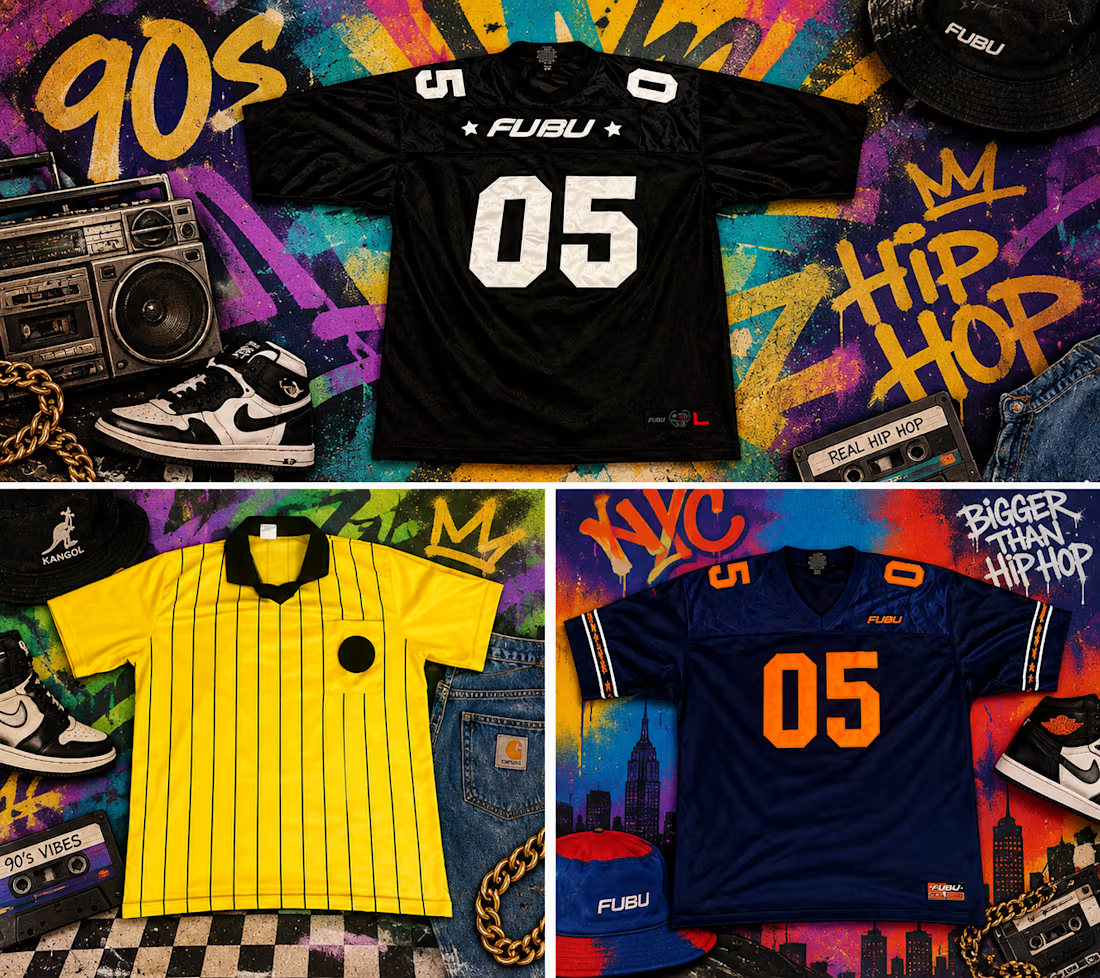
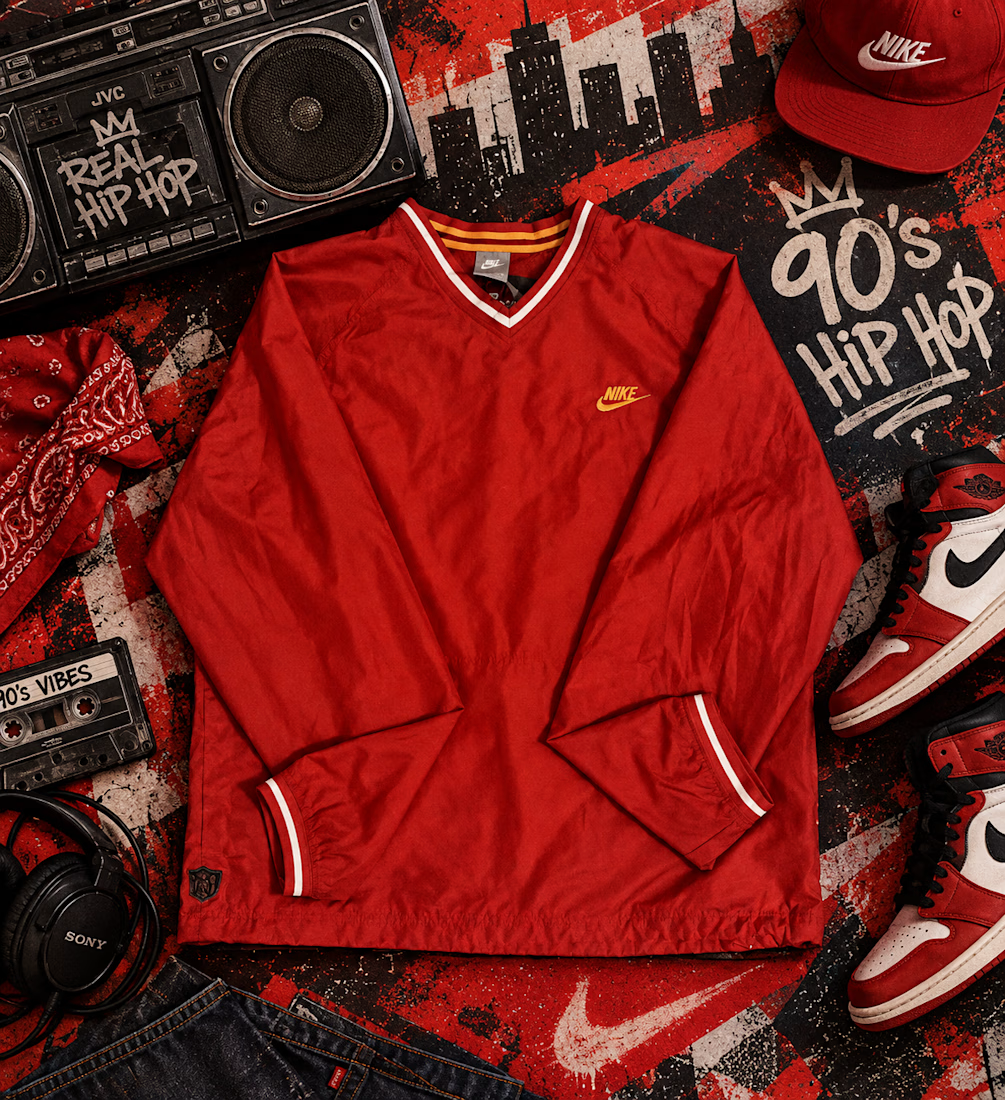
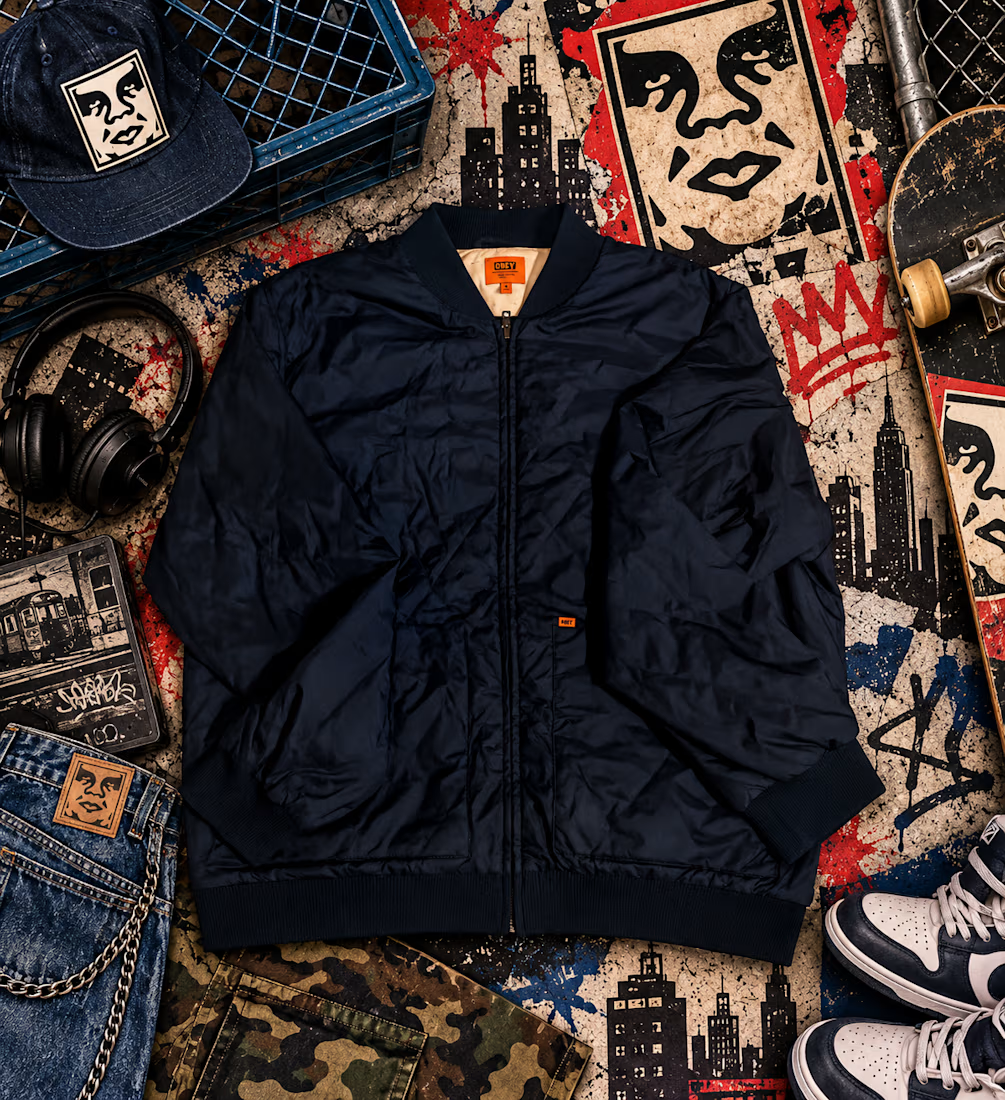
As a lover of different fashion styles, thrifting, and simply putting that sh*t on, I finally decided to open up a Depop shop, and so glad that I did!
We sold our first item (Black FUBU Jersey) within 24 hours 🥳👏🏾.
Check us out: Depop.com/quinnfos
*Photographed by me, and the lookbook backgrounds were prompted by me using ChatGPT.*



Veloura Muse is a jewelry/fashion-accessories brand concept I created around the idea of confidence, elegance, and unforgettable presence.




Timeless aesthetic, stunning work! 🔥