The network for creativity
Join 1.25M professional creatives like you
Connect with clients, get discovered, and run your business 100% commission-free
Creatives on Contra have earned over $150M and we are just getting started
Back to feedPost

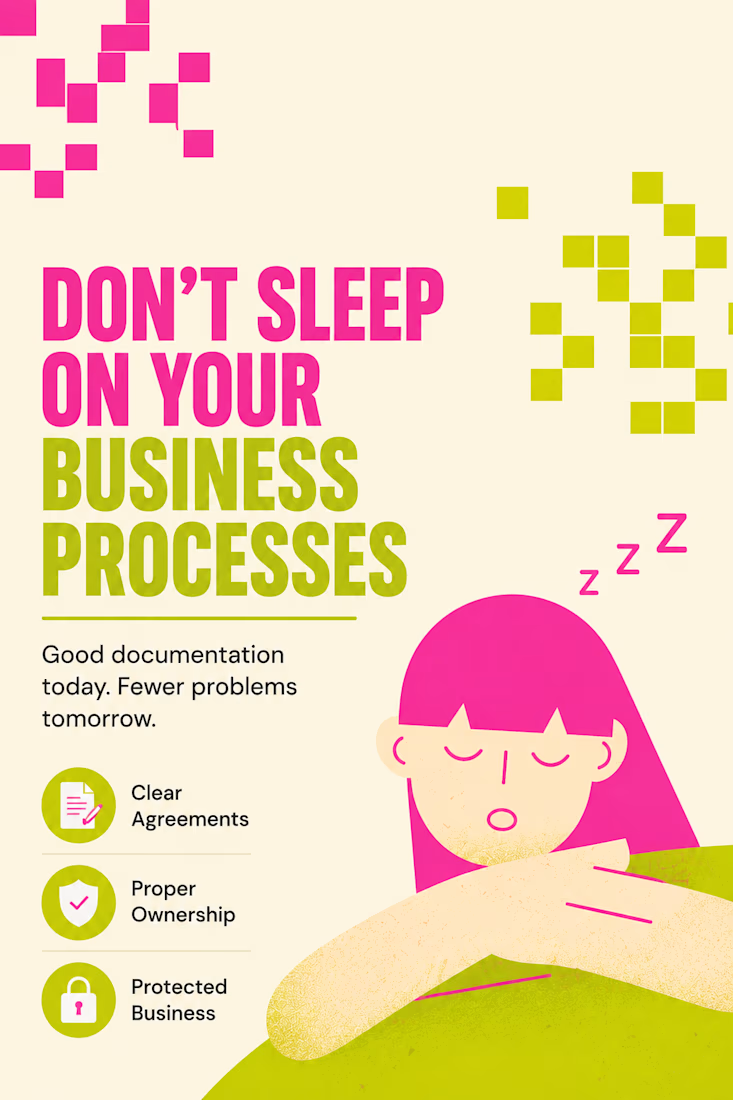
Before you buy a domain or hosting account for your next client, read this.
A software company built a website for a client.
The project was completed successfully.
The client was happy.
Payment was received.
Everything seemed perfect.
Months later, the website became involved in fraudulent activities.
As authorities investigated, they followed the ownership trail.
-The domain registration pointed to the development company.
-The hosting account pointed to the development company.
-The technical ownership pointed to the development company.
Suddenly, a company that had simply developed a website found itself answering questions about activities it had nothing to do with!
Whether this story is common or rare isn't the point.
The lesson is :
Most developers know how to build websites.
Fewer know how to build a business around them.
The difference often comes down to processes, documentation, and ownership, not technical skills.
𝐀 𝐦𝐚𝐭𝐮𝐫𝐞 𝐜𝐥𝐢𝐞𝐧𝐭 𝐨𝐧𝐛𝐨𝐚𝐫𝐝𝐢𝐧𝐠 𝐩𝐫𝐨𝐜𝐞𝐬𝐬 𝐬𝐡𝐨𝐮𝐥𝐝 𝐢𝐧𝐜𝐥𝐮𝐝𝐞:
-Client Service Agreement (CSA) - (Defines the relationship, responsibilities, payment terms, and legal obligations between both parties.)
-Statement of Work (SOW) - (Clearly outlines what will be built, project scope, deliverables, timelines, and success criteria.)
-Ownership & Intellectual Property Agreement - (Specifies who owns the code, designs, AI models, databases, content, and other project assets after completion.)
-Domain & Hosting Ownership Declaration
-Credentials Handover Document - (Confirms that all credentials, admin rights, recovery emails, and ownership have been transferred to the client.)
-Data Processing & Privacy Agreement (DPA) - (Defines how client and user data will be stored, processed, protected, and handled.)
-Payment Terms Agreement
-Project Acceptance & Sign-Off Document
-Maintenance & Support Agreement
Before development begins, ownership should be crystal clear:
The safest approach is simple:
The client should own the domain, hosting, cloud accounts, and business assets from day one.
The development company should be an authorized administrator, not the owner.
If you're building a software agency, AI company, or freelance business, remember this:
"
𝘠𝘰𝘶𝘳 𝘴𝘶𝘤𝘤𝘦𝘴𝘴 𝘸𝘰𝘯'𝘵 𝘣𝘦 𝘥𝘦𝘵𝘦𝘳𝘮𝘪𝘯𝘦𝘥 𝘴𝘰𝘭𝘦𝘭𝘺 𝘣𝘺 𝘵𝘩𝘦 𝘲𝘶𝘢𝘭𝘪𝘵𝘺 𝘰𝘧 𝘺𝘰𝘶𝘳 𝘤𝘰𝘥𝘦. 𝘛𝘩𝘦 𝘲𝘶𝘢𝘭𝘪𝘵𝘺 𝘰𝘧 𝘺𝘰𝘶𝘳 𝘱𝘳𝘰𝘤𝘦𝘴𝘴𝘦𝘴 𝘸𝘪𝘭𝘭 𝘢𝘭𝘴𝘰 𝘥𝘦𝘵𝘦𝘳𝘮𝘪𝘯𝘦 𝘪𝘵.
"
The agencies that survive and scale aren't just good at development.
They're good at onboarding.
They're good at documentation.
They're good at defining ownership and responsibilities before problems arise.
Sometimes the biggest business risk isn't hidden in the codebase.
It's hidden in the process surrounding it.
-
-
#SoftwareDevelopment #AIAgency #SoftwareAgency #StartupFounder #Freelancing #ClientOnboarding #AgencyGrowth #BusinessProcesses #RiskManagement #WebDevelopment #AIDevelopment #Entrepreneurship
The network for creativity
Join 1.25M professional creatives like you
Connect with clients, get discovered, and run your business 100% commission-free
Creatives on Contra have earned over $150M and we are just getting started
Related posts

Built a freelance marketplace where talent is judged on proven work — not bios. It's called Proven.
The whole premise is an inversion of how hiring usually works: freelancers never write their own bio.
Instead, they upload projects they've actually delivered — a short description and a screenshot. An AI engine reads that evidence and builds a verified capability profile from it: a generated headline, a factual capability summary, extracted skills, and a proof score derived entirely from delivered work. Nothing self-reported, nothing salesy.
And companies don't scroll through endless profiles. They describe what they need in plain language, and the platform interprets the brief, then surfaces the freelancers who have already proven they can build it — each match ranked with a feasibility score and a reasoned justification that cites the freelancer's real projects.
The features so far:
My Projects — upload delivered work; each project gets auto-analyzed (summary, capabilities, tech, complexity, domain).
Generated profile — one click synthesizes everything into a verified, evidence-first profile.
Post a Brief — write what you need; the AI structures it into required capabilities, domain, and constraints.
Match Results — ranked, justified matches with fit scores.
Browse Talent — a directory of profiles, every card built from delivered projects, no self-written bios.
The part I love most: every claim on the platform traces back to real evidence. The verified-green accent only ever shows up around things that have actually been proven.
The aesthetic is editorial and credible on purpose — Fraunces serif headlines, a warm off-white canvas — the look of evidence, not advertising.
Try it yourself 👇


this is such a great idea!

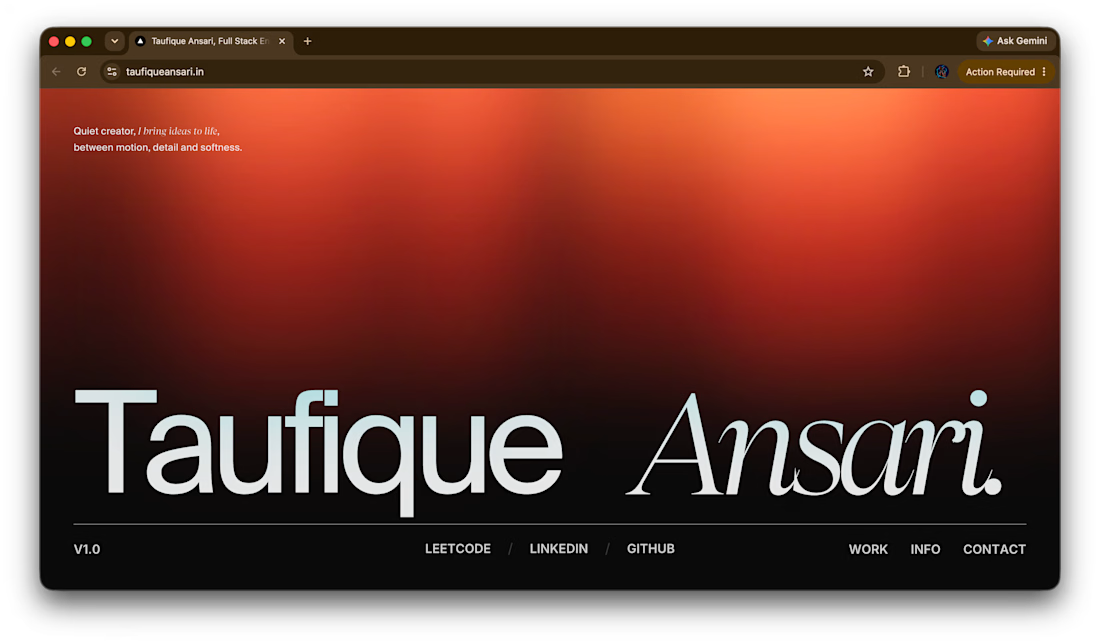
Just pushed a major redesign to my portfolio site!
Kept it ultra-clean, snappy, and dialed in the layout flow for a much better user experience. Check out the video walkthrough below—would love to hear what you guys think of the new look!



Incredible!

we’re new to Contra, but not new to building products.
Over the years, our team has helped founders, startups, and businesses turn ideas into real products—from early-stage MVPs to scalable SaaS platforms and AI-powered solutions.
We work with companies that need a reliable technical partner to move quickly without sacrificing quality.
Some of the projects we help clients with include:
- SaaS MVP development
- AI agents and automation systems
- AI-powered SaaS products
- Custom web applications
- Startup product development
- Framer and Webflow websites
Our team works across Next.js, React, Node.js, NestJS, Express.js, Laravel, Python, GSAP, Motion, and other modern technologies depending on the project requirements.
Whether you're validating a new idea, replacing an outdated system, automating internal workflows, or building a product from scratch, we focus on delivering solutions that are scalable, maintainable, and built around business goals.
We're excited to start our journey on Contra and connect with founders, startups, and teams looking for long-term development support.
If you're building something interesting, we'd love to hear about it. 🚀


















Trending

Claude
Claude has entered the design space. How are you using Claude Design?

Contra University
Learn from expert creatives how to earn more using next-gen AI tools.

MagicPath
The canvas is infinite, and exploration is becoming the workflow. How are you using MagicPath?
creativeaiflow
Creative AI workflows are evolving. What tools do you use, and what are their strengths and weaknesses?
freelancerlife
Freelancer life is wins, pivots, and everything in between. What’s yours right now?