The network for creativity
Join 1.25M professional creatives like you
Connect with clients, get discovered, and run your business 100% commission-free
Creatives on Contra have earned over $150M and we are just getting started
Back to feedPost

I recently completed a new portfolio project, the AI CFO Challenge: Evaluating AI Financial Analysis and Business Decision-Making.
For this project, I wanted to see how well AI could build and analyze financial information, while also giving me an opportunity to use my Excel skills and business experience to evaluate the results.
I used two different AI models. The first model generated budget and actual financials for a fictional 500-person advertising company. I moved the results into Excel, checked the calculations, and identified several errors in the AI-generated financials. After correcting the results, I also created a simple financial dashboard.
I then provided the corrected financials to a second AI model and asked it to independently identify the five most significant issues and provide recommendations. I intentionally did not provide my dashboard or conclusions, as I wanted to see what the model would identify on its own.
I evaluated the recommendations using a rubric across five areas:
• Financial Accuracy
• Business Logic
• Risk Awareness
• Business Applicability
• Strategic Value
What I enjoyed most about the project was combining Excel, budget planning, financial analysis, and my 30+ years of business experience with the AI evaluation and prompt engineering skills I have been developing.
One of my biggest takeaways was that AI generated the financial information and analysis very quickly, but I spent considerably more time checking the calculations, reviewing the financial relationships, and evaluating whether the recommendations made sense from a business perspective.
For me, this reinforced the importance of not accepting an AI response at face value, particularly when the results may be used to support a business decision.
When using AI for financial or business analysis, where do you think human review adds the most value?

The network for creativity
Join 1.25M professional creatives like you
Connect with clients, get discovered, and run your business 100% commission-free
Creatives on Contra have earned over $150M and we are just getting started





Related posts


Top-notch design.

Designed and built an AI operations dashboard that brings projects, decisions, tasks, research, connected tools, and voice interaction into one clear workspace. The goal is to turn complex workflows into a simple, usable system that helps people see what matters and act faster.


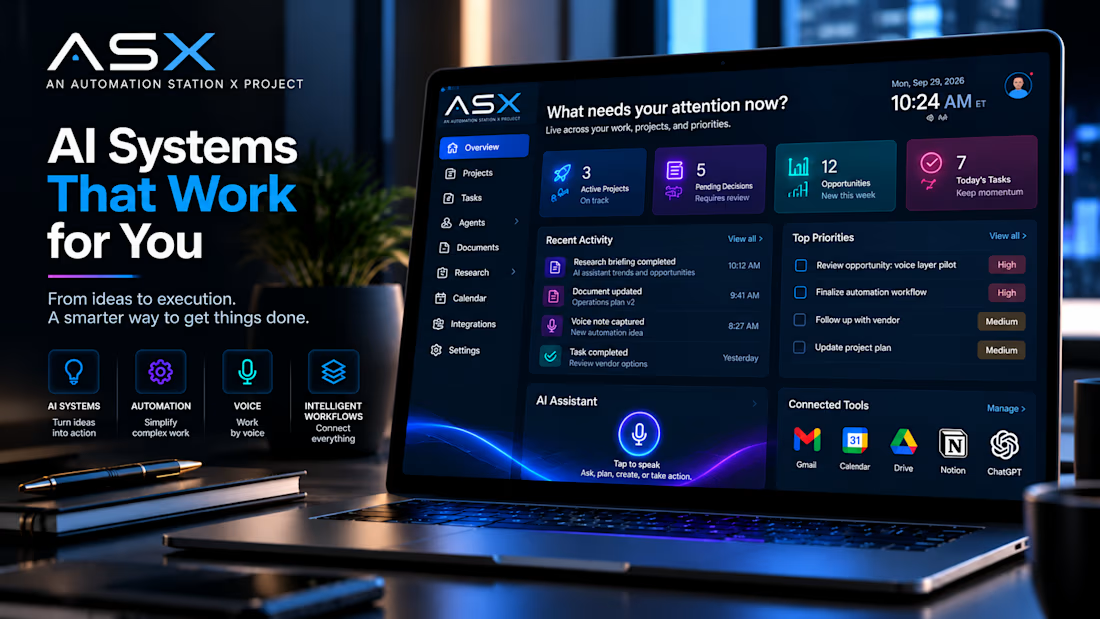

Seeing the voice interaction layer pull data from Supabase into the dashboard cuts down on manual context switching.

Building AI agents is easy. Building one you can trust with a real business workflow is harder.
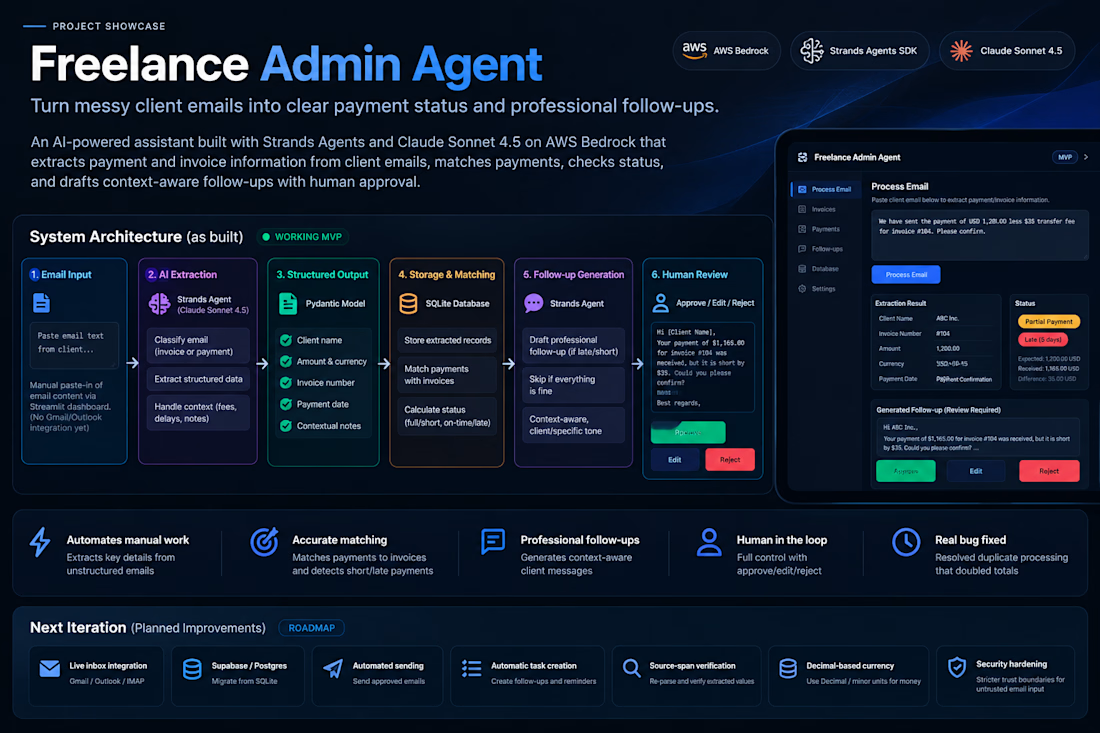
I built a Freelance Admin Agent to explore that problem using Strands Agents SDK and Claude Sonnet 4.5 on Amazon Bedrock.
The working MVP takes manually provided client emails and turns them into a structured payment workflow:
→ Classifies invoice and payment emails
→ Extracts client, invoice, amount, currency, dates and contextual details using structured output
→ Stores and matches records in SQLite
→ Uses deterministic logic to identify full/short and on-time/late payments
→ Uses a second agent to draft a contextual follow-up only when needed
→ Keeps the final decision with the human through Approve / Edit / Reject
One of the most valuable parts wasn't adding another AI feature. It was finding a real reliability issue during testing: reprocessing the same email could duplicate records and inflate payment totals.
I reproduced it through repeat testing, traced the database behavior, and fixed it.
That reinforced something I'm increasingly applying to my AI engineering work:
A useful AI product isn't just an LLM call. It needs clear boundaries between AI reasoning, structured data, deterministic business logic, persistence, testing, and human control.
The next iteration will focus on stronger production safeguards, including source-grounded financial extraction, precise currency handling, stricter trust boundaries for untrusted input, and eventually live inbox integrations.
I'm interested in building more systems like this for startups and teams with repetitive workflows that can genuinely benefit from AI agents and automation.
Stack: Python · Strands Agents SDK · Amazon Bedrock · Claude Sonnet 4.5 · Pydantic · SQLite · Streamlit

turning client emails into admin tasks is such a real freelancer pain, nice build 🔥