The network for creativity
Join 1.25M professional creatives like you
Connect with clients, get discovered, and run your business 100% commission-free
Creatives on Contra have earned over $150M and we are just getting started
Back to feedPost

I engineered a production-grade API governance platform to solve manual review bottlenecks within a leading private banking institution. The system replaces slow, manual validation workflows with an automated, score-based Governance Gate that ensures all API specifications comply with enterprise security and architectural standards before reaching production.
The platform manages the full API lifecycle, from initial YAML upload to automated deployment in WSO2 API Manager. By integrating AI-driven analysis, the system provides real-time feedback, structural linting, and semantic intent detection to prevent redundant or non-compliant APIs from entering the ecosystem.
Achievements:
Reduced manual validation effort by 60% by implementing an automated, four-stage validation pipeline.
Integrated AI-powered validation using a local Qwen 2.5 LLM to provide automated code-level fixes and structural optimization.
Built a custom Governance Gate that enforces Microsoft REST API guidelines and prevents duplicate API entries via vector similarity search (PGVector).
Designed a full-stack dashboard (React + FastAPI) featuring automated diff views, PDF/CSV compliance reporting, and real-time operational monitoring via Prometheus and Grafana.
Tech Stack:
FastAPI (Python), React.js, PostgreSQL (PGVector), Ollama (Qwen 2.5), WSO2 API Manager, Docker, Prometheus, Grafana.


The network for creativity
Join 1.25M professional creatives like you
Connect with clients, get discovered, and run your business 100% commission-free
Creatives on Contra have earned over $150M and we are just getting started





Related posts

Then: 1 month, 1 template.
Now: 1 week, 15 templates.
Same designer, different workflow.
I wrote up how I built no-code.supply: fifteen website templates, each with its own brand, in HTML and React, and some in Framer too. Claude Code did most of the typing. I did the directing.

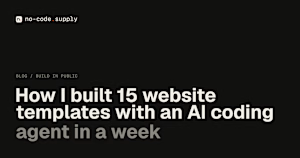
no-code.supply
How I built 15 website templates with an AI coding agent in a week
How I built 15 AI-ready website templates with Claude Code in a week: the workflow, the quality bar, and why a template is only the starting point.

Going from one template a month to fifteen a week is wild. How much of the design direction did you still do by hand?


Built Loop - a landing page that turns “noise into a system.”
Warm gold, dark glass, subtle data-flow animations, and an interactive scroll story.
Built using Cadence Studios
What do you think? 🚀

the gold accents work really well here bro. just enough color to guide the eye without making the page feel busy