The network for creativity
Join 1.25M professional creatives like you
Connect with clients, get discovered, and run your business 100% commission-free
Creatives on Contra have earned over $150M and we are just getting started
Back to feedPost

With one of our clients we have been working together long enough that I am in their Slack more than I am in ours.
No briefs, no scoping call for every small thing. The work comes off their board, I see the problems at the same time their team sees them, and most days I know what is coming before anyone asks.
It took me a while to understand why this works better, and I think it is this. An agency needs a brief before it can start. That is fine for a website, a website has a beginning and an end.
A product does not work like that. Most of the design work inside a shipping product is small and continuous. An empty state nobody specified. A table that stopped working at forty rows. A flow that made sense before you added the second type of user.
Nobody writes a brief for those. So under an agency model they never get done, and the product slowly drifts.
This is the part I would not have understood from the outside.
The network for creativity
Join 1.25M professional creatives like you
Connect with clients, get discovered, and run your business 100% commission-free
Creatives on Contra have earned over $150M and we are just getting started




Related posts

In conversations with clients, I represent the team.
In conversations with the team, I help preserve the client’s context.
Why is this particular date important? What problem does the new feature solve? What will happen to the business if we move it to the next release?
These details are easy to lose when a request turns into a list of tasks.
That’s why I discuss with developers not only what the client wants to do, but also why. And I help the client understand the technical constraints and the options the team is proposing.
This is how we arrive at solutions that take both sides into account: the business goal and how to implement it.
To me, strong sales work means that the client feels understood, while the team understands what it is working toward.


Most of my best Webflow projects don't come from new clients. They come from the second, third or fourth project with the same team.
A client recently wrote in a review: "This was my team's third or fourth time engaging Bogdan." It made me think about what actually brings clients back. It's rarely the code.
Here's what I've noticed:
→ A fixed quote before work starts. No surprises on the invoice.
→ Replies within 24 hours. Speed of communication matters more than speed of building.
→ Saying "this might not work for your users" before building it, not after launch.
→ A clean class structure and CMS, so their team can edit the site without calling me for every typo.
→ A handoff call at the end. If the team can't manage the site, the project isn't finished.
None of this is technical skill. It's just making the next project an easy "yes".
More about how I run Webflow projects: https://www.bohdan-tsiupka.com/
Freelancers: how much of your work comes from repeat clients? And what's the one thing that brings them back? 👇

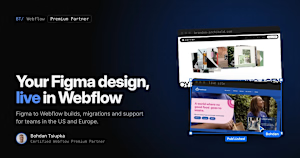
bohdan-tsiupka.com
Webflow Developer & Premium Partner | Bohdan Tsiupka
Certified Webflow Premium Partner. Figma to Webflow builds, template customization, migrations and ongoing support for teams in the US and Europe.


This is the part I love about my work: giving clients all details that they should know before moving to any implementation. If you just go straight into execution, this can work for one-time projects, but for long-term collaboration, treat every task like a whole big project, do the work half the time it should take, and most importantly, focus on quality that brings outcomes.