The network for creativity
Join 1.25M professional creatives like you
Connect with clients, get discovered, and run your business 100% commission-free
Creatives on Contra have earned over $150M and we are just getting started
Back to feedPost
Built a full-stack job portal aggregating government, private, IT, and other sector jobs. Developed the platform with Next.js 14 and Supabase PostgreSQL, including Google OAuth authentication. Created a Python web scraper using BeautifulSoup and Requests to collect job listings automatically, with daily execution through GitHub Actions. Deployed on Vercel with GitHub CI/CD and implemented responsive UI and SEO optimization.


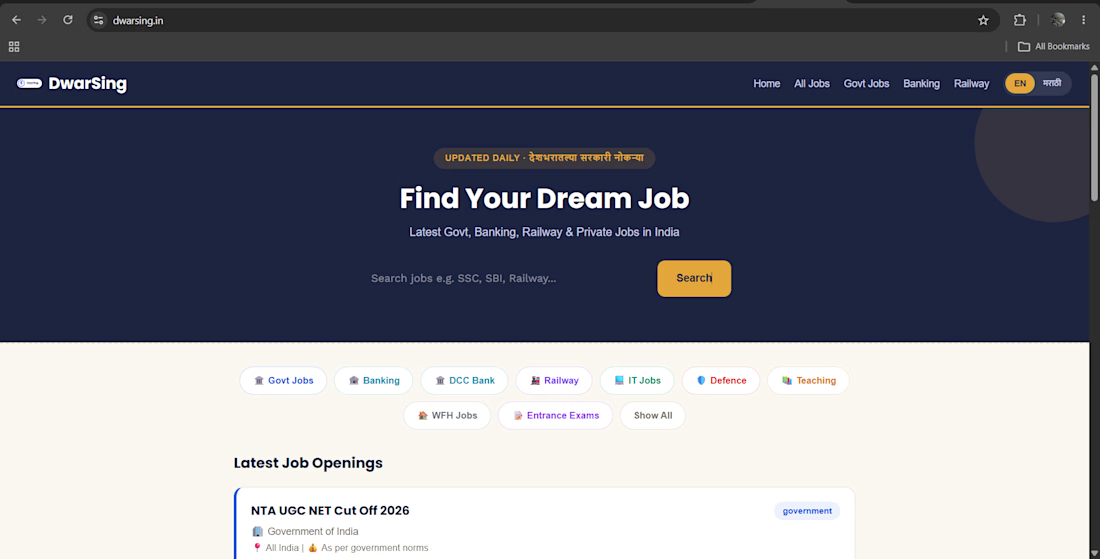

I'd show when each listing was last checked and hide it if the source takes it down. That makes it easier to tell whether the job is still live.

Each job listing will show a "last checked" timestamp, so users can see exactly when we last confirmed it's still live on the source site. my scraper runs daily, so this will usually show as checked within the last 24 hours.
If a listing gets taken down from the source, it'll...
I'd tie the timestamp to the last successful scrape, so a failed run can't make an old listing look freshly checked.
You're right the timestamp should only update on a confirmed successful check of that specific listing, not just because the scraper job ran. So if the scraper run fails partway through, times out, or hits an error before reaching a listing, that listing's "last checked" stays...

The scraper is the part most people underestimate on a job board. Listings move, sites change markup, and half your value is freshness. Honestly just curious how you're handling rescrapes -- full sweep on a schedule, or diffing against what's already in Postgres? I've built...
Mine did break in smaller ways — early on it occasionally grabbed the wrong table off a job's page. One time it pulled an answer-key table (numbered rows, A/B/C/D options) instead of the actual job-details table. Another time it stitched together two unrelated tables into one...
Keying off what the table says instead of where it sits in the DOM is the move -- field labels survive a redesign, selectors don't. And the answer-key trap is the kind of tell you only learn by getting burned once. Numbered rows plus single-letter values is a great...
that's exactly the right approach. Keying off field labels instead of DOM position makes total sense for durability, and yeah, I've been burned by structural assumptions before, so that's a lesson well learned.
For the update-detection piece I already diff titles on insert, so...

The "last checked" timestamp idea in the thread is a good fix for stale listings. On the scraping side, how is it holding up against structure changes on the government job boards specifically? Those sites tend to be the least stable and the hardest to get consistent access to,...
Right now the scraper pulls from a specific site site and I've built it to key off field labels rather than DOM position or CSS selectors so it looks for things like "Post Name," "Last Date," "Qualification" by their label text, not by where they sit in the page structure....
The network for creativity
Join 1.25M professional creatives like you
Connect with clients, get discovered, and run your business 100% commission-free
Creatives on Contra have earned over $150M and we are just getting started





Related posts

Full-Stack Developer & AI Automation Engineer
I build scalable web applications, SaaS platforms, mobile apps, custom dashboards, and AI-powered automation systems that turn complex business workflows into reliable digital products.
My core stack includes Next.js, React, Node.js, NestJS, Python, PostgreSQL, MongoDB, and AI APIs.
I specialize in turning ideas into production-ready systems—from architecture and development to deployment, automation, and optimization.
Available for:
AI Automation • SaaS Development • Web Development • Mobile Apps • Custom Dashboards • API Development • Business Automation


Seeing how you stitch AI APIs into custom dashboards really cuts the manual data wrangling. The stack choice keeps the deployment pipeline smooth.

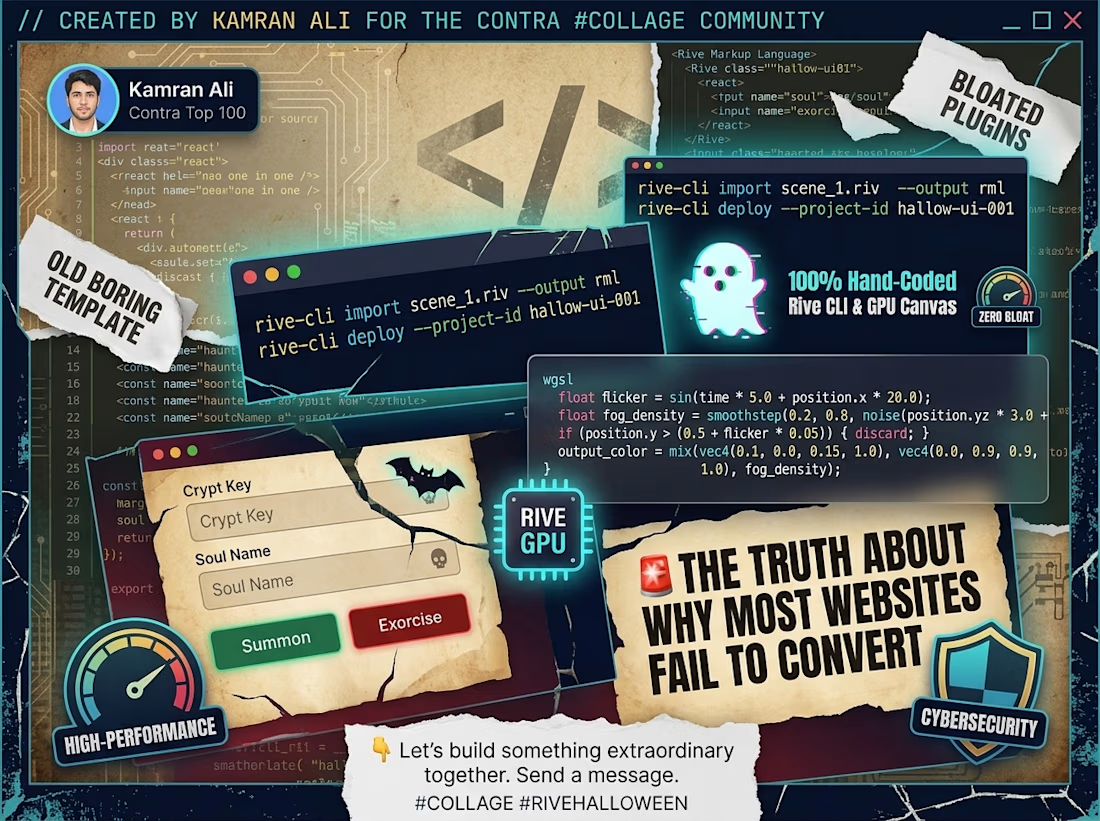
🚨 CODES, SHADERS & SPOOKY UI: WHY BUILDERS CAN’T MATCH HAND-CODED PRECISION
Most creators blend static assets in Figma or Canva. As a Full-Stack Engineer, I treat code itself as an art form.
For the Rive Halloween Challenge, I brought together raw code, terminal-driven workflows, and GPU shaders into one ultimate dev collage:
• Rive CLI & RML: Writing responsive interactive scenes directly inside VS Code—zero bloat.
• GPU Canvas (WGSL Shaders): Custom fog, flickering lights, and real-time spooky effects powered directly by the GPU.
• Cybersecurity & Clean Architecture: High-performance, pixel-perfect web apps built to convert in 0.05 seconds.
Forget laggy plugins and heavy template builders. True digital experiences are engineered from the ground up.
💬 Quick Question for Creatives & Devs:
Are you team Drag-and-Drop Builders or team 100% Hand-Coded Architecture?
👇 Drop your thoughts below, let's connect and push the boundaries of modern web tech!


The part where you drive fog and flickering lights with WGSL shaders on the GPU feels like the kind of low level control that really cuts latency.

New website for CavioAi
Architectural imagery, blue dither textures, and custom motion showing how enquiries, bookings, and CRM workflows connect.
Designed and built from the first concept to the final experience.
A quick walkthrough ↓


The blue dither on the architecture photo gives it a printed feel. Works well for an AI brand.