
Self-Hosted AI Agent: Watches Your Systems, Finds What BrokeCiprian Mandache
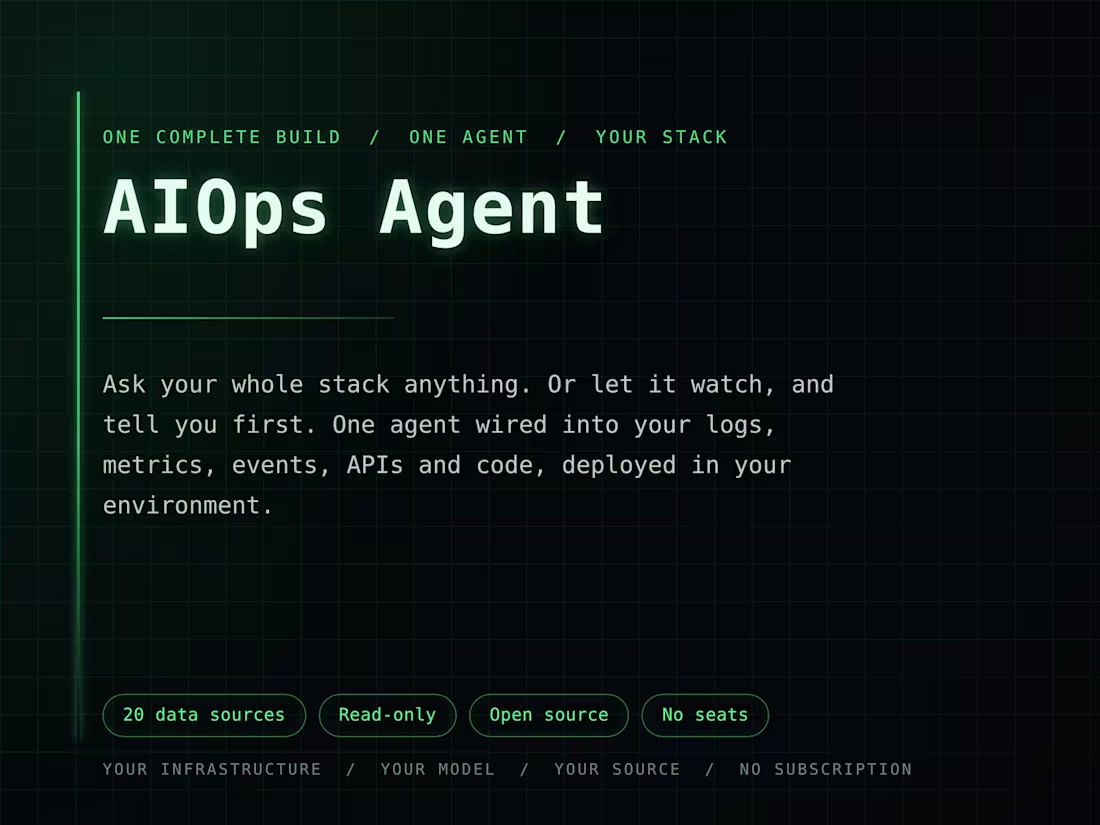
Dashboards show you data. They don't tell you what it means, and they never wake you up with the answer.
One agent, deployed in your environment, wired into everything you already run: logs, metrics, events, system health, internal and external APIs, databases, and your code. I do 100% of the wiring: every connector, every query, every mapping, the integration and the tuning. What I need from you is read-only access to each system, and nothing else.
Ask it anything in plain language from a web UI, your own app, or your MCP client. Or let it watch your systems live and decide for itself what is worth a look. It does not say "CPU is high" - it tells you why, since when, what changed and what to do, and hands you the one chart that proves it. It reads your systems. It never changes them.
ASK - answers, not dashboards
20 data sources wired for you: documented APIs, databases, log, metrics and event systems, queues and streams, cloud provider APIs, object storage, and code repositories (application code, infrastructure as code, config and runbooks).
Cross-source reasoning: it correlates across all of them in one pass, so a question that spans your database, your logs and last week's deploy comes back as one answer.
Server-side computed metrics: real joins, rates and aggregations, not sampled.
Three ways in: a web UI that builds charts, tables and graphs fresh for every answer; an OpenAI-compatible API; and an Agent MCP.
Unlimited team seats, no per-seat billing.
WATCH - it comes to you first
It decides for itself what is worth a look, investigates, traces the symptom back to the cause, and hands you the fix to apply. Because it reads your code and config too, it does not stop at "the database is slow": it names the commit or the setting that caused it and writes out the change it would make. It never applies that change. No commits, no pull requests, no config edits. You get the diff and the reasoning; you decide whether it ships.
10 event-driven hooks tuned to what abnormal means on your stack.
20 scheduled digests.
10 alerts routed by severity to Slack, Discord, Telegram, email or any channel with a webhook or API.
5 custom playbooks for the failure modes you already know by heart.
OWN - yours, forever
The building blocks are open source. You get the whole thing as a repository with a Dockerfile - your integration, connectors, playbooks and config - so it ships as a container through your normal review and your normal pipeline. Your team deploys it like anything else you run, or I deploy it if you would rather give me the access. It runs on your infrastructure, and your data stays on your hardware.
Every build goes through the same CI as everything else I publish, and it is not billed separately:
Linting, tests and vulnerability scanning on the code
Grype vulnerability scan on the image
SBOM and provenance attestation on every image
Bring your own model: any provider with an OpenAI-compatible or Anthropic API, or a model you host yourself behind an OpenAI-compatible endpoint. You pay your provider directly at cost; I take no cut of your tokens. Hardening and a tuning window after handover are included.
READ-ONLY BY DESIGN
Every credential the agent uses is read-only. Where it reads a database it uses a read-only user, or every query runs in a read-only transaction. Nothing leaves your network except the LLM call you configure; self-host the model and nothing leaves at all.
The credentials are yours to create. After we scope what you run, I ask for one thing per system - a read-only user, a scoped key, whatever your policy allows - and you decide what it can see. I do not need admin access to anything, and I will not ask for it.
Price
$15,000. One complete build, delivered in 60 days, usually sooner. No tiers, no locked features, no seats, no subscription.
Paid in four milestones through Contra escrow. Each one is funded before it starts and released when you approve its deliverable:
Scoping and access - $2,500. Written scope, confirmed source list, credentials in place, repository created with CI running.
Core integration - $5,000. First batch of sources wired in; web UI, API and MCP running in your environment; first working demo.
Full wiring and watch layer - $5,000. All 20 sources; hooks, digests, alerts and playbooks configured; container built and deployed.
Handover and tuning - $2,500. Tuning window against real traffic, documentation, handover.
A source is a system with an API, a database or another machine-readable interface. Systems reachable only through their user interface are outside the standard scope and are assessed separately during scoping.
Extra sources, hooks or playbooks beyond the included counts: flat per-unit add-ons, quoted up front.
Monthly retainer for ongoing tuning: available if you want it, never required.
Next step
This is for teams running enough infrastructure that something can break and nobody notices for hours. Send me what you run and what "watch my business" means for you. We get on a call, I scope it, and I build it into your stack. You end up with a repository and a container your team can deploy anywhere, or I deploy it for you.
FAQs
Starting at$15,000
Duration60 days
Tags
AI Engineer
Backend Engineer
Service provided by
Ciprian Mandache Bucharest, Romania
Self-Hosted AI Agent: Watches Your Systems, Finds What BrokeCiprian Mandache
Starting at$15,000
Duration60 days
Tags
AI Engineer
Backend Engineer
Dashboards show you data. They don't tell you what it means, and they never wake you up with the answer.
One agent, deployed in your environment, wired into everything you already run: logs, metrics, events, system health, internal and external APIs, databases, and your code. I do 100% of the wiring: every connector, every query, every mapping, the integration and the tuning. What I need from you is read-only access to each system, and nothing else.
Ask it anything in plain language from a web UI, your own app, or your MCP client. Or let it watch your systems live and decide for itself what is worth a look. It does not say "CPU is high" - it tells you why, since when, what changed and what to do, and hands you the one chart that proves it. It reads your systems. It never changes them.
ASK - answers, not dashboards
20 data sources wired for you: documented APIs, databases, log, metrics and event systems, queues and streams, cloud provider APIs, object storage, and code repositories (application code, infrastructure as code, config and runbooks).
Cross-source reasoning: it correlates across all of them in one pass, so a question that spans your database, your logs and last week's deploy comes back as one answer.
Server-side computed metrics: real joins, rates and aggregations, not sampled.
Three ways in: a web UI that builds charts, tables and graphs fresh for every answer; an OpenAI-compatible API; and an Agent MCP.
Unlimited team seats, no per-seat billing.
WATCH - it comes to you first
It decides for itself what is worth a look, investigates, traces the symptom back to the cause, and hands you the fix to apply. Because it reads your code and config too, it does not stop at "the database is slow": it names the commit or the setting that caused it and writes out the change it would make. It never applies that change. No commits, no pull requests, no config edits. You get the diff and the reasoning; you decide whether it ships.
10 event-driven hooks tuned to what abnormal means on your stack.
20 scheduled digests.
10 alerts routed by severity to Slack, Discord, Telegram, email or any channel with a webhook or API.
5 custom playbooks for the failure modes you already know by heart.
OWN - yours, forever
The building blocks are open source. You get the whole thing as a repository with a Dockerfile - your integration, connectors, playbooks and config - so it ships as a container through your normal review and your normal pipeline. Your team deploys it like anything else you run, or I deploy it if you would rather give me the access. It runs on your infrastructure, and your data stays on your hardware.
Every build goes through the same CI as everything else I publish, and it is not billed separately:
Linting, tests and vulnerability scanning on the code
Grype vulnerability scan on the image
SBOM and provenance attestation on every image
Bring your own model: any provider with an OpenAI-compatible or Anthropic API, or a model you host yourself behind an OpenAI-compatible endpoint. You pay your provider directly at cost; I take no cut of your tokens. Hardening and a tuning window after handover are included.
READ-ONLY BY DESIGN
Every credential the agent uses is read-only. Where it reads a database it uses a read-only user, or every query runs in a read-only transaction. Nothing leaves your network except the LLM call you configure; self-host the model and nothing leaves at all.
The credentials are yours to create. After we scope what you run, I ask for one thing per system - a read-only user, a scoped key, whatever your policy allows - and you decide what it can see. I do not need admin access to anything, and I will not ask for it.
Price
$15,000. One complete build, delivered in 60 days, usually sooner. No tiers, no locked features, no seats, no subscription.
Paid in four milestones through Contra escrow. Each one is funded before it starts and released when you approve its deliverable:
Scoping and access - $2,500. Written scope, confirmed source list, credentials in place, repository created with CI running.
Core integration - $5,000. First batch of sources wired in; web UI, API and MCP running in your environment; first working demo.
Full wiring and watch layer - $5,000. All 20 sources; hooks, digests, alerts and playbooks configured; container built and deployed.
Handover and tuning - $2,500. Tuning window against real traffic, documentation, handover.
A source is a system with an API, a database or another machine-readable interface. Systems reachable only through their user interface are outside the standard scope and are assessed separately during scoping.
Extra sources, hooks or playbooks beyond the included counts: flat per-unit add-ons, quoted up front.
Monthly retainer for ongoing tuning: available if you want it, never required.
Next step
This is for teams running enough infrastructure that something can break and nobody notices for hours. Send me what you run and what "watch my business" means for you. We get on a call, I scope it, and I build it into your stack. You end up with a repository and a container your team can deploy anywhere, or I deploy it for you.
FAQs
$15,000