
Creative Logo DesignFaraz Ahmed
Welcome to my gig! As a Modern Logo Design Specialist, I am here to help you establish a powerful brand identity through visually captivating and innovative logos. With my expertise in contemporary design trends and an eye for aesthetics, I will create a logo that not only captures your brand's essence but also leaves a lasting impression on your target audience.
What You'll Get:
Unique and Custom Logo Design:
I will design a modern logo that reflects your brand's personality, values, and industry.
Each logo is meticulously crafted to ensure it stands out from the competition.
I will explore various creative concepts to find the perfect visual representation for your brand.
You will receive high-resolution files in formats suitable for both print and digital platforms.
Your satisfaction is my top priority. I offer unlimited revisions to ensure your design is exactly as you envisioned it.
Why Choose Me?
Modern Design Expertise:
With a deep understanding of contemporary trends, I specialize in creating logos that are modern, sleek, and visually impactful.
Order now
Feel free to contact me if you have any questions.
What's included
AI, EPS, or SVG) for scalability and raster files (JPEG, PNG) for everyday use.
Color Variations: Different color versions of the logo may be provided, such as full-color, grayscale, and black-and-white versions.
Logo Variations: Depending on the complexity of the logo, variations like horizontal, vertical, and simplified versions may be included to ensure adaptability to different applications.
Usage Guidelines: A style guide or usage guidelines document may be provided, outlining the proper use of the logo, including minimum size requirements, color codes, and clear space guidelines.
Typography Recommendations: If specific fonts were used in the logo, the designer may recommend the use of these fonts in other brand materials.
Mockups: Sometimes, designers include mockups to showcase how the logo would appear in real-world applications, such as on business cards, letterheads, signage, or digital media.
Source Files: The client may receive the source files of the logo, which can be edited and modified in the future, typically in vector formats like AI or EPS.
High-Resolution Files: High-resolution versions of the logo suitable for printing and professional applications are provided.
Transparent Background: Versions of the logo with a transparent background (usually in PNG format) for use on various backgrounds.
Ownership Rights: A transfer of ownership rights or a licensing agreement, specifying how the client can use the logo and any limitations on the designer's rights.
Revisions: Depending on the contract terms, the client may be entitled to a certain number of revisions or refinements to the logo design.
Final Logo Presentation: A presentation or document summarizing the design process and rationale behind the logo.
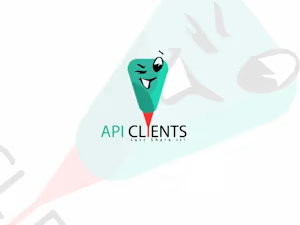
Example work

Faraz's other services

Starting at$300
Tags
Adobe Illustrator

Adobe Photoshop
Graphic Designer
Logo Designer
Packaging Designer
Service provided by
Faraz Ahmed Karachi, Pakistan
Creative Logo DesignFaraz Ahmed
Starting at$300
Tags
Adobe Illustrator
Adobe Photoshop
Graphic Designer
Logo Designer
Packaging Designer
Welcome to my gig! As a Modern Logo Design Specialist, I am here to help you establish a powerful brand identity through visually captivating and innovative logos. With my expertise in contemporary design trends and an eye for aesthetics, I will create a logo that not only captures your brand's essence but also leaves a lasting impression on your target audience.
What You'll Get:
Unique and Custom Logo Design:
I will design a modern logo that reflects your brand's personality, values, and industry.
Each logo is meticulously crafted to ensure it stands out from the competition.
I will explore various creative concepts to find the perfect visual representation for your brand.
You will receive high-resolution files in formats suitable for both print and digital platforms.
Your satisfaction is my top priority. I offer unlimited revisions to ensure your design is exactly as you envisioned it.
Why Choose Me?
Modern Design Expertise:
With a deep understanding of contemporary trends, I specialize in creating logos that are modern, sleek, and visually impactful.
Order now
Feel free to contact me if you have any questions.
What's included
AI, EPS, or SVG) for scalability and raster files (JPEG, PNG) for everyday use.
Color Variations: Different color versions of the logo may be provided, such as full-color, grayscale, and black-and-white versions.
Logo Variations: Depending on the complexity of the logo, variations like horizontal, vertical, and simplified versions may be included to ensure adaptability to different applications.
Usage Guidelines: A style guide or usage guidelines document may be provided, outlining the proper use of the logo, including minimum size requirements, color codes, and clear space guidelines.
Typography Recommendations: If specific fonts were used in the logo, the designer may recommend the use of these fonts in other brand materials.
Mockups: Sometimes, designers include mockups to showcase how the logo would appear in real-world applications, such as on business cards, letterheads, signage, or digital media.
Source Files: The client may receive the source files of the logo, which can be edited and modified in the future, typically in vector formats like AI or EPS.
High-Resolution Files: High-resolution versions of the logo suitable for printing and professional applications are provided.
Transparent Background: Versions of the logo with a transparent background (usually in PNG format) for use on various backgrounds.
Ownership Rights: A transfer of ownership rights or a licensing agreement, specifying how the client can use the logo and any limitations on the designer's rights.
Revisions: Depending on the contract terms, the client may be entitled to a certain number of revisions or refinements to the logo design.
Final Logo Presentation: A presentation or document summarizing the design process and rationale behind the logo.
Example work
Faraz's other services
$300