
Longevity Evidence Check — a GRADE-style evidence briefR. Dong
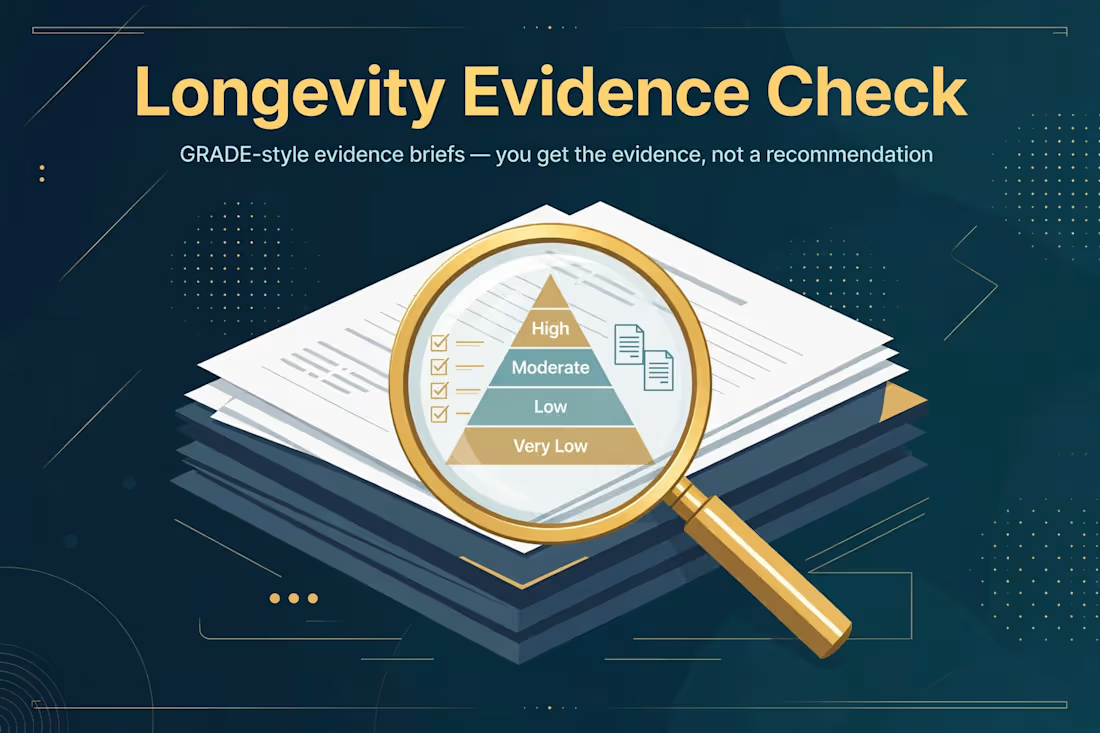
You get the evidence, not a recommendation. One intervention, one claim, graded against the published human literature — by a physician who does systematic reviews for a living.
The longevity market runs on claims: peptides, rapamycin, senolytics, NAD+ boosters, off-label protocols. Almost none of the marketing distinguishes between a mouse study, a 12-person case series, and a randomised trial — because the distinction is bad for sales.
I am a physician and systematic reviewer (pen name R. Dong). Evidence appraisal is my day job: I design searches, extract trial data, assess risk of bias, and grade certainty for meta-analyses submitted to medical journals. This service applies exactly that machinery to a single longevity claim and gives you a written brief you can check, cite, and make decisions with.
Every brief follows the same structure:
The claim, stated precisely — intervention, population, outcome
What human evidence exists, separated into randomised trials, observational data, and animal/in-vitro work (animal data always labelled as animal data)
A GRADE-style certainty rating (High / Moderate / Low / Very low) with the reasoning shown
Known harms and unknowns — including what has simply never been studied
Bottom line in three sentences
Key sources, every one verifiable (PMID / DOI)
Three sample briefs (BPC-157; rapamycin for longevity; GLP-1 drugs and muscle loss) are available free — ask, or see my Substack, Meta, in Practice. The samples are the product: a paid brief is the same document, on your question.
What I need from you before starting:
The intervention, spelled precisely (compound/product, dose form if relevant)
The specific claim or outcome you want graded — "does it work?" is not gradable; "does it improve tendon healing time in adults?" is
Your context, in one or two lines: personal research, clinic programme, content project (this changes emphasis, never the rating)
Any deadline If the claim turns out to be ungradable as posed, I will tell you before payment rather than sell you a brief that says nothing.
Service boundary: educational evidence appraisal only — not medical advice, not an endorsement, not a product. The author has no financial relationship with any seller of longevity interventions and accepts no affiliate or referral fees.
Pricing:
Single Evidence Brief — $149, delivery 5 days. One intervention × one claimed outcome; full structured brief, typically 800–1,200 words plus source list; PubMed and trial-registry search current to the month of delivery.
Deep Evidence Brief — $299, delivery 7 days. One intervention, up to three claimed outcomes; everything in the Single Evidence Brief plus risk-of-bias appraisal of each key trial, effect sizes with confidence intervals, and a "what would change this rating" section.
Commissioned Brief for Clinics, Coaches and Brands — $450, scoped per project, $450–900; delivery typically 10–15 business days; may include a 30-minute walkthrough call; hard condition: a commissioned brief is not an endorsement and ratings may not be used in marketing to imply a recommendation.
FAQs

Starting at$149
Duration5 days
Tags
Consultant
Researcher
Writer
Service provided by
R. Dong The Dalles, USA
Longevity Evidence Check — a GRADE-style evidence briefR. Dong
Starting at$149
Duration5 days
Tags
Consultant
Researcher
Writer
You get the evidence, not a recommendation. One intervention, one claim, graded against the published human literature — by a physician who does systematic reviews for a living.
The longevity market runs on claims: peptides, rapamycin, senolytics, NAD+ boosters, off-label protocols. Almost none of the marketing distinguishes between a mouse study, a 12-person case series, and a randomised trial — because the distinction is bad for sales.
I am a physician and systematic reviewer (pen name R. Dong). Evidence appraisal is my day job: I design searches, extract trial data, assess risk of bias, and grade certainty for meta-analyses submitted to medical journals. This service applies exactly that machinery to a single longevity claim and gives you a written brief you can check, cite, and make decisions with.
Every brief follows the same structure:
The claim, stated precisely — intervention, population, outcome
What human evidence exists, separated into randomised trials, observational data, and animal/in-vitro work (animal data always labelled as animal data)
A GRADE-style certainty rating (High / Moderate / Low / Very low) with the reasoning shown
Known harms and unknowns — including what has simply never been studied
Bottom line in three sentences
Key sources, every one verifiable (PMID / DOI)
Three sample briefs (BPC-157; rapamycin for longevity; GLP-1 drugs and muscle loss) are available free — ask, or see my Substack, Meta, in Practice. The samples are the product: a paid brief is the same document, on your question.
What I need from you before starting:
The intervention, spelled precisely (compound/product, dose form if relevant)
The specific claim or outcome you want graded — "does it work?" is not gradable; "does it improve tendon healing time in adults?" is
Your context, in one or two lines: personal research, clinic programme, content project (this changes emphasis, never the rating)
Any deadline If the claim turns out to be ungradable as posed, I will tell you before payment rather than sell you a brief that says nothing.
Service boundary: educational evidence appraisal only — not medical advice, not an endorsement, not a product. The author has no financial relationship with any seller of longevity interventions and accepts no affiliate or referral fees.
Pricing:
Single Evidence Brief — $149, delivery 5 days. One intervention × one claimed outcome; full structured brief, typically 800–1,200 words plus source list; PubMed and trial-registry search current to the month of delivery.
Deep Evidence Brief — $299, delivery 7 days. One intervention, up to three claimed outcomes; everything in the Single Evidence Brief plus risk-of-bias appraisal of each key trial, effect sizes with confidence intervals, and a "what would change this rating" section.
Commissioned Brief for Clinics, Coaches and Brands — $450, scoped per project, $450–900; delivery typically 10–15 business days; may include a 30-minute walkthrough call; hard condition: a commissioned brief is not an endorsement and ratings may not be used in marketing to imply a recommendation.
FAQs
$149