
The Manual Labour Tax AuditLori Callum
Here is the day-by-day breakdown of The Manual Labor Tax Audit:
Phase 1: The Extraction (Days 1–2)
We don’t start with technology; we start with the Headcount vs. Output map.
Workflow Ingestion: We identify the top 5 high-volume, repetitive processes in Finance, Logistics, or Ops.
The "Glue Work" Interview: Short, sharp sessions with Department Heads to find where humans are manually moving data between systems (e.g., ERP to Spreadsheet to CRM).
Data Integrity Check: Assessing if your current data "cleanliness" can support autonomous agents.
Phase 2: The Logic Mapping (Days 3–4)
We apply the DeptOS Framework to the identified leaks.
Logic-Tree Drafting: We convert manual human decisions into "If-Then-Else" autonomous logic.
Governance Bottlenecks: We identify where a "Human-in-the-Loop" is legally or operationally required vs. where Shadow Mode can take over.
Risk Profiling: We categorize every task by its "Hallucination Cost" to determine the safety guardrails needed in the Command Center.
Phase 3: The Recovery Roadmap (Day 5)
The final delivery is an Executive Briefing focused on Capital Recovery.
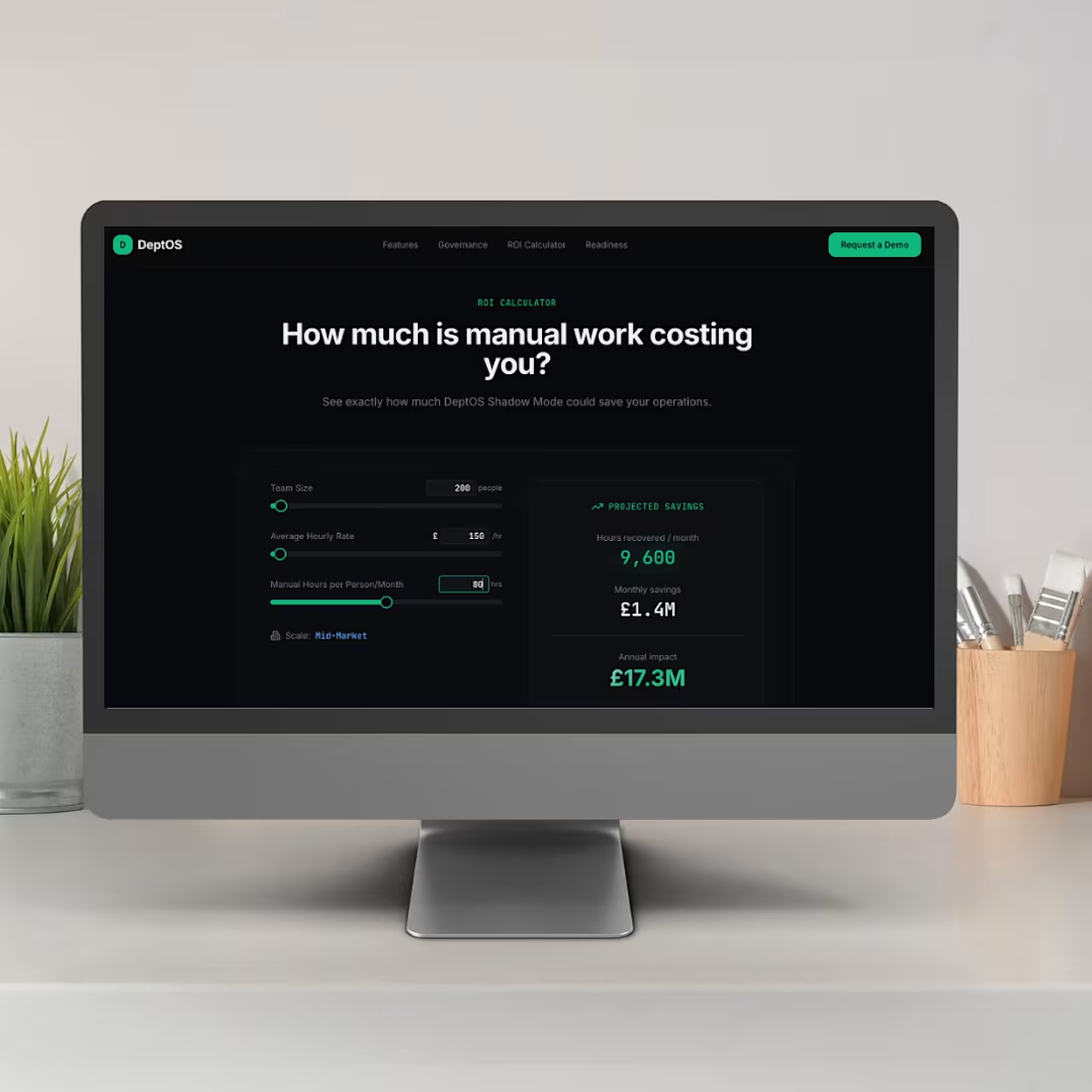
The ROI Blueprint: A breakdown showing exactly how many hours per month can be reclaimed (e.g., the 9,600 hours shown in your calculator).
The Deployment Sequence: Which department to "switch on" first for the fastest payback.
The "Shadow Mode" Strategy: A technical plan for running AI agents in the background to prove 99%+ accuracy before they go live.
FAQs
It is the hidden financial drain caused by hiring high-salary specialists to perform "human glue" tasks—manual data entry, cross-referencing systems, and administrative triage. For a 200-person team, this typically leaks £1.4M per month in lost strategic capacity.
We use Shadow Mode. This allows AI agents to run in the background, processing real data alongside your human team. We don't grant execution rights until the agent's output matches your human baseline with 99.9% accuracy over a verified period.
Absolutely. We implement Compliance Vaults and local data boundaries. Your data is used to steer your specific agents within your governed environment; it is never used to train public models or shared outside your organization’s stack.
Chatbots answer questions; Autonomous Departments execute workflows. DeptOS agents have "Bounded Autonomy," meaning they are hard-coded with specific operational limits (spend caps, prohibited actions) and integrated directly into your ERP/CRM to perform end-to-end tasks.
The Manual Labor Tax Audit takes 1 week. A pilot "Shadow Mode" department typically takes 4–6 weeks to deploy, depending on the complexity of your legacy systems and the required logic-trees.
No. DeptOS is an Operating Model designed to sit on top of your existing stack (SAP, Salesforce, Oracle, etc.). It acts as the intelligent orchestration layer that connects your fragmented tools into a unified workforce.
Starting at$2,500
Duration1 week
Tags
Auditor
Service provided by
Lori Callum Milton Keynes, UK
- 8
- Followers
The Manual Labour Tax AuditLori Callum
Here is the day-by-day breakdown of The Manual Labor Tax Audit:
Phase 1: The Extraction (Days 1–2)
We don’t start with technology; we start with the Headcount vs. Output map.
Workflow Ingestion: We identify the top 5 high-volume, repetitive processes in Finance, Logistics, or Ops.
The "Glue Work" Interview: Short, sharp sessions with Department Heads to find where humans are manually moving data between systems (e.g., ERP to Spreadsheet to CRM).
Data Integrity Check: Assessing if your current data "cleanliness" can support autonomous agents.
Phase 2: The Logic Mapping (Days 3–4)
We apply the DeptOS Framework to the identified leaks.
Logic-Tree Drafting: We convert manual human decisions into "If-Then-Else" autonomous logic.
Governance Bottlenecks: We identify where a "Human-in-the-Loop" is legally or operationally required vs. where Shadow Mode can take over.
Risk Profiling: We categorize every task by its "Hallucination Cost" to determine the safety guardrails needed in the Command Center.
Phase 3: The Recovery Roadmap (Day 5)
The final delivery is an Executive Briefing focused on Capital Recovery.
The ROI Blueprint: A breakdown showing exactly how many hours per month can be reclaimed (e.g., the 9,600 hours shown in your calculator).
The Deployment Sequence: Which department to "switch on" first for the fastest payback.
The "Shadow Mode" Strategy: A technical plan for running AI agents in the background to prove 99%+ accuracy before they go live.
FAQs
It is the hidden financial drain caused by hiring high-salary specialists to perform "human glue" tasks—manual data entry, cross-referencing systems, and administrative triage. For a 200-person team, this typically leaks £1.4M per month in lost strategic capacity.
We use Shadow Mode. This allows AI agents to run in the background, processing real data alongside your human team. We don't grant execution rights until the agent's output matches your human baseline with 99.9% accuracy over a verified period.
Absolutely. We implement Compliance Vaults and local data boundaries. Your data is used to steer your specific agents within your governed environment; it is never used to train public models or shared outside your organization’s stack.
Chatbots answer questions; Autonomous Departments execute workflows. DeptOS agents have "Bounded Autonomy," meaning they are hard-coded with specific operational limits (spend caps, prohibited actions) and integrated directly into your ERP/CRM to perform end-to-end tasks.
The Manual Labor Tax Audit takes 1 week. A pilot "Shadow Mode" department typically takes 4–6 weeks to deploy, depending on the complexity of your legacy systems and the required logic-trees.
No. DeptOS is an Operating Model designed to sit on top of your existing stack (SAP, Salesforce, Oracle, etc.). It acts as the intelligent orchestration layer that connects your fragmented tools into a unified workforce.
$2,500