
Power Platform Engineer | Intelligent Automation & AI SystemLori Callum
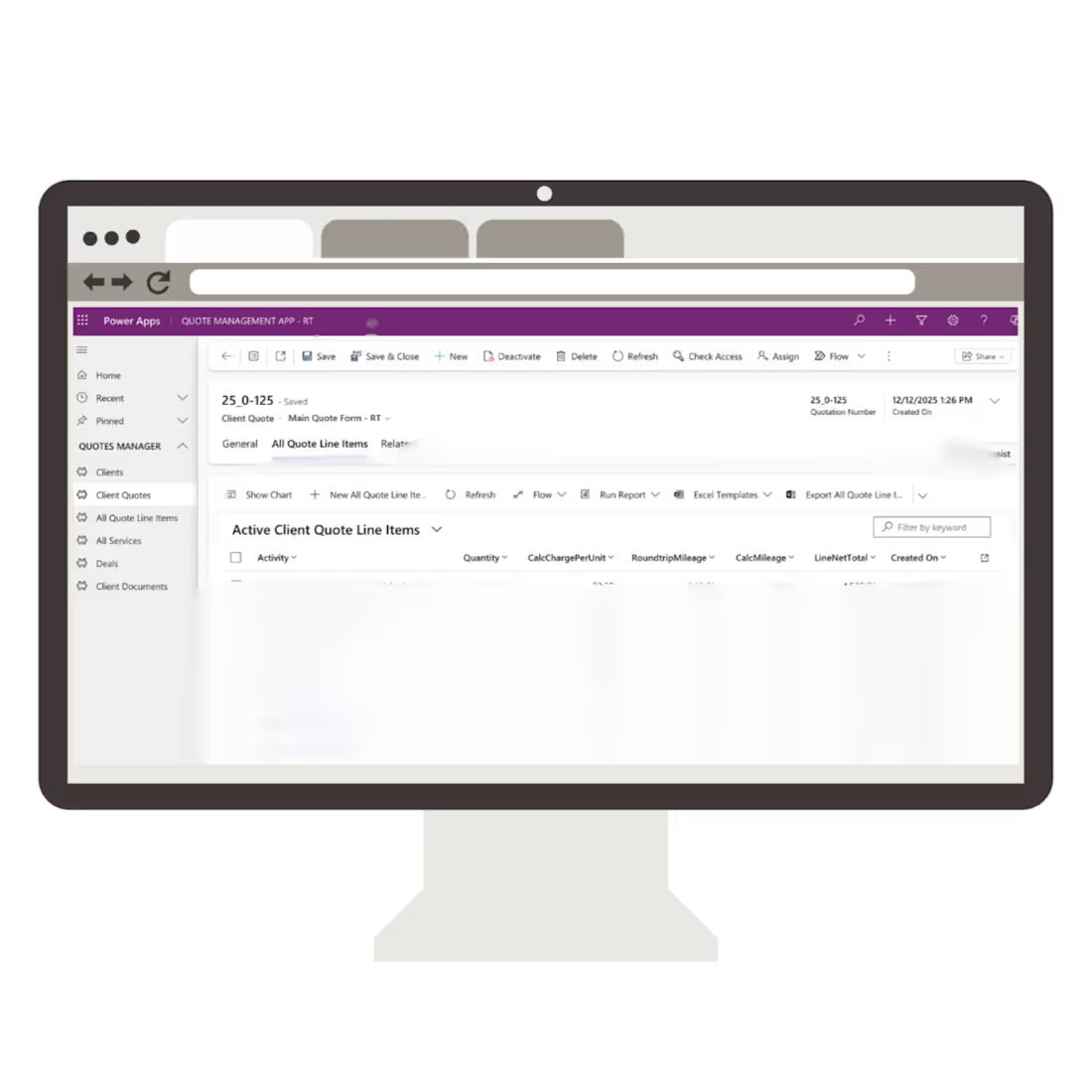
I bridge the gap between complex business challenges and scalable Microsoft solutions. As a Power Platform Engineer, I architect intelligent ecosystems that combine the robust security of the Microsoft Cloud with the cutting-edge capabilities of Generative AI.
I specialize in Intelligent Document Processing (IDP), custom API integrations, and high-performance Dataverse environments. Whether you need to automate a multi-stage insurance proposal process or build a custom AI-driven client portal, I deliver clean, maintainable, and high-ROI solutions.
Technical Core:
Architecture & Security: Dataverse environment strategy, DLP policies, and Managed Solutions.
Automation (RPA & Cloud): Power Automate (API-based) and Desktop (UI-based) for legacy system bridging.
AI & Intelligence: Copilot Studio, Azure OpenAI integration, and custom AI Builder models for OCR and sentiment analysis.
Extensibility: Custom Connectors, PCF Components, and Power Pages for external-facing portals.
Customer Journey
I follow a structured 4-Phase Engineering Framework to ensure every project is delivered on time, within budget, and fully scalable.
Phase 1: Discovery & Architecture Mapping (Week 1)
We start with a deep dive into your current "As-Is" process.
Audit: Reviewing your existing data sources (SharePoint, SQL, 3rd party APIs).
Solution Design: I provide a technical blueprint and a "To-Be" process map.
Deliverable: A Project Charter and Technical Architecture Document.
Phase 2: Rapid Prototype & Data Foundation (Weeks 2–3)
I build the "skeleton" of the solution to ensure data flows correctly.
Dataverse Setup: Building the relational database and security roles.
The "Happy Path": Developing the core automation or app functionality for the most common use case.
Deliverable: A functional MVP for internal stakeholder feedback.
Phase 3: AI Integration & Edge Case Handling (Weeks 4–5)
This is where the "intelligence" happens.
AI Tuning: Prompt engineering for GPT-4 integrations or training AI Builder models to recognize specific carrier forms.
Edge Cases: Building logic to handle exceptions (e.g., what happens if a PDF is missing a page?).
Deliverable: A feature-complete system ready for User Acceptance Testing (UAT).
Phase 4: Stress Testing & Deployment (Week 6)
Final polishing to ensure the system is "agent-proof."
Optimization: Refining flow performance and app responsiveness.
Handover: I provide full documentation and a 30-minute training session for your team.
Deliverable: The live solution migrated to your Production environment.
FAQs
Starting at$1,000
Duration1 week
Tags
Azure

Microsoft Copilot Studio

Microsoft Power BI

Power Apps

Service provided by
Lori Callum Milton Keynes, UK
- 8
- Followers
Power Platform Engineer | Intelligent Automation & AI SystemLori Callum
Starting at$1,000
Duration1 week
Tags
Azure
Microsoft Copilot Studio
Microsoft Power BI
Power Apps
I bridge the gap between complex business challenges and scalable Microsoft solutions. As a Power Platform Engineer, I architect intelligent ecosystems that combine the robust security of the Microsoft Cloud with the cutting-edge capabilities of Generative AI.
I specialize in Intelligent Document Processing (IDP), custom API integrations, and high-performance Dataverse environments. Whether you need to automate a multi-stage insurance proposal process or build a custom AI-driven client portal, I deliver clean, maintainable, and high-ROI solutions.
Technical Core:
Architecture & Security: Dataverse environment strategy, DLP policies, and Managed Solutions.
Automation (RPA & Cloud): Power Automate (API-based) and Desktop (UI-based) for legacy system bridging.
AI & Intelligence: Copilot Studio, Azure OpenAI integration, and custom AI Builder models for OCR and sentiment analysis.
Extensibility: Custom Connectors, PCF Components, and Power Pages for external-facing portals.
Customer Journey
I follow a structured 4-Phase Engineering Framework to ensure every project is delivered on time, within budget, and fully scalable.
Phase 1: Discovery & Architecture Mapping (Week 1)
We start with a deep dive into your current "As-Is" process.
Audit: Reviewing your existing data sources (SharePoint, SQL, 3rd party APIs).
Solution Design: I provide a technical blueprint and a "To-Be" process map.
Deliverable: A Project Charter and Technical Architecture Document.
Phase 2: Rapid Prototype & Data Foundation (Weeks 2–3)
I build the "skeleton" of the solution to ensure data flows correctly.
Dataverse Setup: Building the relational database and security roles.
The "Happy Path": Developing the core automation or app functionality for the most common use case.
Deliverable: A functional MVP for internal stakeholder feedback.
Phase 3: AI Integration & Edge Case Handling (Weeks 4–5)
This is where the "intelligence" happens.
AI Tuning: Prompt engineering for GPT-4 integrations or training AI Builder models to recognize specific carrier forms.
Edge Cases: Building logic to handle exceptions (e.g., what happens if a PDF is missing a page?).
Deliverable: A feature-complete system ready for User Acceptance Testing (UAT).
Phase 4: Stress Testing & Deployment (Week 6)
Final polishing to ensure the system is "agent-proof."
Optimization: Refining flow performance and app responsiveness.
Handover: I provide full documentation and a 30-minute training session for your team.
Deliverable: The live solution migrated to your Production environment.
FAQs
$1,000