
Headless CMS Website with Strapi or SanityKevine Nzapdi
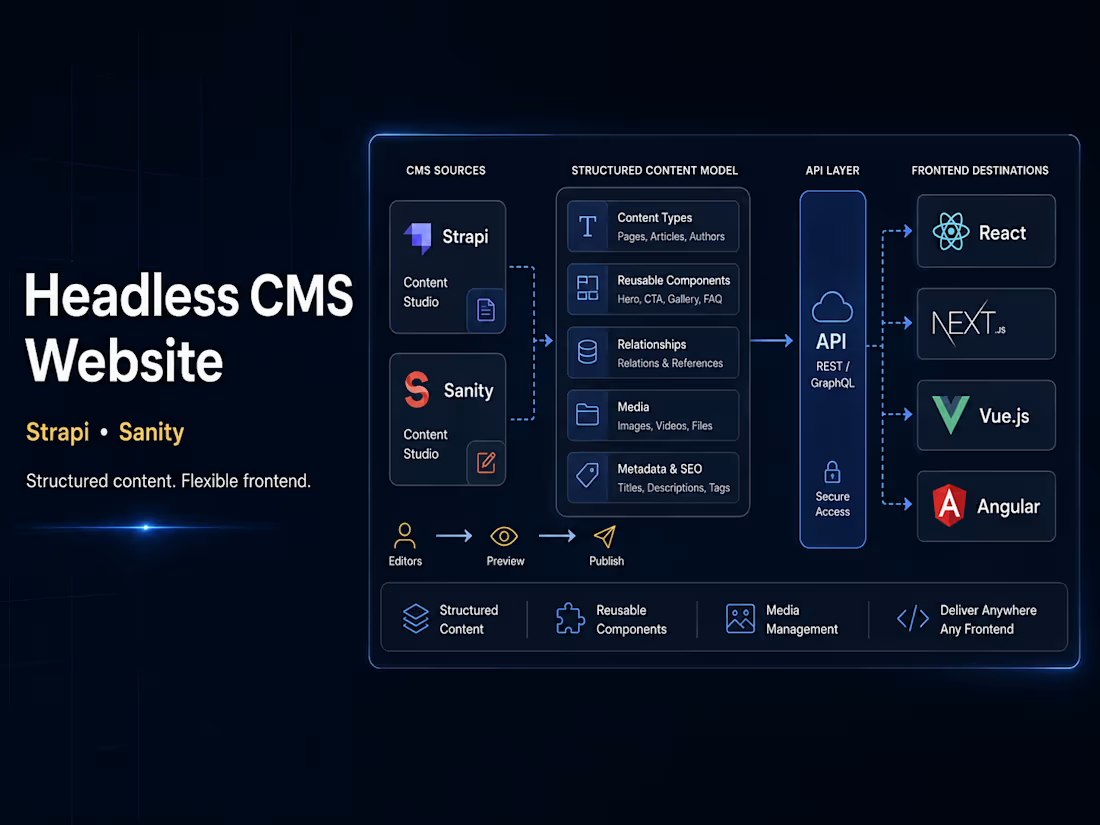
Give editors control without limiting your frontend
Your content should not be hard-coded into frontend components or require a developer every time the marketing team needs to publish a page.
I build content-first headless websites using Strapi or Sanity, connected to frontends developed with React, Next.js, Vue.js or Angular.
You receive a structured content system for editors, a maintainable frontend for developers and documented workflows for previewing, publishing and deploying updates.
The technology stack is selected according to your existing codebase, editorial needs, search requirements, infrastructure and internal technical expertise. I will not recommend changing frameworks simply to follow a trend.
Problems this service solves
This service can help when:
Marketing depends on developers for routine content changes
Content is hard-coded into the frontend
Your existing CMS limits design or frontend development
Editors work with confusing or poorly organized fields
Similar content is recreated manually across several pages
Your website needs reusable landing-page sections
Content must be shared across multiple pages or applications
Your current headless website lacks previews
Published CMS changes do not update the frontend reliably
SEO titles, canonicals or social metadata cannot be managed properly
Roles and API permissions are too broad or incorrectly configured
Your team needs to integrate content with external APIs
Developers lack setup, deployment or maintenance documentation
You are migrating from WordPress or another CMS
Your organization needs separate CMS and frontend deployments
Suitable projects
I can build or improve:
SaaS and technology websites
Developer-tool websites
Blogs and editorial platforms
Resource centres
Case-study libraries
Documentation websites
Integration directories
Product and feature websites
Reusable landing-page systems
Multilingual content foundations
Existing React, Next.js, Vue.js or Angular applications that need a CMS
Websites migrating to Strapi or Sanity
Supported technology
Headless CMS
Strapi
Sanity
Frontend
React
Next.js
Vue.js
Angular
The selected frontend may be an existing application or a new implementation. Rendering, caching and deployment decisions are based on the project rather than applying the same architecture to every website.
What is included
The final scope may include:
Content architecture
Content-type planning
Structured fields
Reusable content components
Relationships and taxonomies
Media requirements
Editorial roles
SEO fields
Migration mapping
CMS configuration
For Strapi, this may include content types, components, relationships, roles, permissions, media, REST or GraphQL APIs and publishing configuration.
For Sanity, this may include schemas, reusable objects, references, validation, Studio configuration, GROQ queries and editorial workflows.
Frontend integration
CMS data fetching
Reusable frontend components
Dynamic routes
Responsive templates
Loading and error states
Search or filtering when scoped
Forms and external API integrations
Appropriate rendering and caching
Accessible semantic markup
Preview and publishing workflow
Draft previews
Publishing webhooks
Cache revalidation
Frontend build triggers
Preview and publishing instructions
Technical SEO foundations
Editable titles and descriptions
Canonical URLs
Open Graph metadata
Indexation controls
XML sitemap
Robots.txt
Semantic headings
Crawlable internal links
Search-friendly URLs
Structured data where appropriate
These foundations do not guarantee rankings. A complete SEO strategy or audit is a separate service.
Deployment and handover
CMS and frontend environment configuration
Database and media-storage setup where applicable
Environment variables
Deployment configuration
Source-code handover
Editor documentation
Developer setup and deployment documentation
Final walkthrough
What you receive
Depending on the agreed scope, you will receive:
A configured Strapi or Sanity content system
A responsive React, Next.js, Vue.js or Angular frontend
Structured content types and reusable components
Appropriate roles and permissions
Draft preview and publishing workflows
SEO and social-metadata controls
API and third-party integrations included in the scope
Deployment configuration
Tested content and publishing workflows
Editor and developer documentation
Source-code handover
A final handover call
My process
1. Discovery
We define the website goals, users, content types, editorial team, integrations, existing technology and launch requirements.
2. Architecture
I recommend the appropriate CMS, frontend, content model, API approach, rendering strategy and deployment architecture.
3. Content modelling
I define the content types, reusable components, fields, relationships, validation and permissions.
4. Development
I configure the CMS, develop or integrate the frontend and implement the agreed publishing workflow.
5. Testing
I test content management, API behaviour, roles, previews, responsive templates, publishing and relevant integrations.
6. Deployment and handover
I deploy or hand over the agreed systems and provide editor and developer documentation.
What I need from you
Please provide:
A description of the website and its purpose
Target users
Existing codebase or website, if applicable
Required pages and functionality
Content types you need to manage
Approved designs, if available
Representative content
Required integrations
Existing CMS export, if migrating
Hosting preferences
SEO and analytics requirements
Required launch date
Scope, pricing and timeline
Every headless CMS project differs in content complexity, frontend requirements, integrations, migration and infrastructure.
I provide a custom quote after reviewing the project and confirming the most appropriate architecture.
A focused headless website typically takes approximately six weeks after the required designs, content and access have been provided. Larger migrations, multilingual platforms or complex integrations may require additional time.
The final proposal will define the included content types, templates, integrations, environments, milestones, revisions and responsibilities.
Not included unless specifically scoped
Brand identity or logo design
Original UI/UX design
Copywriting for every page
Unlimited content types or templates
Unlimited revisions
Hosting and third-party fees
Large-scale content migration
E-commerce functionality
Complex user authentication
Full web-application development
Ongoing infrastructure management
Security penetration testing
Guaranteed SEO rankings or performance scores
Indefinite post-launch support
FAQs
Kevine's other services
Starting at$40 /hr
Tags
Angular

Next.js

React

Sanity

Strapi

Vue.js

Frontend Engineer
Fullstack Engineer
Headless CMS
Service provided by
Kevine Nzapdi Yaounde, Cameroon
Headless CMS Website with Strapi or SanityKevine Nzapdi
Starting at$40 /hr
Tags
Angular
Next.js
React
Sanity
Strapi
Vue.js
Frontend Engineer
Fullstack Engineer
Headless CMS
Give editors control without limiting your frontend
Your content should not be hard-coded into frontend components or require a developer every time the marketing team needs to publish a page.
I build content-first headless websites using Strapi or Sanity, connected to frontends developed with React, Next.js, Vue.js or Angular.
You receive a structured content system for editors, a maintainable frontend for developers and documented workflows for previewing, publishing and deploying updates.
The technology stack is selected according to your existing codebase, editorial needs, search requirements, infrastructure and internal technical expertise. I will not recommend changing frameworks simply to follow a trend.
Problems this service solves
This service can help when:
Marketing depends on developers for routine content changes
Content is hard-coded into the frontend
Your existing CMS limits design or frontend development
Editors work with confusing or poorly organized fields
Similar content is recreated manually across several pages
Your website needs reusable landing-page sections
Content must be shared across multiple pages or applications
Your current headless website lacks previews
Published CMS changes do not update the frontend reliably
SEO titles, canonicals or social metadata cannot be managed properly
Roles and API permissions are too broad or incorrectly configured
Your team needs to integrate content with external APIs
Developers lack setup, deployment or maintenance documentation
You are migrating from WordPress or another CMS
Your organization needs separate CMS and frontend deployments
Suitable projects
I can build or improve:
SaaS and technology websites
Developer-tool websites
Blogs and editorial platforms
Resource centres
Case-study libraries
Documentation websites
Integration directories
Product and feature websites
Reusable landing-page systems
Multilingual content foundations
Existing React, Next.js, Vue.js or Angular applications that need a CMS
Websites migrating to Strapi or Sanity
Supported technology
Headless CMS
Strapi
Sanity
Frontend
React
Next.js
Vue.js
Angular
The selected frontend may be an existing application or a new implementation. Rendering, caching and deployment decisions are based on the project rather than applying the same architecture to every website.
What is included
The final scope may include:
Content architecture
Content-type planning
Structured fields
Reusable content components
Relationships and taxonomies
Media requirements
Editorial roles
SEO fields
Migration mapping
CMS configuration
For Strapi, this may include content types, components, relationships, roles, permissions, media, REST or GraphQL APIs and publishing configuration.
For Sanity, this may include schemas, reusable objects, references, validation, Studio configuration, GROQ queries and editorial workflows.
Frontend integration
CMS data fetching
Reusable frontend components
Dynamic routes
Responsive templates
Loading and error states
Search or filtering when scoped
Forms and external API integrations
Appropriate rendering and caching
Accessible semantic markup
Preview and publishing workflow
Draft previews
Publishing webhooks
Cache revalidation
Frontend build triggers
Preview and publishing instructions
Technical SEO foundations
Editable titles and descriptions
Canonical URLs
Open Graph metadata
Indexation controls
XML sitemap
Robots.txt
Semantic headings
Crawlable internal links
Search-friendly URLs
Structured data where appropriate
These foundations do not guarantee rankings. A complete SEO strategy or audit is a separate service.
Deployment and handover
CMS and frontend environment configuration
Database and media-storage setup where applicable
Environment variables
Deployment configuration
Source-code handover
Editor documentation
Developer setup and deployment documentation
Final walkthrough
What you receive
Depending on the agreed scope, you will receive:
A configured Strapi or Sanity content system
A responsive React, Next.js, Vue.js or Angular frontend
Structured content types and reusable components
Appropriate roles and permissions
Draft preview and publishing workflows
SEO and social-metadata controls
API and third-party integrations included in the scope
Deployment configuration
Tested content and publishing workflows
Editor and developer documentation
Source-code handover
A final handover call
My process
1. Discovery
We define the website goals, users, content types, editorial team, integrations, existing technology and launch requirements.
2. Architecture
I recommend the appropriate CMS, frontend, content model, API approach, rendering strategy and deployment architecture.
3. Content modelling
I define the content types, reusable components, fields, relationships, validation and permissions.
4. Development
I configure the CMS, develop or integrate the frontend and implement the agreed publishing workflow.
5. Testing
I test content management, API behaviour, roles, previews, responsive templates, publishing and relevant integrations.
6. Deployment and handover
I deploy or hand over the agreed systems and provide editor and developer documentation.
What I need from you
Please provide:
A description of the website and its purpose
Target users
Existing codebase or website, if applicable
Required pages and functionality
Content types you need to manage
Approved designs, if available
Representative content
Required integrations
Existing CMS export, if migrating
Hosting preferences
SEO and analytics requirements
Required launch date
Scope, pricing and timeline
Every headless CMS project differs in content complexity, frontend requirements, integrations, migration and infrastructure.
I provide a custom quote after reviewing the project and confirming the most appropriate architecture.
A focused headless website typically takes approximately six weeks after the required designs, content and access have been provided. Larger migrations, multilingual platforms or complex integrations may require additional time.
The final proposal will define the included content types, templates, integrations, environments, milestones, revisions and responsibilities.
Not included unless specifically scoped
Brand identity or logo design
Original UI/UX design
Copywriting for every page
Unlimited content types or templates
Unlimited revisions
Hosting and third-party fees
Large-scale content migration
E-commerce functionality
Complex user authentication
Full web-application development
Ongoing infrastructure management
Security penetration testing
Guaranteed SEO rankings or performance scores
Indefinite post-launch support
FAQs
Kevine's other services
$40 /hr