
AI Business Strategy ResearchFaisal Bhatti
AI Business Strategy Research
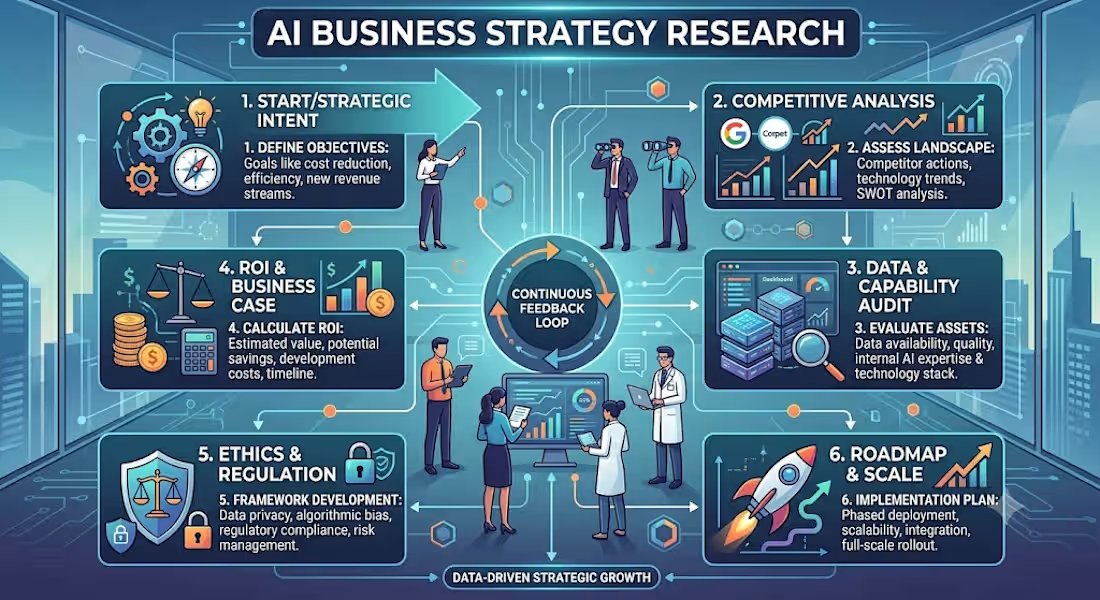
AI Business Strategy Research investigates how businesses can best leverage Artificial Intelligence (AI) to create a competitive advantage and achieve their long-term goals. Here is a breakdown of the key elements typically involved in such a project:
Strategic Intent and Opportunity Identification: This phase defines the overall goals of the AI initiatives. For example, is the primary objective to reduce costs, enhance customer experiences, or create an entirely new AI-powered product line?
Competitive Landscape and Industry Benchmarking: Research is conducted to understand how competitors are deploying AI. This benchmarking reveals best practices, potential "blue ocean" opportunities where competitors are absent, and potential threats to existing business models.
Technological and Organizational Capability Assessment: The project assesses the company's existing capabilities. It asks, "Do we have the data quality and quantity, the technical talent, and the computational infrastructure required?" It also includes an evaluation of the current organizational culture to gauge its readiness for an AI-driven transformation.
Business Case Development and ROI Forecasting: This phase moves from concepts to calculations. It involves creating detailed financial models to project the return on investment (ROI) for specific AI projects. This includes estimating both direct and indirect costs and benefits, like improved operational efficiency and customer lifetime value.
Ethical, Legal, and Governance Frameworks: AI involves critical data and algorithmic considerations. Research defines clear policies for data privacy, algorithmic fairness (to avoid bias), transparency, and regulatory compliance (e.g., GDPR, CCPA).
Implementation and Scale-Up Strategy: Finally, the research produces a phased deployment roadmap. This strategy outlines how to move from a pilot or proof-of-concept (PoC) to full-scale, production-ready implementation, ensuring the solution scales efficiently.

Starting at$30 /hr
Tags
Researcher
AI Business Strategy
Governance Frameworks
Industry Benchmarking
Opportunity Identification
Organizational Capability Assessment
ROI Forecasting
Scale-Up Strategy
Service provided by
Faisal Bhatti Faisalabad, Pakistan
AI Business Strategy ResearchFaisal Bhatti
Starting at$30 /hr
Tags
Researcher
AI Business Strategy
Governance Frameworks
Industry Benchmarking
Opportunity Identification
Organizational Capability Assessment
ROI Forecasting
Scale-Up Strategy
AI Business Strategy Research
AI Business Strategy Research investigates how businesses can best leverage Artificial Intelligence (AI) to create a competitive advantage and achieve their long-term goals. Here is a breakdown of the key elements typically involved in such a project:
Strategic Intent and Opportunity Identification: This phase defines the overall goals of the AI initiatives. For example, is the primary objective to reduce costs, enhance customer experiences, or create an entirely new AI-powered product line?
Competitive Landscape and Industry Benchmarking: Research is conducted to understand how competitors are deploying AI. This benchmarking reveals best practices, potential "blue ocean" opportunities where competitors are absent, and potential threats to existing business models.
Technological and Organizational Capability Assessment: The project assesses the company's existing capabilities. It asks, "Do we have the data quality and quantity, the technical talent, and the computational infrastructure required?" It also includes an evaluation of the current organizational culture to gauge its readiness for an AI-driven transformation.
Business Case Development and ROI Forecasting: This phase moves from concepts to calculations. It involves creating detailed financial models to project the return on investment (ROI) for specific AI projects. This includes estimating both direct and indirect costs and benefits, like improved operational efficiency and customer lifetime value.
Ethical, Legal, and Governance Frameworks: AI involves critical data and algorithmic considerations. Research defines clear policies for data privacy, algorithmic fairness (to avoid bias), transparency, and regulatory compliance (e.g., GDPR, CCPA).
Implementation and Scale-Up Strategy: Finally, the research produces a phased deployment roadmap. This strategy outlines how to move from a pilot or proof-of-concept (PoC) to full-scale, production-ready implementation, ensuring the solution scales efficiently.
$30 /hr