Digital Performance Upgrade by Matthew DixDigital Performance Upgrade by Matthew Dix
Digital Performance UpgradeMatthew Dix
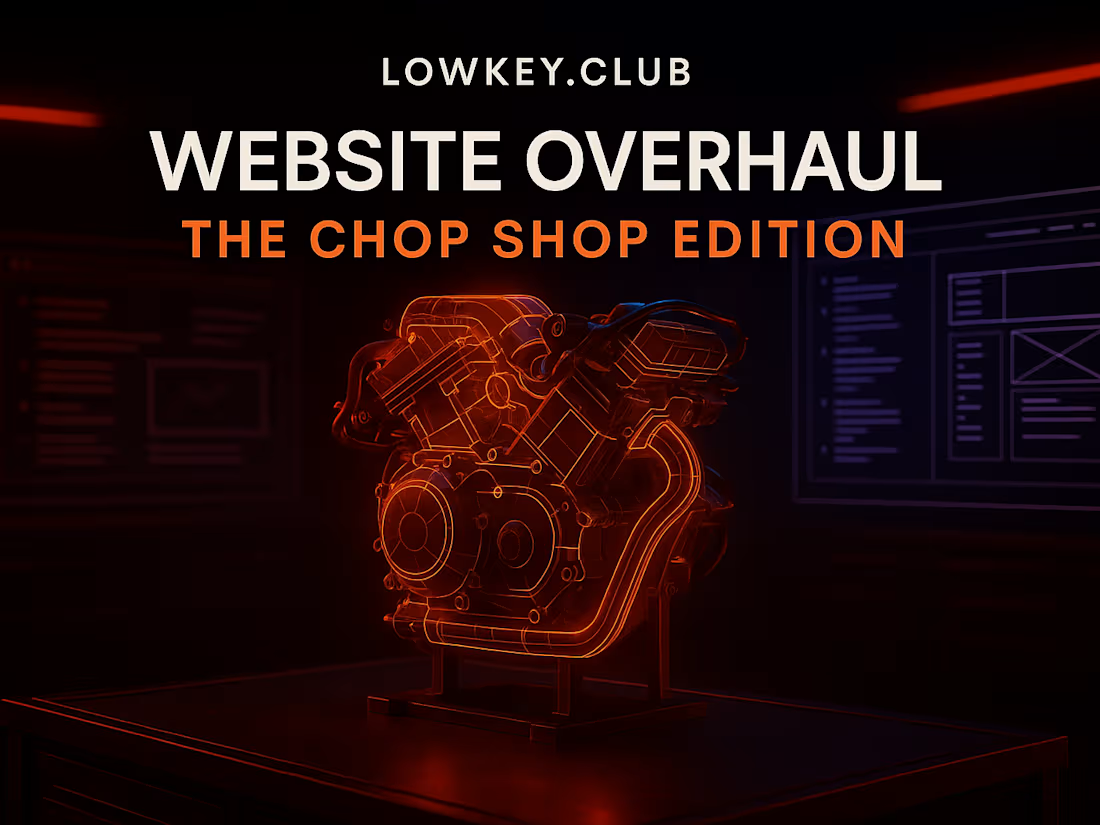
Cover image for Digital Performance Upgrade
A complete brand, website and launch-system upgrade for founders and ambitious businesses.
The Digital Performance Upgrade (DPU) transforms an outdated, fragmented or underperforming digital presence into a coherent, distinctive and production-ready system.
It combines brand refinement, messaging, generative visual exploration, live AI-assisted prototyping, responsive interface design, motion and implementation planning.
The result is not simply a new website. It is a stronger digital operating system for the business, designed to improve credibility, clarity, memorability and conversion.

How it works

Modern websites are created by intelligently combining different methods, tools and technologies. This service is built around your specific business, not an off-the-shelf website package. The scope is based on the required user journeys, content structure and highest-priority public-facing experience, not a fixed number of pages.

1. Audit and performance diagnosis

Review the existing website, brand materials, business goals, target audiences, competitors and current technical setup. Identify what is weakening the digital presence: unclear messaging, inconsistent branding, poor hierarchy, weak conversion journeys, dated visuals, limited responsiveness or unsuitable technology.

2. Strategy and architecture

Define the website's role, audience journeys, sitemap, content hierarchy and conversion priorities. Establish a clear strategic direction before visual production begins.

3. Brand-system upgrade

Refine the core ingredients required for a distinctive digital presence: typography, colour, imagery, graphic devices, iconography, interface styling and key messaging. Existing logos or brand elements may be cleaned up, traced or recreated as usable vector assets where necessary.

4. Generative visual exploration

Use directed ChatGPT and image-generation workflows to explore art direction, branded compositions, campaign-style imagery, interface concepts and visual storytelling. These outputs are treated as creative material that is selected, edited and refined, not as generic AI-generated design.

5. Live browser prototyping

Combine the approved strategy, references, content structure and brand-system seed inside Lovable or another appropriate AI-assisted production environment. This creates an early working version of the website in the browser, allowing layout, messaging, responsive behaviour and interaction ideas to be evaluated faster than through static screens alone.

6. Motion and interaction

Identify a focused set of high-impact motion opportunities. These may include an animated hero, layered brand graphics, scroll transitions, hover behaviour, interface demonstrations, number counters or lightweight product storytelling. Motion improves clarity, hierarchy and memorability. It is not added as decoration to every section.

7. Figma systemisation and refinement

Reverse-engineer the strongest live direction into a structured Figma design system. Rebuild and refine the interface using reusable components, variables, layers and Auto Layout. Fine-tune typography, spacing, hierarchy, interaction states and responsive behaviour across desktop, tablet and mobile viewports.

8. Prototype and testing

Create a clickable prototype where appropriate. Test the most important audience journeys, calls to action and responsive layouts before implementation.

9. Production and code alignment

Prepare the final direction for implementation through the most appropriate production route. This may include Lovable, Framer, Webflow, Wix Studio, Squarespace, Sitejet, another low-code platform or a custom React or Next.js build.
I can lead the implementation or provide a development-aligned Figma system, production assets, responsive guidance and motion direction for an internal or external developer.

Scope and pricing

The starting price is $2,500 with an indicative duration of three weeks. Larger websites, complex integrations, CMS migrations, advanced motion, custom software development, extensive copywriting or significant content production will be scoped separately.
FAQs

Starting at$2,500
Duration5 weeks
Tags
Figma
Framer
Lovable
Webflow

Brand Designer
Motion Designer
Responsive Design
UI Designer
Web Designer
Service provided by
Matthew Dix proJohannesburg, South Africa
$1k+
Earned
2
Paid projects
5.00
Rating
199
Followers
Digital Performance UpgradeMatthew Dix
Starting at$2,500
Duration5 weeks
Tags
Figma
Framer
Lovable
Webflow
Brand Designer
Motion Designer
Responsive Design
UI Designer
Web Designer
Cover image for Digital Performance Upgrade
A complete brand, website and launch-system upgrade for founders and ambitious businesses.
The Digital Performance Upgrade (DPU) transforms an outdated, fragmented or underperforming digital presence into a coherent, distinctive and production-ready system.
It combines brand refinement, messaging, generative visual exploration, live AI-assisted prototyping, responsive interface design, motion and implementation planning.
The result is not simply a new website. It is a stronger digital operating system for the business, designed to improve credibility, clarity, memorability and conversion.

How it works

Modern websites are created by intelligently combining different methods, tools and technologies. This service is built around your specific business, not an off-the-shelf website package. The scope is based on the required user journeys, content structure and highest-priority public-facing experience, not a fixed number of pages.

1. Audit and performance diagnosis

Review the existing website, brand materials, business goals, target audiences, competitors and current technical setup. Identify what is weakening the digital presence: unclear messaging, inconsistent branding, poor hierarchy, weak conversion journeys, dated visuals, limited responsiveness or unsuitable technology.

2. Strategy and architecture

Define the website's role, audience journeys, sitemap, content hierarchy and conversion priorities. Establish a clear strategic direction before visual production begins.

3. Brand-system upgrade

Refine the core ingredients required for a distinctive digital presence: typography, colour, imagery, graphic devices, iconography, interface styling and key messaging. Existing logos or brand elements may be cleaned up, traced or recreated as usable vector assets where necessary.

4. Generative visual exploration

Use directed ChatGPT and image-generation workflows to explore art direction, branded compositions, campaign-style imagery, interface concepts and visual storytelling. These outputs are treated as creative material that is selected, edited and refined, not as generic AI-generated design.

5. Live browser prototyping

Combine the approved strategy, references, content structure and brand-system seed inside Lovable or another appropriate AI-assisted production environment. This creates an early working version of the website in the browser, allowing layout, messaging, responsive behaviour and interaction ideas to be evaluated faster than through static screens alone.

6. Motion and interaction

Identify a focused set of high-impact motion opportunities. These may include an animated hero, layered brand graphics, scroll transitions, hover behaviour, interface demonstrations, number counters or lightweight product storytelling. Motion improves clarity, hierarchy and memorability. It is not added as decoration to every section.

7. Figma systemisation and refinement

Reverse-engineer the strongest live direction into a structured Figma design system. Rebuild and refine the interface using reusable components, variables, layers and Auto Layout. Fine-tune typography, spacing, hierarchy, interaction states and responsive behaviour across desktop, tablet and mobile viewports.

8. Prototype and testing

Create a clickable prototype where appropriate. Test the most important audience journeys, calls to action and responsive layouts before implementation.

9. Production and code alignment

Prepare the final direction for implementation through the most appropriate production route. This may include Lovable, Framer, Webflow, Wix Studio, Squarespace, Sitejet, another low-code platform or a custom React or Next.js build.
I can lead the implementation or provide a development-aligned Figma system, production assets, responsive guidance and motion direction for an internal or external developer.

Scope and pricing

The starting price is $2,500 with an indicative duration of three weeks. Larger websites, complex integrations, CMS migrations, advanced motion, custom software development, extensive copywriting or significant content production will be scoped separately.
FAQs

$2,500