
Multi-Page Framer WebsiteArtis Lutkovskis
Website Design & Development
Your website is your brand's home base on the internet. It's where someone goes after seeing your ad, hearing your name on a podcast, or reading your founder's post. In the first 60 seconds they decide whether you're worth their attention, or they leave and you never know they were there.
A bad website doesn't just lose visitors. It quietly undermines every other piece of marketing you do. Your ads work harder, your sales team explains more, your founder repeats the same pitch in every call. A good website does that work for you, 24/7.
What makes this different
Most agency websites are designed page by page. Each one looks fine on its own, but together they feel like a folder of unrelated PDFs. I design websites as a system: one visual language, one tone of voice, one navigation logic across every page.
In practice, that means:
The homepage answers "Who are you and why should I care?" before introducing anything else.
Every page after that has one job, and every page knows what the others are doing.
The CMS is built so your team can update content without breaking the design.
The structure is set up so adding a new page in 6 months still feels native, not bolted on.
The result is a website that grows with you, instead of one you'll want to redo in 18 months.
Who this is for
Companies that have outgrown their current site and need something that matches where the business is now
Founders who want a website that builds trust on its own, without a sales call attached
Teams that want a real CMS, one they actually use and aren't scared to touch
What's included
Discovery & strategy. Before anything visual, we get clarity on what the site needs to do, who it's for, what content it needs, and which pages actually earn their place. This cuts the scope before it grows.
Sitemap & wireframes. A clear map of every page and how they connect. We agree on structure before pixels, which is where most projects waste two weeks.
Brand-aligned visual design in Figma. Full UI design across all pages, desktop and mobile. Typography, color, components, and visual direction defined as a system rather than page by page. Two rounds of revisions included.
Framer development. Pixel-tight build using reusable components, so editing one piece updates everywhere it's used. Your designer or marketer can adjust copy and layout without calling a developer. One round of revisions included.
CMS setup. Configured for the content you actually publish: blog posts, case studies, team members, careers, resources, whatever applies. Your team gets a CMS that feels like a tool, not an obstacle.
Performance optimization. Your site loads before the visitor loses patience, which on mobile is about 3 seconds. Lazy loading, compressed images, optimized fonts, clean code.
Technical SEO. Meta tags, Open Graph images, semantic structure, sitemap.xml, robots.txt. Your pages look right when shared, and Google understands what each one is about.
Light & dark mode (optional). If your brand uses both, components and media are set up to switch cleanly between them.
Integrations. Analytics (GA4, Plausible, PostHog), forms (Tally, Typeform, native), CRM and newsletter (HubSpot, Mailchimp, ConvertKit), calendar embeds, chat. Whatever your stack needs.
QA & launch. Cross-device testing on real devices, fixes, domain connection, redirect mapping from your old site if there is one.
Handoff. Framer access transferred to you, a walkthrough video on the design system and CMS, and a written guide so anyone on your team can update content later.
Three weeks of post-launch support. I fix any bugs, adjust copy and layouts on request, and help your team get comfortable inside Framer.
Process & timeline
Week 1. Discovery, strategy, sitemap, wireframes.
Week 2-3. Visual design in Figma, page by page, with revision rounds.
Week 4-5. Framer build, CMS setup, responsive layouts.
Week 6. Integrations, performance, SEO, QA, launch, handoff.
FAQs
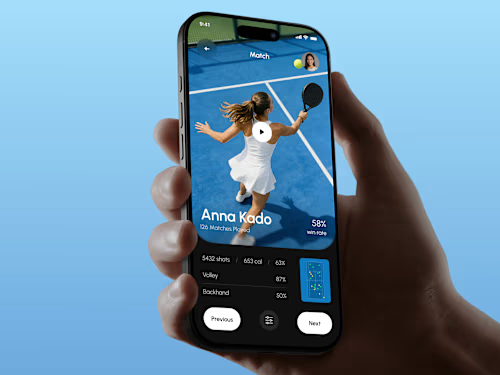
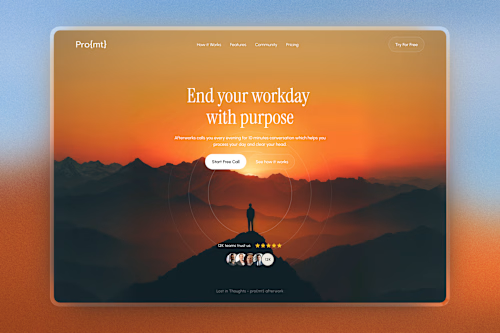
Example work

Starting at$7,999
Duration6 weeks
Tags
Figma

Framer

Framer Designer
Framer Developer
UI Designer
UX Designer
Web Designer
Service provided by
Artis Lutkovskis proRiga, Latvia
- 5.00
- Rating
- 9
- Followers
Multi-Page Framer WebsiteArtis Lutkovskis
Starting at$7,999
Duration6 weeks
Tags
Figma
Framer
Framer Designer
Framer Developer
UI Designer
UX Designer
Web Designer
Website Design & Development
Your website is your brand's home base on the internet. It's where someone goes after seeing your ad, hearing your name on a podcast, or reading your founder's post. In the first 60 seconds they decide whether you're worth their attention, or they leave and you never know they were there.
A bad website doesn't just lose visitors. It quietly undermines every other piece of marketing you do. Your ads work harder, your sales team explains more, your founder repeats the same pitch in every call. A good website does that work for you, 24/7.
What makes this different
Most agency websites are designed page by page. Each one looks fine on its own, but together they feel like a folder of unrelated PDFs. I design websites as a system: one visual language, one tone of voice, one navigation logic across every page.
In practice, that means:
The homepage answers "Who are you and why should I care?" before introducing anything else.
Every page after that has one job, and every page knows what the others are doing.
The CMS is built so your team can update content without breaking the design.
The structure is set up so adding a new page in 6 months still feels native, not bolted on.
The result is a website that grows with you, instead of one you'll want to redo in 18 months.
Who this is for
Companies that have outgrown their current site and need something that matches where the business is now
Founders who want a website that builds trust on its own, without a sales call attached
Teams that want a real CMS, one they actually use and aren't scared to touch
What's included
Discovery & strategy. Before anything visual, we get clarity on what the site needs to do, who it's for, what content it needs, and which pages actually earn their place. This cuts the scope before it grows.
Sitemap & wireframes. A clear map of every page and how they connect. We agree on structure before pixels, which is where most projects waste two weeks.
Brand-aligned visual design in Figma. Full UI design across all pages, desktop and mobile. Typography, color, components, and visual direction defined as a system rather than page by page. Two rounds of revisions included.
Framer development. Pixel-tight build using reusable components, so editing one piece updates everywhere it's used. Your designer or marketer can adjust copy and layout without calling a developer. One round of revisions included.
CMS setup. Configured for the content you actually publish: blog posts, case studies, team members, careers, resources, whatever applies. Your team gets a CMS that feels like a tool, not an obstacle.
Performance optimization. Your site loads before the visitor loses patience, which on mobile is about 3 seconds. Lazy loading, compressed images, optimized fonts, clean code.
Technical SEO. Meta tags, Open Graph images, semantic structure, sitemap.xml, robots.txt. Your pages look right when shared, and Google understands what each one is about.
Light & dark mode (optional). If your brand uses both, components and media are set up to switch cleanly between them.
Integrations. Analytics (GA4, Plausible, PostHog), forms (Tally, Typeform, native), CRM and newsletter (HubSpot, Mailchimp, ConvertKit), calendar embeds, chat. Whatever your stack needs.
QA & launch. Cross-device testing on real devices, fixes, domain connection, redirect mapping from your old site if there is one.
Handoff. Framer access transferred to you, a walkthrough video on the design system and CMS, and a written guide so anyone on your team can update content later.
Three weeks of post-launch support. I fix any bugs, adjust copy and layouts on request, and help your team get comfortable inside Framer.
Process & timeline
Week 1. Discovery, strategy, sitemap, wireframes.
Week 2-3. Visual design in Figma, page by page, with revision rounds.
Week 4-5. Framer build, CMS setup, responsive layouts.
Week 6. Integrations, performance, SEO, QA, launch, handoff.
FAQs
Example work
$7,999