
DevSecOps Audit — Cloud, Pipeline & Kubernetes Review Adil Shahzad
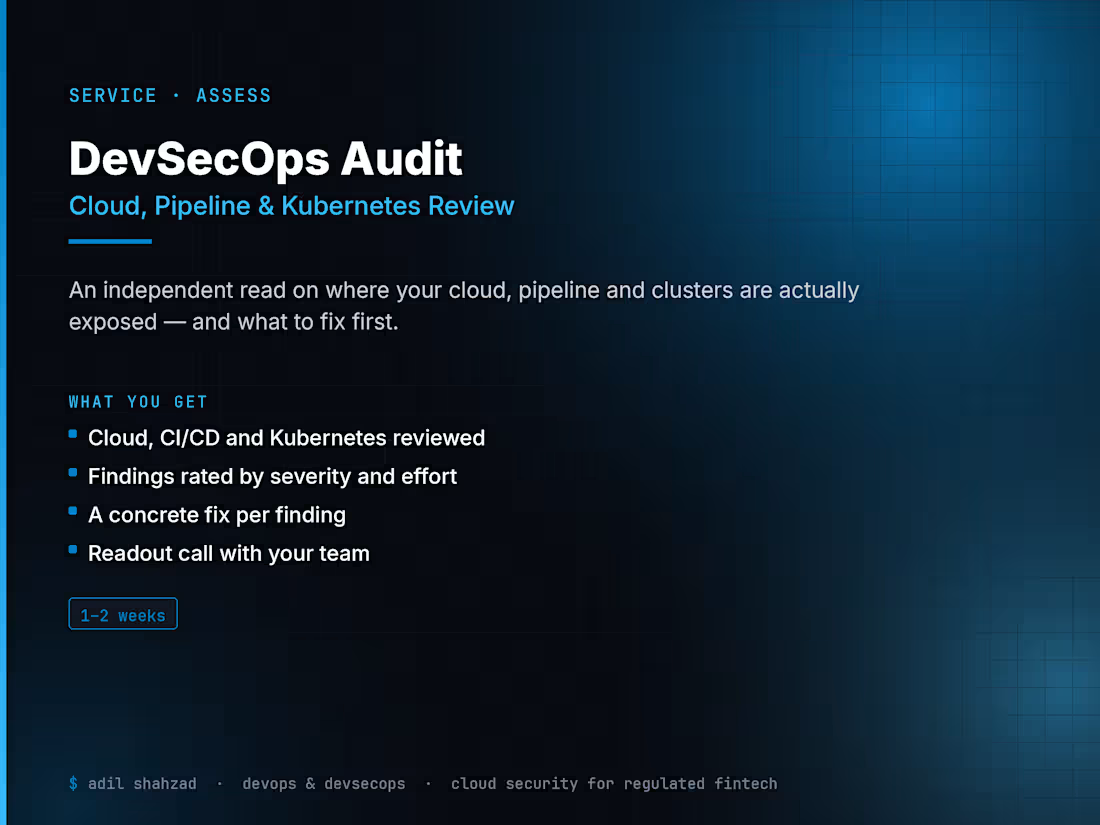
Most teams have scanning that reports and nothing that blocks, clusters nobody outside the team has ever reviewed, and cloud permissions that grew faster than anyone tracked. This finds all three before a customer questionnaire or an auditor does.
How it works
Read-only access across the cloud accounts, repositories and clusters in scope.
Structured review across three layers — cloud posture (identity and access, network exposure, encryption, logging), delivery pipeline (supply chain, scanning, secrets, permissions), and Kubernetes (RBAC, network policy, resource limits, ingress).
Every finding written up with severity, effort, and a specific remediation step.
Readout call to walk your team through it and agree the sequence.
What you get
Findings report — Severity-rated, with the reasoning behind each call. Written for engineers and readable by someone who isn't one.
Remediation roadmap — Prioritised and sequenced, with effort estimates so you can plan around it.
Evidence notes — What you can hand to a customer or an auditor who asks.
Readout call — Walk-through, questions, and agreement on what happens next.
What I need from you to start
Read-only access to the cloud accounts, repositories and clusters in scope
An architecture diagram if one exists — no problem if not
Any compliance framework you're measured against
Handover is always included. You keep the code, the documentation and the runbooks —
the point is that your team can operate this without me.
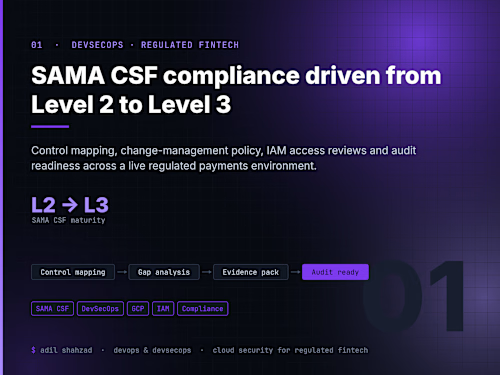
I work across GCP, AWS and Azure, and most of my recent work has been in regulated
fintech, so compliance-shaped requirements (SAMA CSF, PCI-DSS, SOC 2, ISO 27001) are
familiar rather than an add-on.
FAQs
Contact for pricing
Duration1 week
Tags
AWS
Google Cloud Platform

Kubernetes
Cloud Security Engineer
DevSecOps
Service provided by
Adil Shahzad proLahore, Pakistan
- 5
- Followers
DevSecOps Audit — Cloud, Pipeline & Kubernetes Review Adil Shahzad
Contact for pricing
Duration1 week
Tags
AWS
Google Cloud Platform
Kubernetes
Cloud Security Engineer
DevSecOps
Most teams have scanning that reports and nothing that blocks, clusters nobody outside the team has ever reviewed, and cloud permissions that grew faster than anyone tracked. This finds all three before a customer questionnaire or an auditor does.
How it works
Read-only access across the cloud accounts, repositories and clusters in scope.
Structured review across three layers — cloud posture (identity and access, network exposure, encryption, logging), delivery pipeline (supply chain, scanning, secrets, permissions), and Kubernetes (RBAC, network policy, resource limits, ingress).
Every finding written up with severity, effort, and a specific remediation step.
Readout call to walk your team through it and agree the sequence.
What you get
Findings report — Severity-rated, with the reasoning behind each call. Written for engineers and readable by someone who isn't one.
Remediation roadmap — Prioritised and sequenced, with effort estimates so you can plan around it.
Evidence notes — What you can hand to a customer or an auditor who asks.
Readout call — Walk-through, questions, and agreement on what happens next.
What I need from you to start
Read-only access to the cloud accounts, repositories and clusters in scope
An architecture diagram if one exists — no problem if not
Any compliance framework you're measured against
Handover is always included. You keep the code, the documentation and the runbooks —
the point is that your team can operate this without me.
I work across GCP, AWS and Azure, and most of my recent work has been in regulated
fintech, so compliance-shaped requirements (SAMA CSF, PCI-DSS, SOC 2, ISO 27001) are
familiar rather than an add-on.
FAQs
Contact for pricing