BIG Social Media Data Gathering & Insights by Matthew WoodBIG Social Media Data Gathering & Insights by Matthew Wood
BIG Social Media Data Gathering & InsightsMatthew Wood
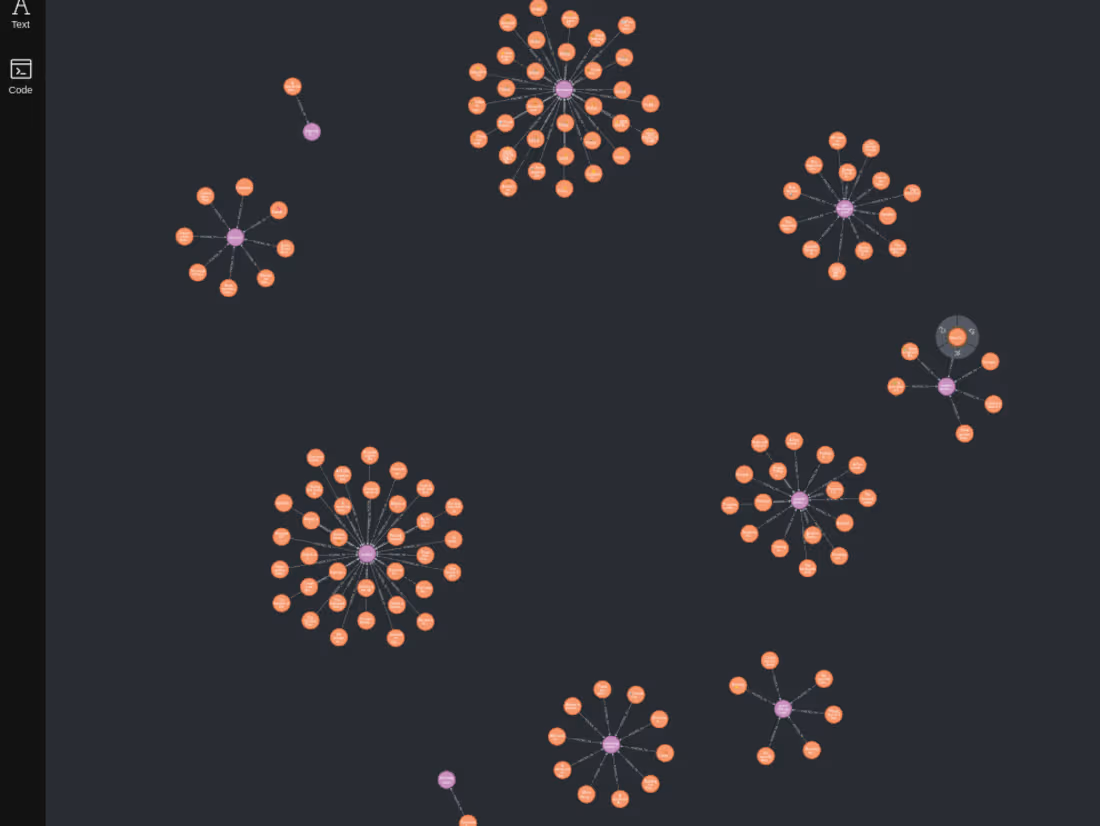
Integrating big data with Neo4j, a robust graph database, enables rapid access to powerful insights through Cypher Queries, facilitating both comprehensive data collection and continuous updating.
Standardized query presets allow for ongoing monitoring of market trends, competitors, and fresh lead generation, ensuring data relevance and adaptability to market dynamics.
Additionally, integrating AI with these databases enhances predictive capabilities, foreseeing future trends and connections within the data.
FAQs
This query is frequently posed, and there are two primary reasons for our approach:
1. Alignment with Social Media Platform Algorithms
Social media platforms prioritize showcasing fresh content! The content you encounter is typically trending and is constantly being updated and posted in myriad ways by a diverse user base. Our empirical testing revealed that when we delve deeply into information, the quality diminishes rapidly.
The content displayed on our feeds is tailored by sophisticated algorithms to match our search criteria. For instance, if we're seeking active leads for people with damaged roofs, we need up-to-date data. Digging deeper often leads to finding outdated or irrelevant content, such as people who have already repaired their roofs, which contradicts the algorithm's intent.
2. Compliance with Terms of Service
Social media platforms, like other websites, strive to prevent aggressive bot behavior. Actions such as scraping thousands of leads in a specific industry by following a routine pattern (Search → Find page → Gather Information → Repeat) are not typical human activities.
Websites may implement subtle countermeasures to obstruct or contaminate large-scale data scraping. These can range from outright user restrictions, captchas, to more covert tactics like hiding, moving, or corrupting data. Such measures can significantly slow down the process or even jeopardize its success, making adherence to these terms critical for efficient and ethical data collection.
Neo4j is an advanced graph database management system developed by Neo4j, Inc. It manages data through nodes, edges that connect these nodes, and attributes associated with both nodes and edges.
In simpler terms, Neo4j is a highly capable and user-friendly graph database, equipped with its own specialized query language, Cypher Queries. This feature enables the creation of custom query presets, facilitating the organization, sorting, filtering, visualization, and exporting of data in an efficient manner.
Furthermore, the system's capabilities extend to integrating sophisticated AI tools. These tools can navigate the database, offering predictive analytics based on existing data patterns.
Envision a scenario where your company harvests all the peripheral posts related to your industry, based on user interactions. Not only can AI be integrated to decode the underlying patterns or 'secret formula' of these interactions, but it can also forecast future trends and posts. This predictive ability allows your company to proactively adapt and enhance your content strategy, staying ahead in the dynamic landscape of your industry.
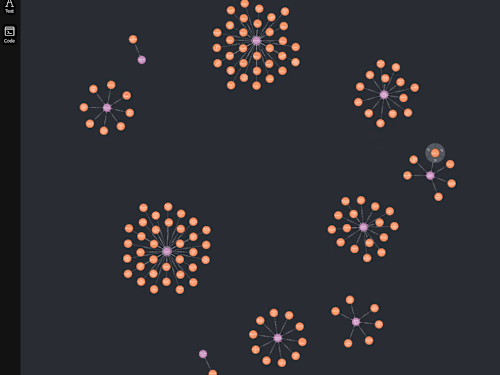
A Graph Database represents a novel, highly intuitive, and visually engaging approach to data management, structured around the concepts of "Nodes" and "Edges".
Picture sketching a workflow on a board: the "Nodes" symbolize distinct points or thoughts, while the "Edges" are the lines that link these points, illustrating the relationships between them. This is the essence of how a graph database operates. It mirrors this natural, human-centric way of organizing and connecting ideas, translating it into a digital format that makes complex data relationships easier to understand and navigate.
This visual and relational structure makes graph databases particularly effective for analyzing interconnected data and uncovering insights that might be less apparent in traditional database formats.
Integrating big data with Neo4j, a robust graph database, enables rapid access to powerful insights through Cypher Queries, facilitating both comprehensive data collection and continuous updating.
Standardized query presets allow for ongoing monitoring of market trends, competitors, and fresh lead generation, ensuring data relevance and adaptability to market dynamics.
Additionally, integrating AI with these databases enhances predictive capabilities, foreseeing future trends and connections within the data.
FAQs
This query is frequently posed, and there are two primary reasons for our approach:
1. Alignment with Social Media Platform Algorithms
Social media platforms prioritize showcasing fresh content! The content you encounter is typically trending and is constantly being updated and posted in myriad ways by a diverse user base. Our empirical testing revealed that when we delve deeply into information, the quality diminishes rapidly.
The content displayed on our feeds is tailored by sophisticated algorithms to match our search criteria. For instance, if we're seeking active leads for people with damaged roofs, we need up-to-date data. Digging deeper often leads to finding outdated or irrelevant content, such as people who have already repaired their roofs, which contradicts the algorithm's intent.
2. Compliance with Terms of Service
Social media platforms, like other websites, strive to prevent aggressive bot behavior. Actions such as scraping thousands of leads in a specific industry by following a routine pattern (Search → Find page → Gather Information → Repeat) are not typical human activities.
Websites may implement subtle countermeasures to obstruct or contaminate large-scale data scraping. These can range from outright user restrictions, captchas, to more covert tactics like hiding, moving, or corrupting data. Such measures can significantly slow down the process or even jeopardize its success, making adherence to these terms critical for efficient and ethical data collection.
Neo4j is an advanced graph database management system developed by Neo4j, Inc. It manages data through nodes, edges that connect these nodes, and attributes associated with both nodes and edges.
In simpler terms, Neo4j is a highly capable and user-friendly graph database, equipped with its own specialized query language, Cypher Queries. This feature enables the creation of custom query presets, facilitating the organization, sorting, filtering, visualization, and exporting of data in an efficient manner.
Furthermore, the system's capabilities extend to integrating sophisticated AI tools. These tools can navigate the database, offering predictive analytics based on existing data patterns.
Envision a scenario where your company harvests all the peripheral posts related to your industry, based on user interactions. Not only can AI be integrated to decode the underlying patterns or 'secret formula' of these interactions, but it can also forecast future trends and posts. This predictive ability allows your company to proactively adapt and enhance your content strategy, staying ahead in the dynamic landscape of your industry.
A Graph Database represents a novel, highly intuitive, and visually engaging approach to data management, structured around the concepts of "Nodes" and "Edges".
Picture sketching a workflow on a board: the "Nodes" symbolize distinct points or thoughts, while the "Edges" are the lines that link these points, illustrating the relationships between them. This is the essence of how a graph database operates. It mirrors this natural, human-centric way of organizing and connecting ideas, translating it into a digital format that makes complex data relationships easier to understand and navigate.
This visual and relational structure makes graph databases particularly effective for analyzing interconnected data and uncovering insights that might be less apparent in traditional database formats.