
Kotlin Multiplatform migration — one codebase, both storesMohsin Ali
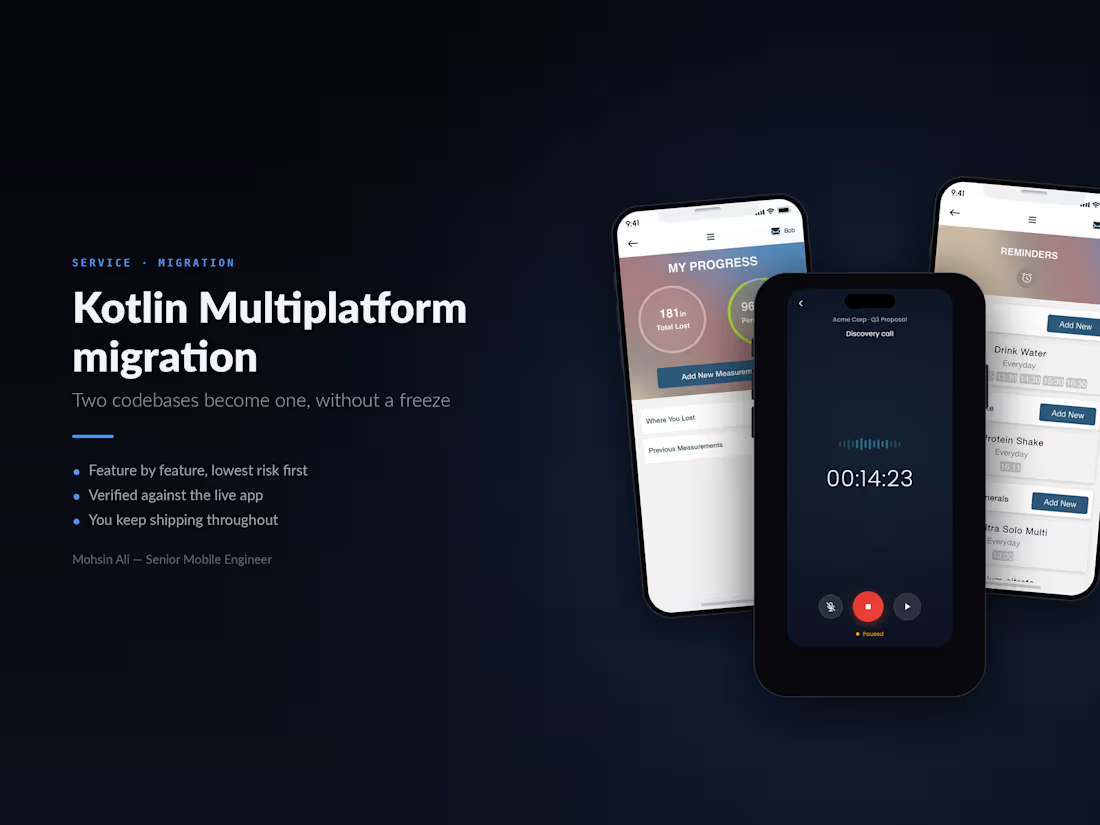
Two apps. Two teams. Every feature built twice, released twice, and broken twice in slightly different ways. If that’s your situation, this is the service.
I move your existing Android and iOS apps onto a single Kotlin Multiplatform codebase — incrementally, with the live apps still shipping the whole time.
How it’s done safely
Feature by feature, lowest risk first. Nothing is migrated in one jump and nothing is rewritten for its own sake
Each migrated feature is verified against the behaviour of the live app, not the spec. An app that’s been running for years does things nobody ever wrote down, and the spec is exactly where those things go missing
Platform-specific work — audio, Bluetooth, background services, permissions — stays native underneath a shared interface. That’s why the shared layer stays honest instead of sinking to the lowest common denominator
Your release cadence continues throughout. There is no freeze
What you end up with
One codebase. One set of bugs. Features that land on both platforms on the same day. And the same product your users already know, with nothing they relied on quietly changed.
What it costs
Driven by how many screens exist, how much platform-specific behaviour is buried in them, and how much of the current code has tests. Send me both repositories and I’ll tell you honestly whether migrating is worth it for you. Sometimes it isn’t — and I’d rather say that at the start than halfway through.
FAQs
Contact for pricing
Duration1 week
Tags
Kotlin

Swift

SwiftUI
Android Developer
iOS Developer
Mobile Engineer
Technical Writer
Service provided by
Mohsin Ali Lahore, Pakistan
Kotlin Multiplatform migration — one codebase, both storesMohsin Ali
Contact for pricing
Duration1 week
Tags
Kotlin
Swift
SwiftUI
Android Developer
iOS Developer
Mobile Engineer
Technical Writer
Two apps. Two teams. Every feature built twice, released twice, and broken twice in slightly different ways. If that’s your situation, this is the service.
I move your existing Android and iOS apps onto a single Kotlin Multiplatform codebase — incrementally, with the live apps still shipping the whole time.
How it’s done safely
Feature by feature, lowest risk first. Nothing is migrated in one jump and nothing is rewritten for its own sake
Each migrated feature is verified against the behaviour of the live app, not the spec. An app that’s been running for years does things nobody ever wrote down, and the spec is exactly where those things go missing
Platform-specific work — audio, Bluetooth, background services, permissions — stays native underneath a shared interface. That’s why the shared layer stays honest instead of sinking to the lowest common denominator
Your release cadence continues throughout. There is no freeze
What you end up with
One codebase. One set of bugs. Features that land on both platforms on the same day. And the same product your users already know, with nothing they relied on quietly changed.
What it costs
Driven by how many screens exist, how much platform-specific behaviour is buried in them, and how much of the current code has tests. Send me both repositories and I’ll tell you honestly whether migrating is worth it for you. Sometimes it isn’t — and I’d rather say that at the start than halfway through.
FAQs
Contact for pricing