
Multi-Modal Authentication & Intelligent Threat DetectionAjay Bidyarthy
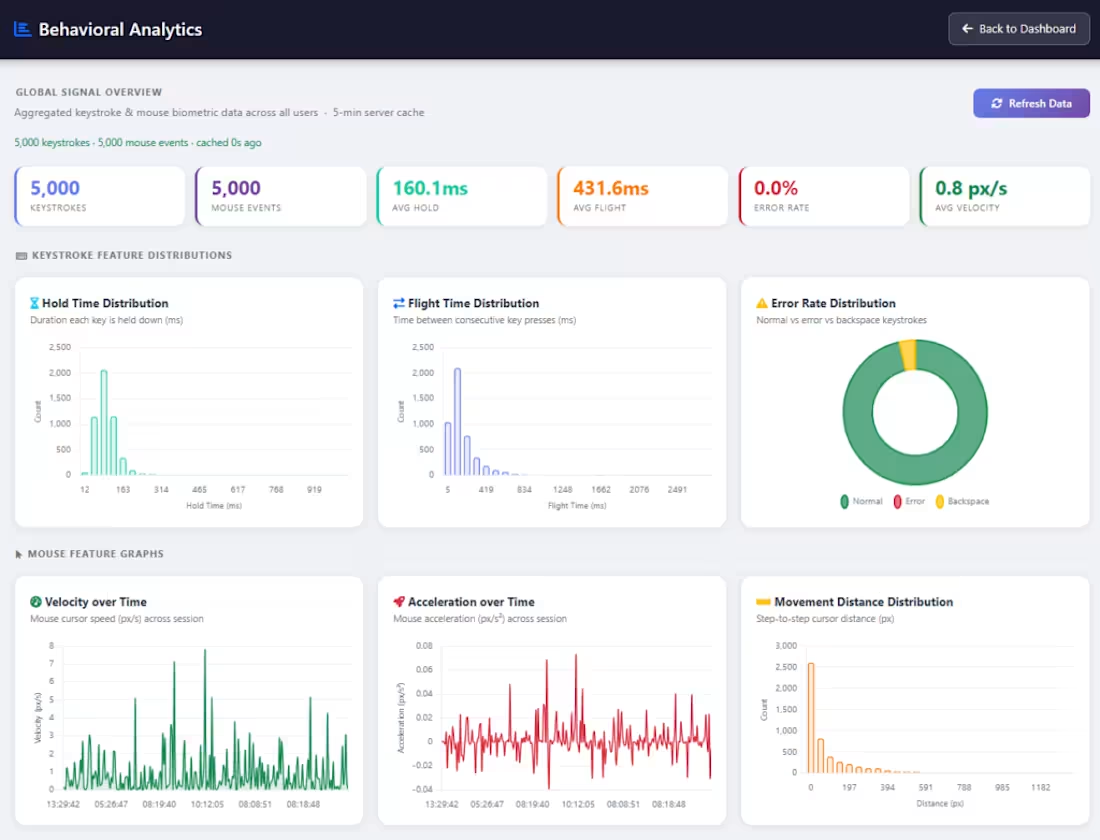
The client operates in the secure communications domain, offering real-time messaging services for organizations that require strong identity verification and protection against insider threats and cyber attacks. Their existing system relied on traditional login-based authentication, which was insufficient for continuous identity assurance and real-time threat detection.
The Problem
The client faced several critical challenges:
Session Hijacking Risk: Once logged in, there was no continuous verification of the user.
Insider Threats: Unauthorized users could misuse active sessions.
Weak Behavioral Security: No use of behavioral biometrics like typing or mouse patterns.
Lack of Voice Verification: Voice messages could not be authenticated.
Spam & Attack Vulnerability: Group chats were exposed to spam and malicious traffic.
No Real-time Threat Detection: Network-level anomalies were not monitored effectively.
This created a gap between authentication and actual user behavior, increasing security risks.
Our Solution
We developed a multi-modal security platform combining:
1. Continuous Biometric Authentication
Keystroke dynamics (typing behavior)
Mouse movement patterns
Real-time identity verification using BiLSTM models
2. Voice Authentication System
Speaker verification using ECAPA-TDNN embeddings
Automatic enrollment and similarity-based validation
3. Real-Time Chat System
WebSocket-based communication
Integrated authentication checks during active sessions
4. Network Intrusion Detection System (NIDS)
Hybrid model:
Random Forest (known attacks)
Isolation Forest (unknown anomalies)
Real-time monitoring and alerting
5. Adaptive Learning System
Models retrain automatically using new behavioral data
Improves accuracy over time without manual intervention
Solution Architecture
The system follows a multi-layered architecture:
Frontend Layer
Captures keystroke, mouse, and voice data
Sends batched behavioral data to backend
Backend Layer (FastAPI)
Handles authentication, chat, and processing
Runs behavioral verification models
Manages user sessions and strike logic
ML Layer
BiLSTM models for behavioral authentication
ECAPA-TDNN for voice embeddings
Ensemble ML models for intrusion detection
Data Layer
PostgreSQL for behavioral data
SQLite for chat and messages
Real-time Communication
WebSockets for instant updates and alerts
Deliverables
Secure real-time chat application
Continuous authentication system
Voice verification module
Network intrusion detection dashboard
Adaptive ML training pipeline
Admin dashboards and analytics
Tech Stack
Framework used
FastAPI, Flask, SocketIO
Language/techniques used
Python, JavaScript, HTML/CSS
Models used
Bidirectional LSTM (behavioral biometrics)
ECAPA-TDNN (voice recognition)
Random Forest + Isolation Forest (NIDS)
Skills used
Machine Learning
Deep Learning
Real-time systems design
Cybersecurity engineering
Databases used
PostgreSQL, SQLite
Web Cloud Servers used
Uvicorn (ASGI server), Flask server for NIDS
What are the technical Challenges Faced during Project Execution
Real-time processing of behavioral data without latency
Designing accurate biometric models with limited user data
Handling asynchronous voice processing
Avoiding false positives in authentication
Integrating multiple ML models into a single pipeline
Ensuring scalability for concurrent users
How the Technical Challenges were Solved
Implemented batch processing for keystroke and mouse events
Used BiLSTM models for sequence learning and better accuracy
Introduced adaptive retraining pipelines
Applied threshold-based decision fusion (70% keystroke, 30% mouse)
Used background workers and thread pools for non-blocking processing
Combined supervised + unsupervised models for robust intrusion detection
Business Impact
Enhanced Security: Continuous authentication reduced unauthorized access risk
Improved User Trust: Real-time identity verification increased confidence
Reduced Fraud & Abuse: Immediate logout on suspicious behavior
Scalable Architecture: Supports multiple concurrent users and real-time processing
Intelligent Threat Detection: Early detection of anomalies and attacks
Example work

Ajay's other services

Contact for pricing
Duration1 week
Tags
FastAPI

Flask

JavaScript

PostgreSQL

Python

Socket.io

Cybersecurity Specialist
Deep Learning
Real-time systems design
Service provided by
Ajay Bidyarthy Delhi, India
- 12
- Followers
Multi-Modal Authentication & Intelligent Threat DetectionAjay Bidyarthy
Contact for pricing
Duration1 week
Tags
FastAPI
Flask
JavaScript
PostgreSQL
Python
Socket.io
Cybersecurity Specialist
Deep Learning
Real-time systems design
The client operates in the secure communications domain, offering real-time messaging services for organizations that require strong identity verification and protection against insider threats and cyber attacks. Their existing system relied on traditional login-based authentication, which was insufficient for continuous identity assurance and real-time threat detection.
The Problem
The client faced several critical challenges:
Session Hijacking Risk: Once logged in, there was no continuous verification of the user.
Insider Threats: Unauthorized users could misuse active sessions.
Weak Behavioral Security: No use of behavioral biometrics like typing or mouse patterns.
Lack of Voice Verification: Voice messages could not be authenticated.
Spam & Attack Vulnerability: Group chats were exposed to spam and malicious traffic.
No Real-time Threat Detection: Network-level anomalies were not monitored effectively.
This created a gap between authentication and actual user behavior, increasing security risks.
Our Solution
We developed a multi-modal security platform combining:
1. Continuous Biometric Authentication
Keystroke dynamics (typing behavior)
Mouse movement patterns
Real-time identity verification using BiLSTM models
2. Voice Authentication System
Speaker verification using ECAPA-TDNN embeddings
Automatic enrollment and similarity-based validation
3. Real-Time Chat System
WebSocket-based communication
Integrated authentication checks during active sessions
4. Network Intrusion Detection System (NIDS)
Hybrid model:
Random Forest (known attacks)
Isolation Forest (unknown anomalies)
Real-time monitoring and alerting
5. Adaptive Learning System
Models retrain automatically using new behavioral data
Improves accuracy over time without manual intervention
Solution Architecture
The system follows a multi-layered architecture:
Frontend Layer
Captures keystroke, mouse, and voice data
Sends batched behavioral data to backend
Backend Layer (FastAPI)
Handles authentication, chat, and processing
Runs behavioral verification models
Manages user sessions and strike logic
ML Layer
BiLSTM models for behavioral authentication
ECAPA-TDNN for voice embeddings
Ensemble ML models for intrusion detection
Data Layer
PostgreSQL for behavioral data
SQLite for chat and messages
Real-time Communication
WebSockets for instant updates and alerts
Deliverables
Secure real-time chat application
Continuous authentication system
Voice verification module
Network intrusion detection dashboard
Adaptive ML training pipeline
Admin dashboards and analytics
Tech Stack
Framework used
FastAPI, Flask, SocketIO
Language/techniques used
Python, JavaScript, HTML/CSS
Models used
Bidirectional LSTM (behavioral biometrics)
ECAPA-TDNN (voice recognition)
Random Forest + Isolation Forest (NIDS)
Skills used
Machine Learning
Deep Learning
Real-time systems design
Cybersecurity engineering
Databases used
PostgreSQL, SQLite
Web Cloud Servers used
Uvicorn (ASGI server), Flask server for NIDS
What are the technical Challenges Faced during Project Execution
Real-time processing of behavioral data without latency
Designing accurate biometric models with limited user data
Handling asynchronous voice processing
Avoiding false positives in authentication
Integrating multiple ML models into a single pipeline
Ensuring scalability for concurrent users
How the Technical Challenges were Solved
Implemented batch processing for keystroke and mouse events
Used BiLSTM models for sequence learning and better accuracy
Introduced adaptive retraining pipelines
Applied threshold-based decision fusion (70% keystroke, 30% mouse)
Used background workers and thread pools for non-blocking processing
Combined supervised + unsupervised models for robust intrusion detection
Business Impact
Enhanced Security: Continuous authentication reduced unauthorized access risk
Improved User Trust: Real-time identity verification increased confidence
Reduced Fraud & Abuse: Immediate logout on suspicious behavior
Scalable Architecture: Supports multiple concurrent users and real-time processing
Intelligent Threat Detection: Early detection of anomalies and attacks
Example work
Ajay's other services
Contact for pricing