
AI Agent Governance & Architecture AuditAivar R.
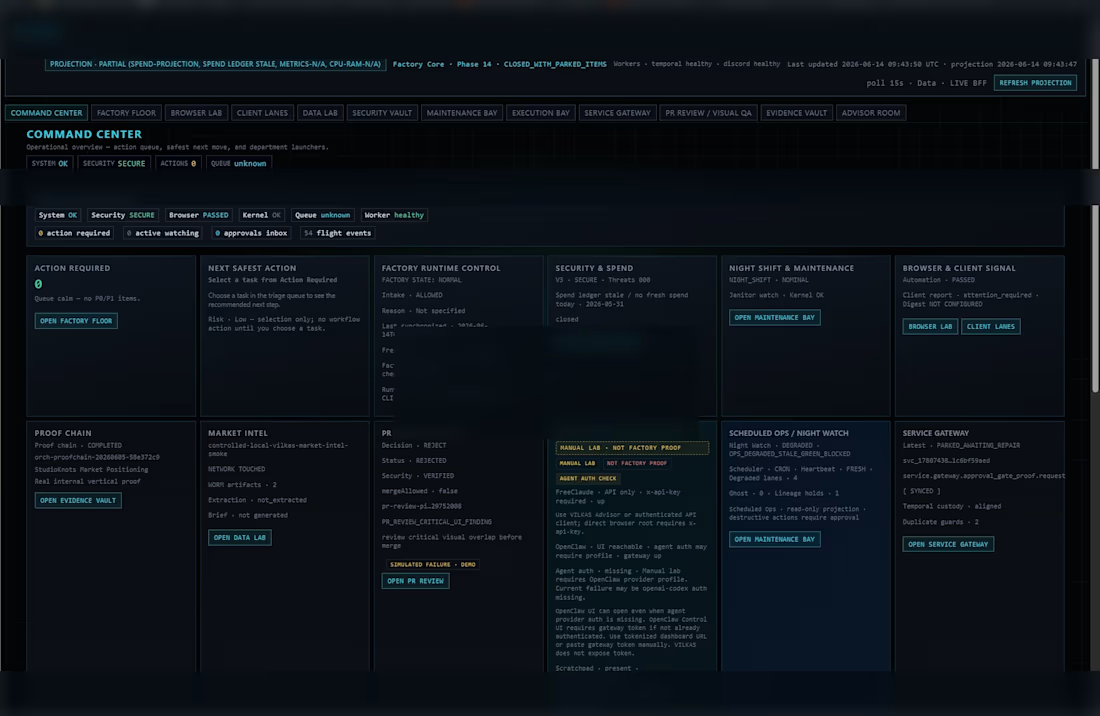
Stop deploying AI workflows your team cannot control, explain, or recover.
AI agents and automated workflows often reach production before their operational controls are ready.
A temporary API failure, duplicated webhook, interrupted process, or missing approval boundary can cause repeated actions, inconsistent data, lost execution state, or decisions that nobody can reconstruct afterwards.
This service is a focused technical audit of your AI-agent and automation architecture. It identifies where your system is exposed and gives your engineering team a practical hardening roadmap.
What the audit evaluates
Workflow durability and recovery
I assess how your workflows behave during timeouts, worker interruptions, API failures, retries, and partial execution.
The audit looks for:
lost or corrupted workflow state;
duplicated business actions;
unsafe retry behaviour;
missing idempotency;
incomplete recovery procedures;
silent or poorly surfaced failures.
Agent authority and approval boundaries
I review which systems your agents can access, what actions they can initiate, and where explicit human approval is required.
The audit identifies:
over-permissioned agents;
ungoverned tool or API access;
missing human-in-the-loop gates;
weak separation between advisory and execution authority;
irreversible actions without formal approval.
Execution evidence and traceability
I assess whether your team can prove what ran, what data was used, what changed, and who approved consequential actions.
This includes:
workflow and action ledgers;
decision records;
evidence retention;
artifact hashes;
append-only or WORM-style evidence patterns;
auditability for internal security and compliance reviews.
Gateway and integration controls
I review how requests enter your system and how agents interact with APIs, tools, webhooks, MCP servers, and downstream services.
The audit examines:
authentication and token handling;
typed intent validation;
request and callback controls;
rate and spend boundaries;
replay protection;
service-level failure handling.
What you receive
You will receive:
an executive risk summary;
a current-state architecture and control map;
a prioritised vulnerability register;
workflow durability and recovery findings;
agent-authority and human-gate analysis;
evidence and traceability gap analysis;
a remediation roadmap ranked by urgency and implementation effort;
a 60-minute technical findings call.
The roadmap is designed to be usable by your existing engineering team. It does not require you to replace your entire stack or adopt a specific platform.
Best suited for
SaaS companies deploying AI agents into operational workflows;
fintech, healthtech, legaltech, and compliance-sensitive teams;
automation agencies managing client workflows;
teams using n8n, Make, Zapier, LangGraph, Temporal, custom Python or Node.js agents;
technical founders preparing for enterprise security reviews;
engineering teams concerned about agent permissions, workflow failures, or missing audit evidence.
What this service is not
This is not a penetration test, legal compliance certification, SOC 2 audit, or automated vulnerability scanner.
It is a senior architecture and operational-control assessment focused on AI agents, workflow reliability, human authority, and execution evidence.
FAQs
Starting at$2,200
Duration1 week
Tags
AI Agents
Temporal

Business Workflow Automation
Systems Architecture
AI SECURITY
API Architecture
Backend Architecture
Human-in-the-Loop
Service provided by
Aivar R. London, UK
AI Agent Governance & Architecture AuditAivar R.
Starting at$2,200
Duration1 week
Tags
AI Agents
Temporal
Business Workflow Automation
Systems Architecture
AI SECURITY
API Architecture
Backend Architecture
Human-in-the-Loop
Stop deploying AI workflows your team cannot control, explain, or recover.
AI agents and automated workflows often reach production before their operational controls are ready.
A temporary API failure, duplicated webhook, interrupted process, or missing approval boundary can cause repeated actions, inconsistent data, lost execution state, or decisions that nobody can reconstruct afterwards.
This service is a focused technical audit of your AI-agent and automation architecture. It identifies where your system is exposed and gives your engineering team a practical hardening roadmap.
What the audit evaluates
Workflow durability and recovery
I assess how your workflows behave during timeouts, worker interruptions, API failures, retries, and partial execution.
The audit looks for:
lost or corrupted workflow state;
duplicated business actions;
unsafe retry behaviour;
missing idempotency;
incomplete recovery procedures;
silent or poorly surfaced failures.
Agent authority and approval boundaries
I review which systems your agents can access, what actions they can initiate, and where explicit human approval is required.
The audit identifies:
over-permissioned agents;
ungoverned tool or API access;
missing human-in-the-loop gates;
weak separation between advisory and execution authority;
irreversible actions without formal approval.
Execution evidence and traceability
I assess whether your team can prove what ran, what data was used, what changed, and who approved consequential actions.
This includes:
workflow and action ledgers;
decision records;
evidence retention;
artifact hashes;
append-only or WORM-style evidence patterns;
auditability for internal security and compliance reviews.
Gateway and integration controls
I review how requests enter your system and how agents interact with APIs, tools, webhooks, MCP servers, and downstream services.
The audit examines:
authentication and token handling;
typed intent validation;
request and callback controls;
rate and spend boundaries;
replay protection;
service-level failure handling.
What you receive
You will receive:
an executive risk summary;
a current-state architecture and control map;
a prioritised vulnerability register;
workflow durability and recovery findings;
agent-authority and human-gate analysis;
evidence and traceability gap analysis;
a remediation roadmap ranked by urgency and implementation effort;
a 60-minute technical findings call.
The roadmap is designed to be usable by your existing engineering team. It does not require you to replace your entire stack or adopt a specific platform.
Best suited for
SaaS companies deploying AI agents into operational workflows;
fintech, healthtech, legaltech, and compliance-sensitive teams;
automation agencies managing client workflows;
teams using n8n, Make, Zapier, LangGraph, Temporal, custom Python or Node.js agents;
technical founders preparing for enterprise security reviews;
engineering teams concerned about agent permissions, workflow failures, or missing audit evidence.
What this service is not
This is not a penetration test, legal compliance certification, SOC 2 audit, or automated vulnerability scanner.
It is a senior architecture and operational-control assessment focused on AI agents, workflow reliability, human authority, and execution evidence.
FAQs
$2,200