
A launch site for AI products, with docs, a changelog and stated accuracy
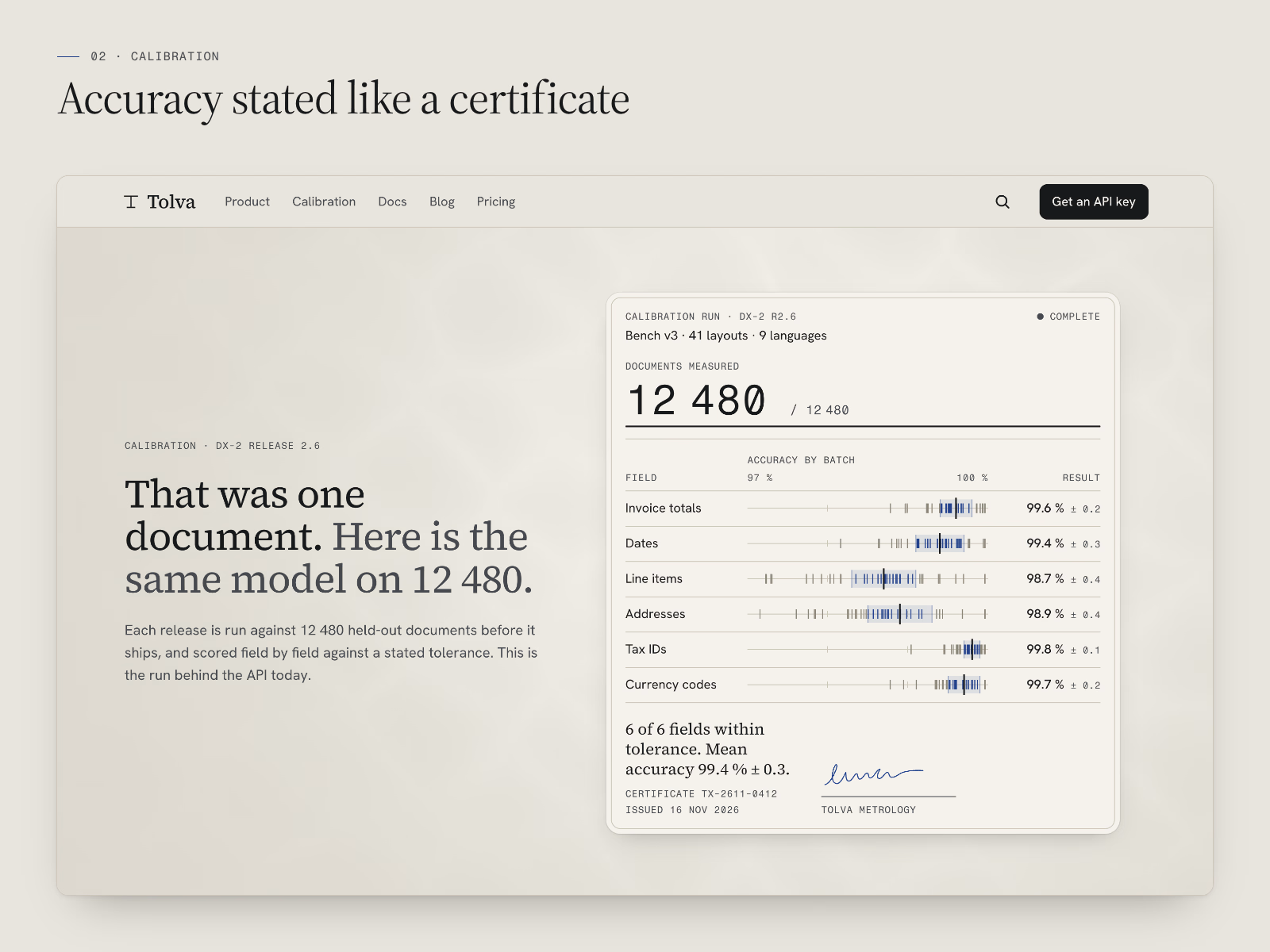
Tolva is a launch site for an AI product that has to earn trust. It shows the model's accuracy the way an instrument datasheet does: measured curves, tolerances and a calibration certificate, next to the docs and changelog a developer checks before signing up.
What's included
Pages: Home, Docs, Blog, Changelog and a 404, plus a CMS page for every doc and post
3 CMS collections: Docs (6 pages), Blog (4 posts), Revisions (4 changelog entries)
6 code components: a WebGL hero where a lamp reads the document; the calibration certificate; the calibration bench; characteristic curves (Fig 1 and Fig 2); a threshold scale linked to its request and response (Fig 3); a code block
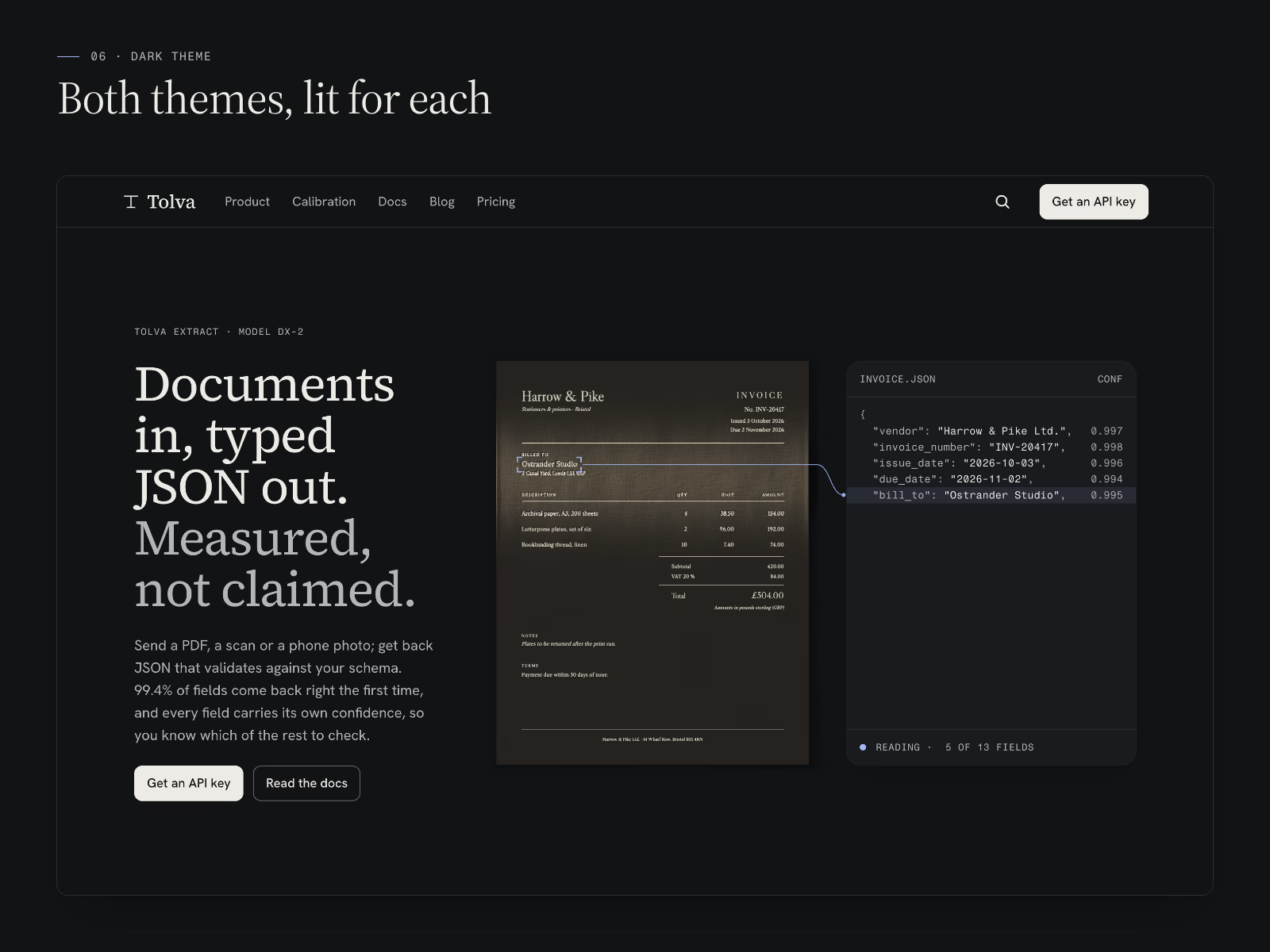
Light and dark themes, each lit for itself
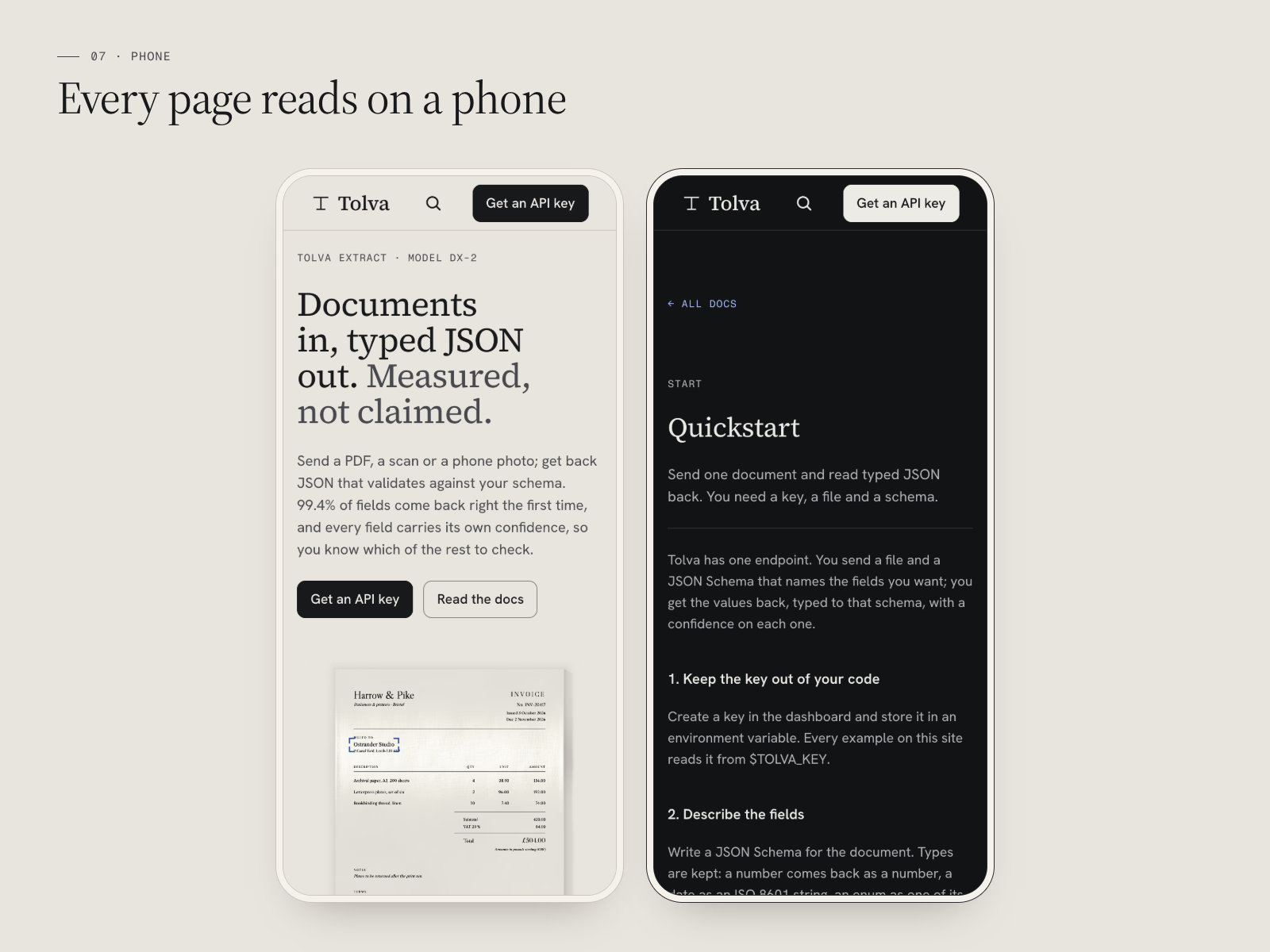
Desktop, tablet and phone
English only, with no extra locales to pay for
Site search in the navigation
What makes it different
Accuracy is stated like an instrument's, not claimed: curves with ± tolerances, a review threshold and a certificate per release.
The hero is a physical object, a document under a lamp drawn in WebGL. Without a GPU, or with reduced motion on, it shows a still poster.
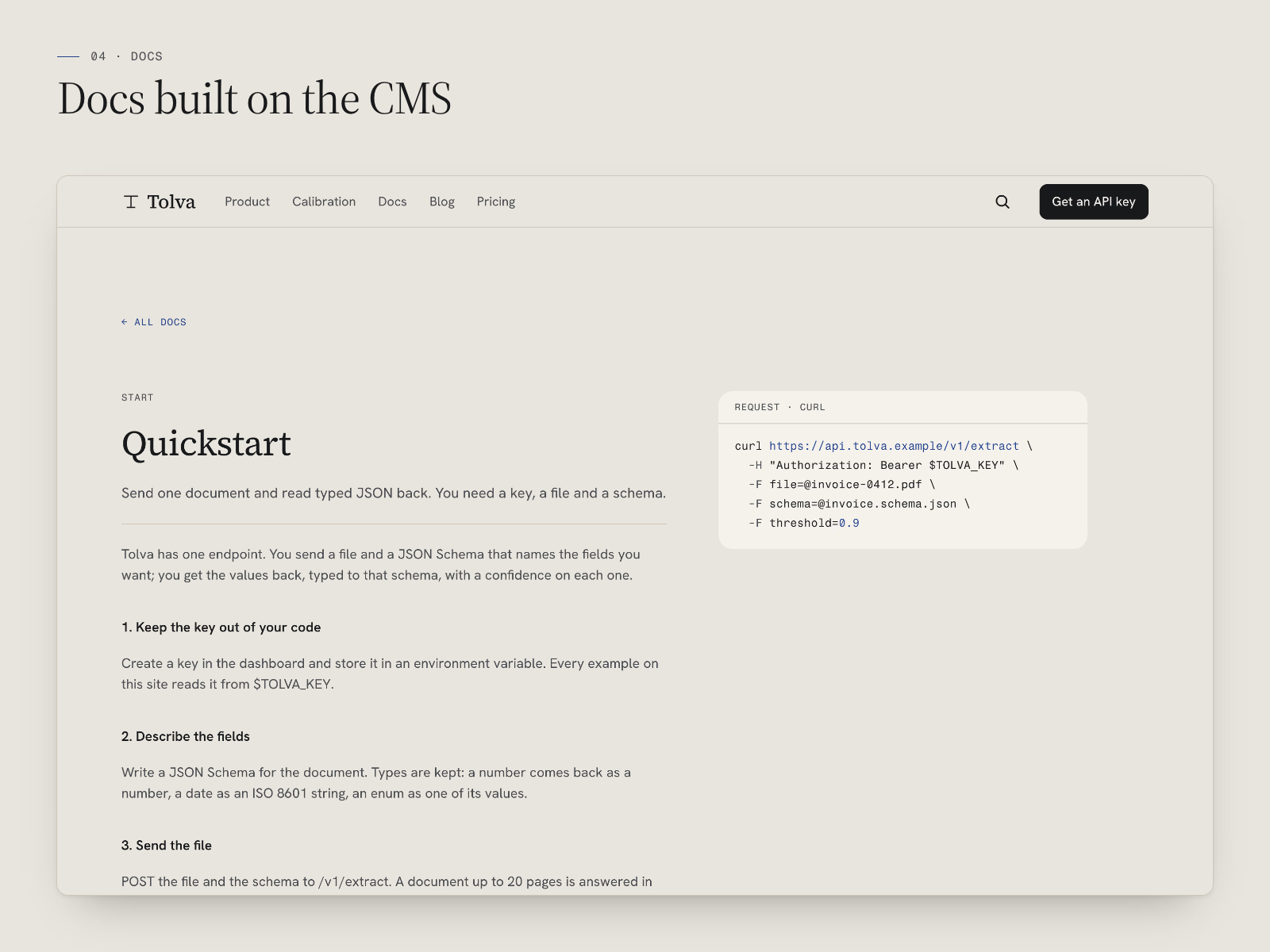
Docs and changelog are CMS collections, so your releases fill the site as you ship.
Setup
Remix it, set the color tokens and text styles, and every page and code component follows. Replace the sample content in the CMS and publish.
To publish it you need Framer's Pro plan or above, because it uses three CMS collections (Basic allows two).
Support and licence
Questions or bugs: hello@gua.studio. I reply within 2 working days. Sales are final and there are no refunds; if you report a bug, I fix it and send you a fresh remix link.
Fonts
Source Serif 4 (SIL Open Font License), Hanken Grotesk (SIL Open Font License), Fragment Mono (SIL Open Font License). All three are Google Fonts, free for commercial use.


Pedro's other products
Glass: a refractive slab, lens or pill for Framer
$12.00
Caustics: sunlight through moving water, for Framer
$9.00
Get it for$129.00
Tags
Framer
A launch site for AI products, with docs, a changelog and stated accuracy
Tolva is a launch site for an AI product that has to earn trust. It shows the model's accuracy the way an instrument datasheet does: measured curves, tolerances and a calibration certificate, next to the docs and changelog a developer checks before signing up.
What's included
Pages: Home, Docs, Blog, Changelog and a 404, plus a CMS page for every doc and post
3 CMS collections: Docs (6 pages), Blog (4 posts), Revisions (4 changelog entries)
6 code components: a WebGL hero where a lamp reads the document; the calibration certificate; the calibration bench; characteristic curves (Fig 1 and Fig 2); a threshold scale linked to its request and response (Fig 3); a code block
Light and dark themes, each lit for itself
Desktop, tablet and phone
English only, with no extra locales to pay for
Site search in the navigation
What makes it different
Accuracy is stated like an instrument's, not claimed: curves with ± tolerances, a review threshold and a certificate per release.
The hero is a physical object, a document under a lamp drawn in WebGL. Without a GPU, or with reduced motion on, it shows a still poster.
Docs and changelog are CMS collections, so your releases fill the site as you ship.
Setup
Remix it, set the color tokens and text styles, and every page and code component follows. Replace the sample content in the CMS and publish.
To publish it you need Framer's Pro plan or above, because it uses three CMS collections (Basic allows two).
Support and licence
Questions or bugs: hello@gua.studio. I reply within 2 working days. Sales are final and there are no refunds; if you report a bug, I fix it and send you a fresh remix link.
Fonts
Source Serif 4 (SIL Open Font License), Hanken Grotesk (SIL Open Font License), Fragment Mono (SIL Open Font License). All three are Google Fonts, free for commercial use.
Pedro's other products
Glass: a refractive slab, lens or pill for Framer
$12.00
Caustics: sunlight through moving water, for Framer
$9.00
$129.00