
Written for: Contra buyers browsing templates (founders, studios and developers).
Here's the full product description, ready to paste into Contra's description field. Bold lines work as headings in the editor.
Specimen: an X-ray landing page for developer tools and SaaS
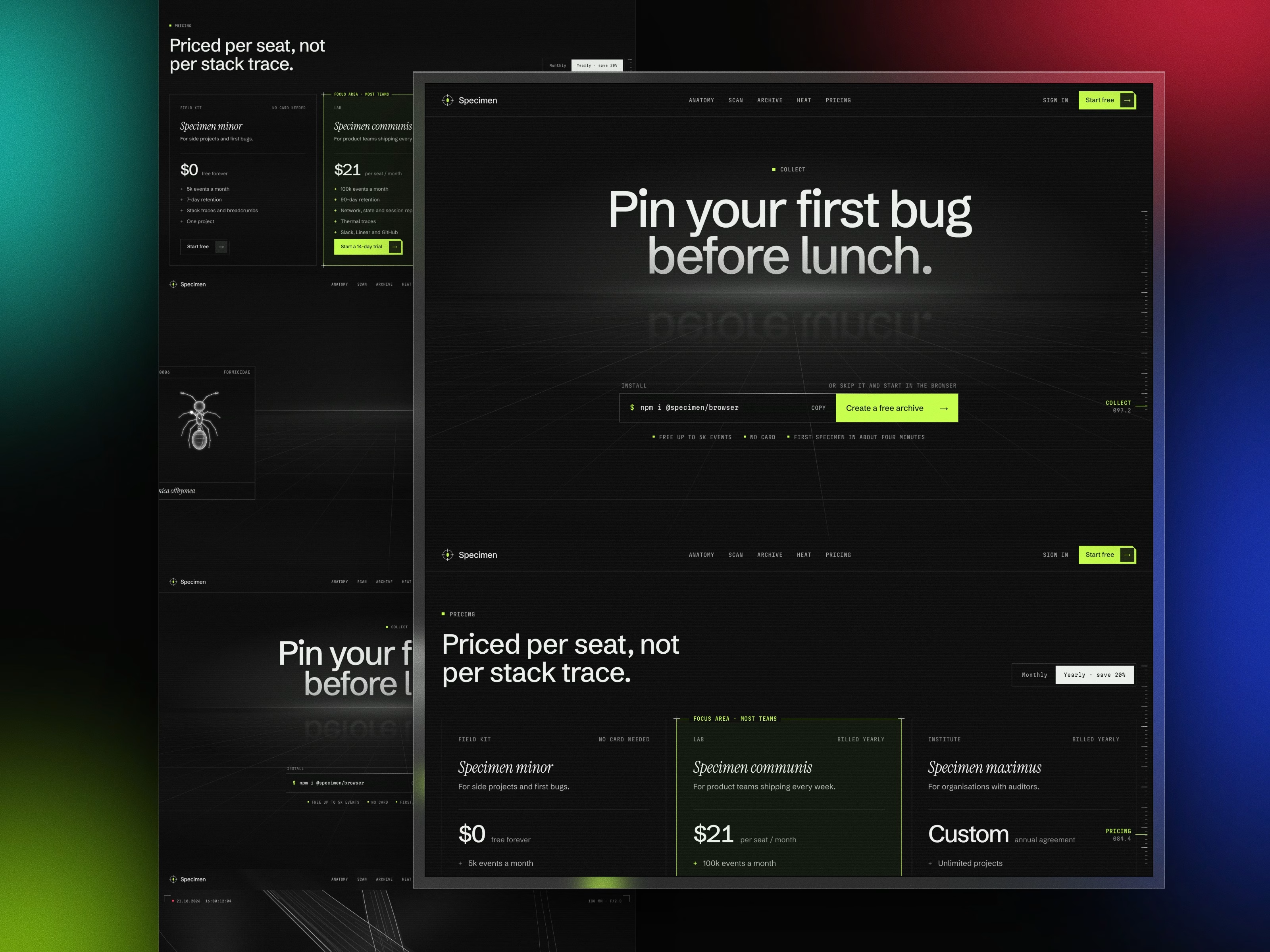
Specimen is a landing page that looks like nothing else in its category. Most SaaS templates are a gradient, a dashboard screenshot and three feature cards. Specimen is a lightbox. Every section reads like an X-ray plate, and every animation tells part of one story.
The idea is simple: software bugs, drawn as real bugs. Six insects are drawn in code as radiographs, each one standing for a class of error:
A moth for a memory leak
A bee for an unhandled rejection
A tarantula for a race condition
A beetle for a null reference
A centipede for an N+1 query
An ant with one extra leg for an off-by-one
Colour only appears inside a lens: acid green for focus, teal and red for heat. There are no stock photos and no image files. Everything you see is SVG and CSS.
What's on the page
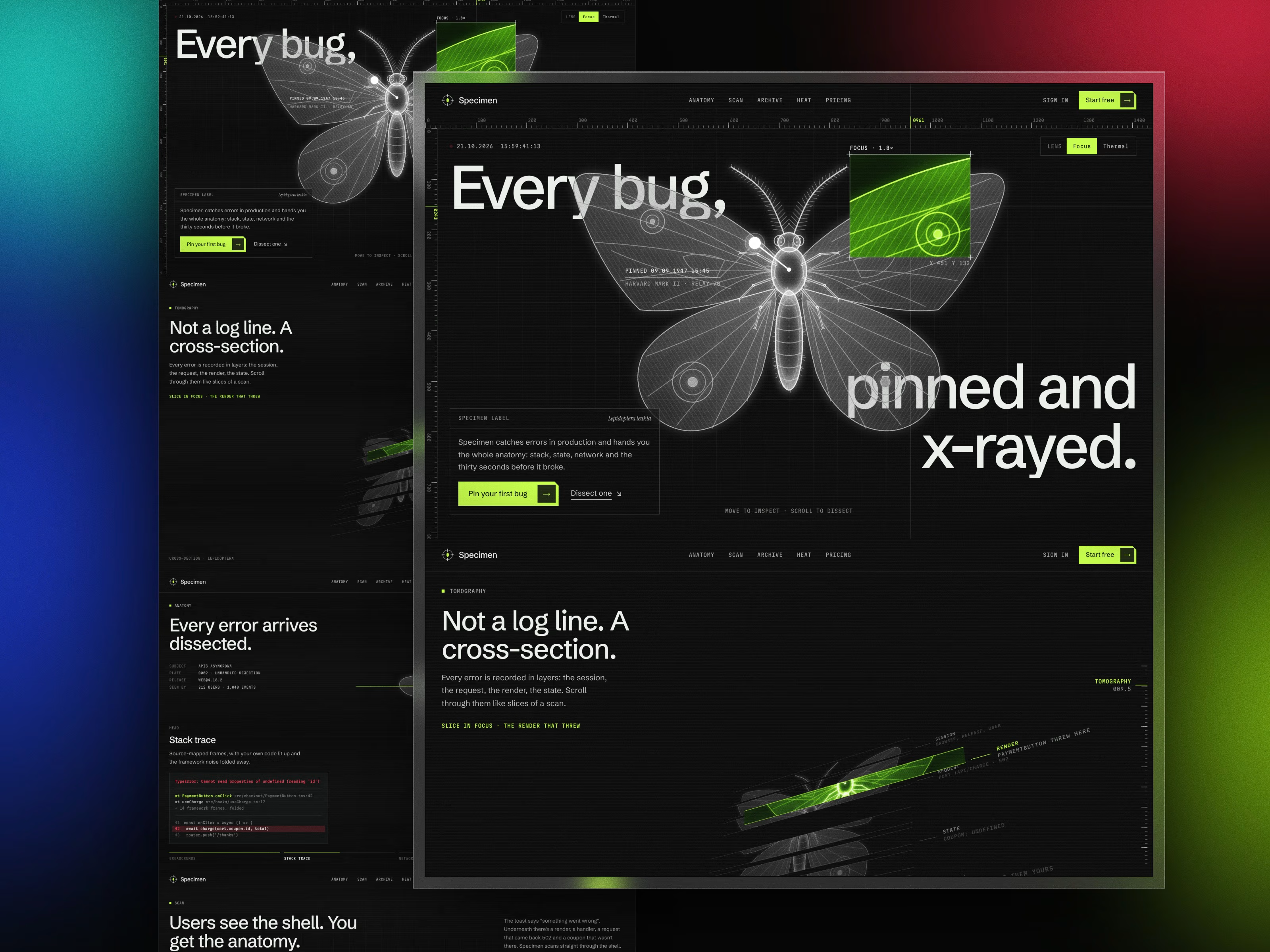
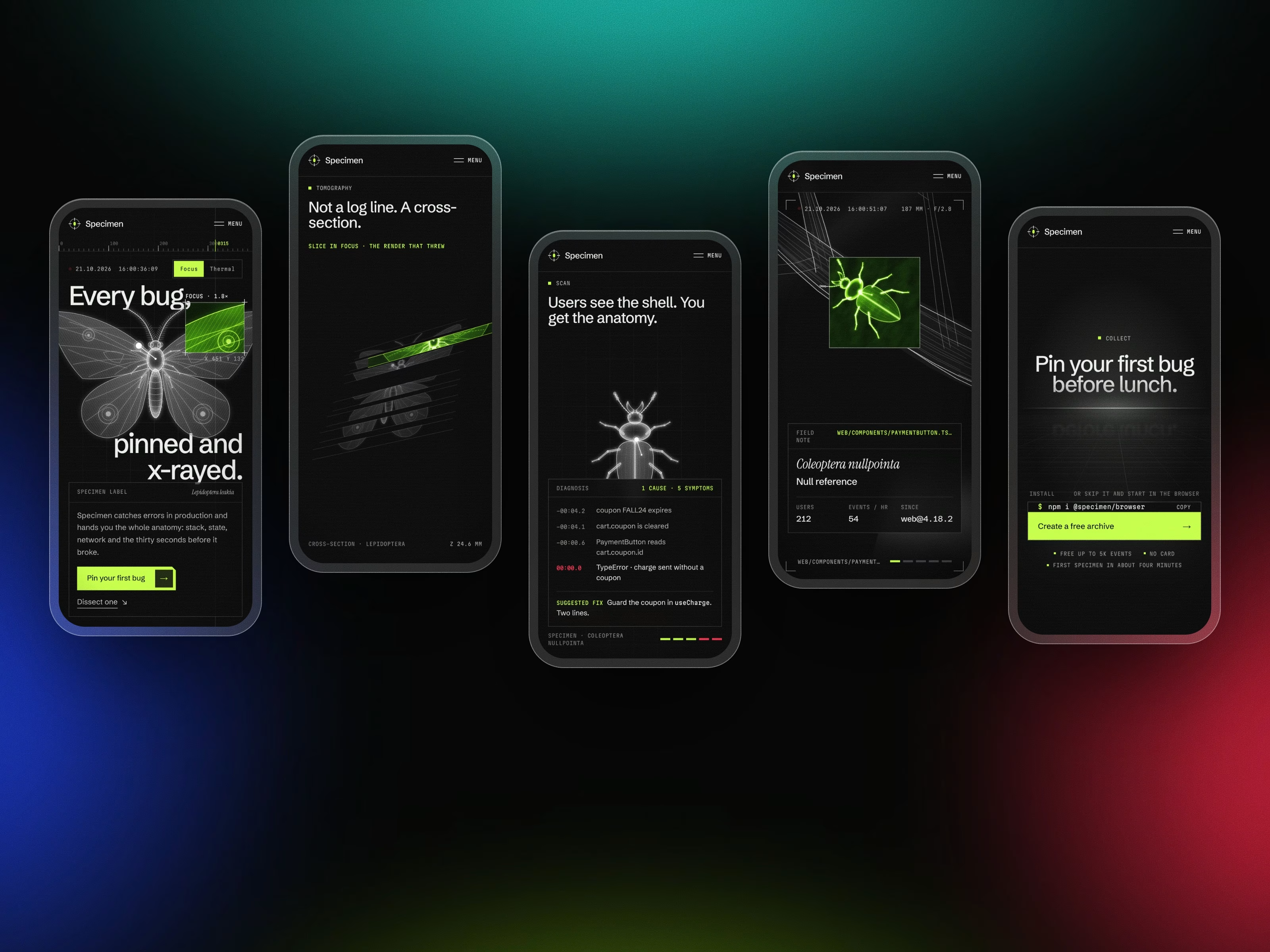
Hero: a specimen viewer. Rulers run along the edges, crosshairs follow the lens, and a magnifying lens you steer with the cursor re-colours whatever it passes over. A Focus / Thermal switch changes the lens colour. The headline is set across the moth on a diagonal, like a poster.
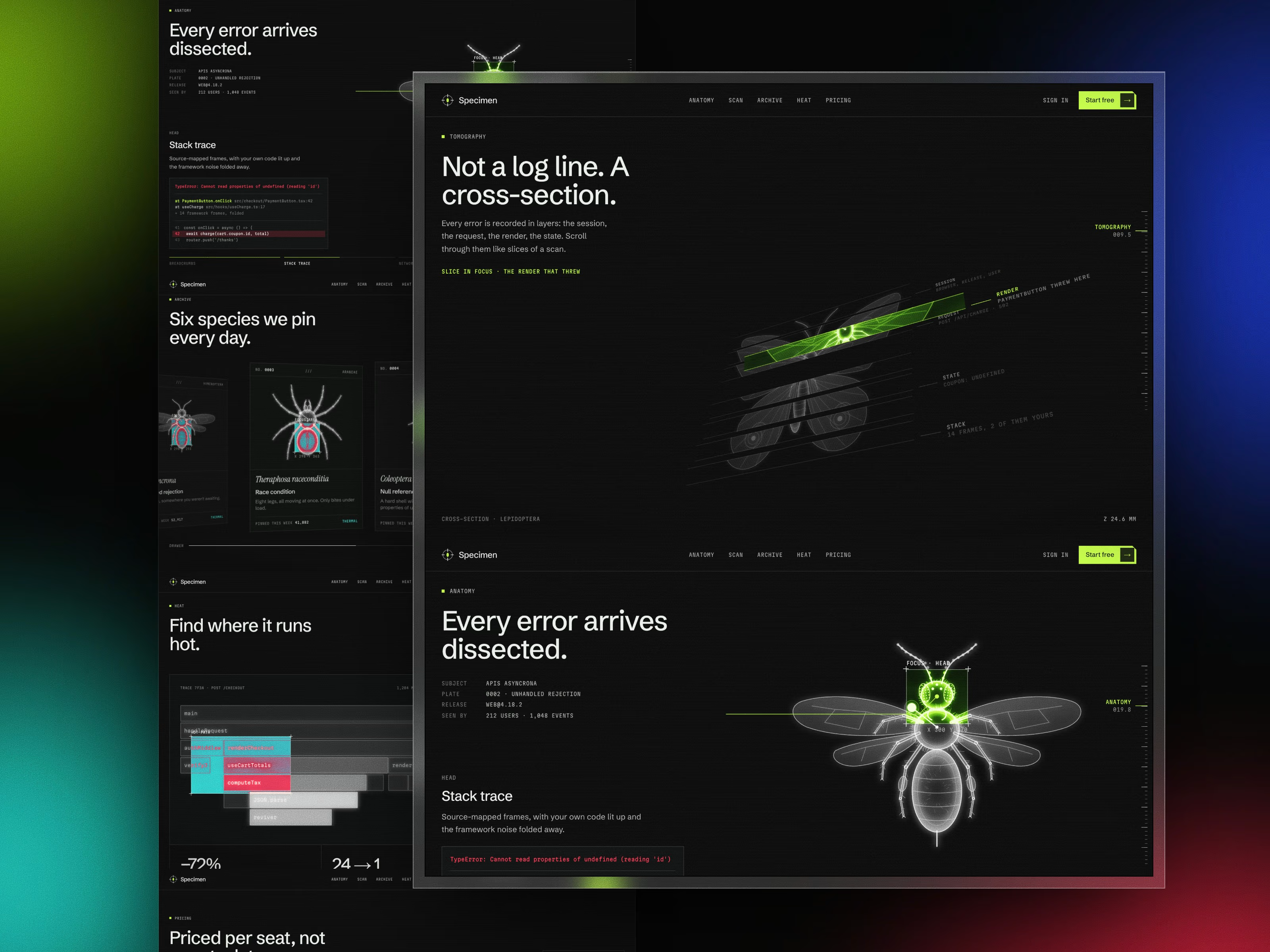
Tomography. The moth is sliced into a CT stack that fans out in 3D as you scroll. One slice pulls out of the stack in false colour.
Anatomy. A pinned bee is dissected in four scroll stages: antennae for breadcrumbs, head for the stack trace, wings for network requests, abdomen for app state. Each stage shows a realistic data panel.
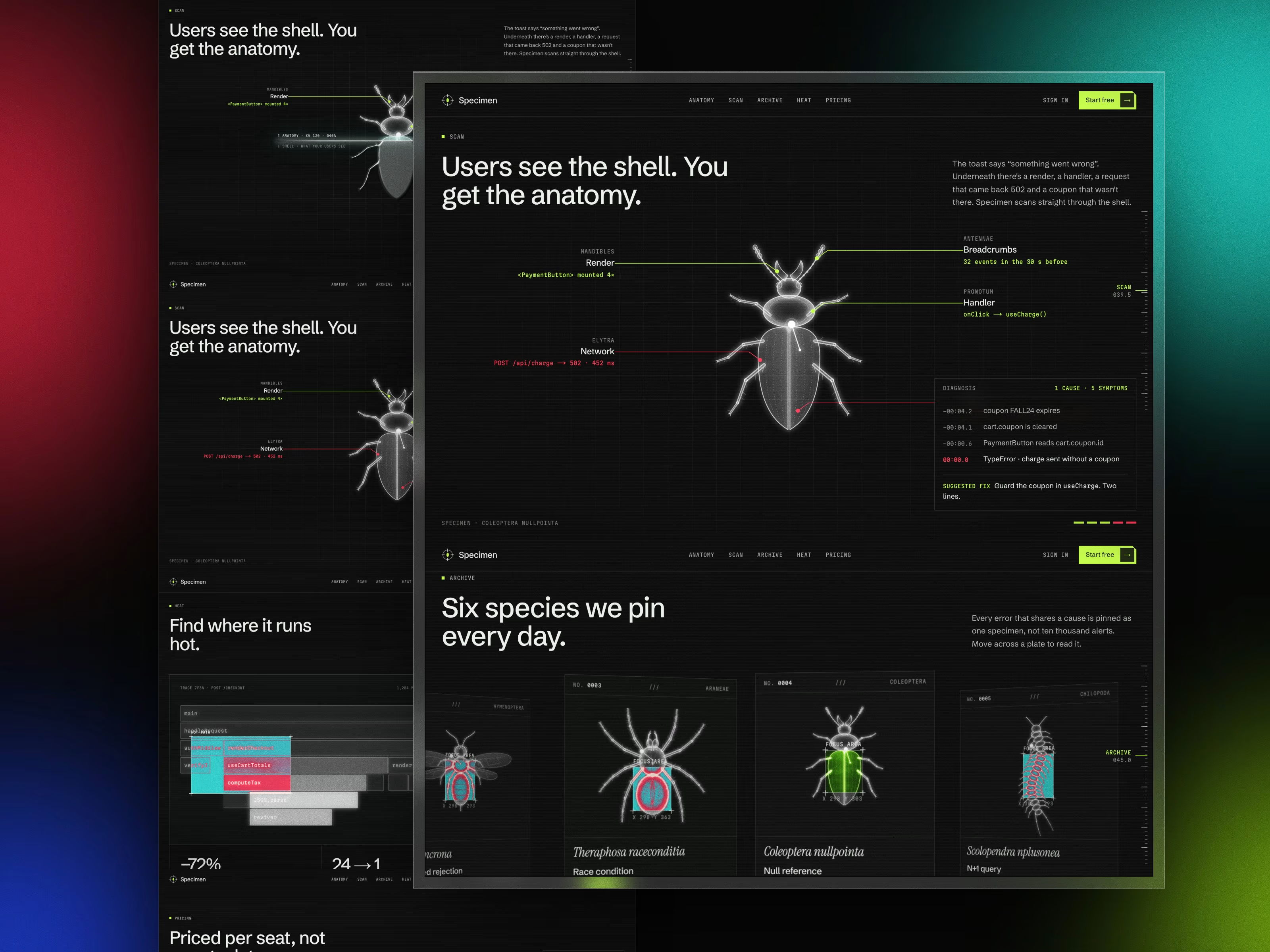
Scan. A glossy, lacquered beetle shell sits beside the "Something went wrong" toast your users see. A beam turns the shell into X-ray as you scroll. Each body part it crosses opens a callout, and the scan ends with a diagnosis showing the cause chain and a suggested fix.
Archive. A sideways drawer of six specimen plates that bends around a cylinder as it scrolls, with a hover lens on every plate.
Heat. A performance flame graph read through a thermal lens, so the slow path glows red.
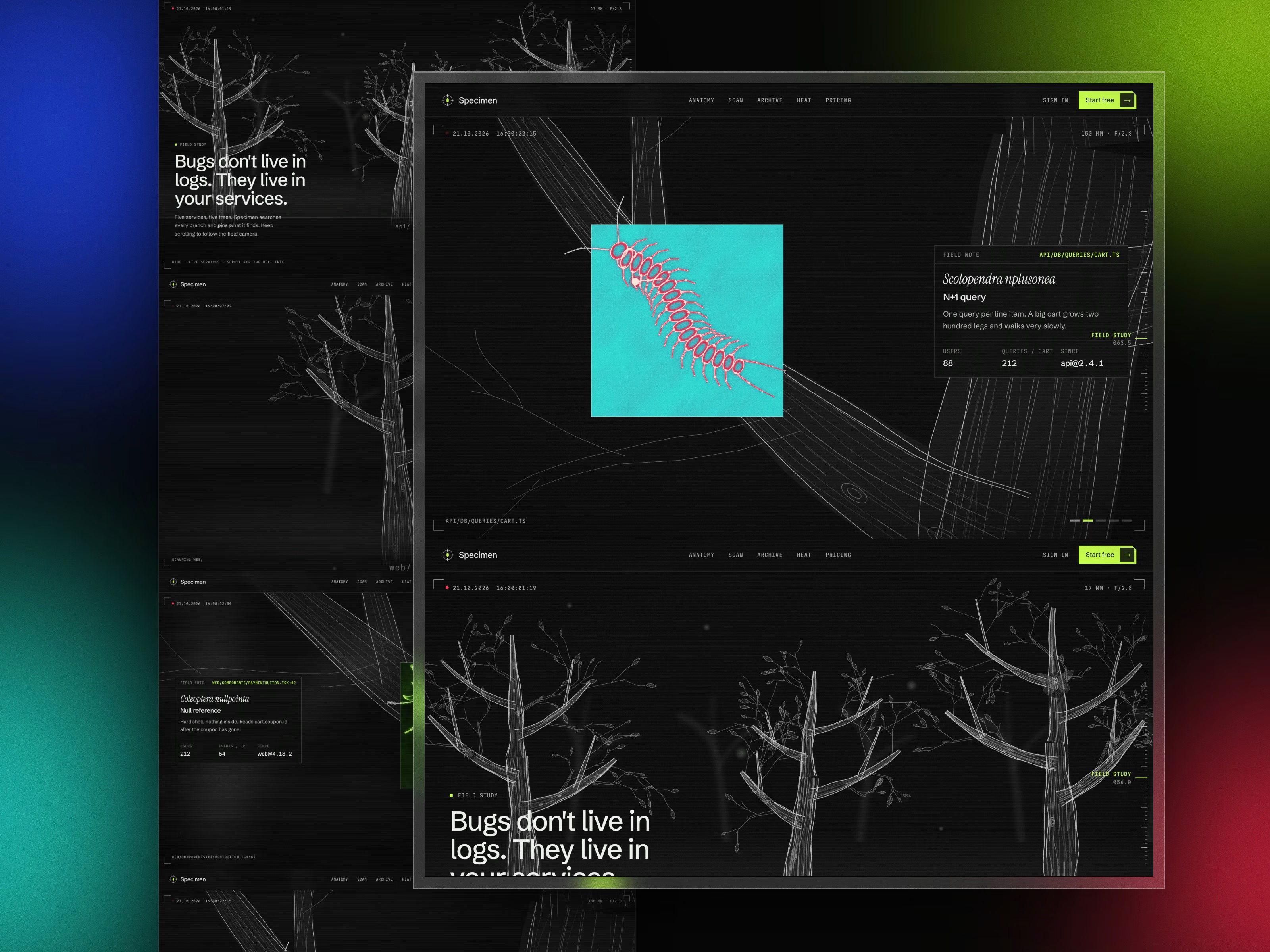
Field study. A cinematic camera sequence across a forest of five trees, one per service. The camera glides to each tree, a targeting reticle searches the branches and locks onto the bug, then the camera zooms in while a false-colour reveal and a field note develop. It plays on its own smooth timing instead of jumping with the scrollbar.
Pricing. Three plans with a monthly / yearly switch. The recommended plan is framed as the "focus area".
Finale. The camera flies down an aisle of standing plates over an endless lit floor. The call to action rises out of the light on the horizon, with a one-click install command beside it.
Details throughout. A custom reticle cursor with live coordinates, a depth gauge that tracks your place on the page, film grain, scanlines and a live recording timecode.
Built properly
Next.js 16 (App Router), React 19, TypeScript, Tailwind CSS v4, Motion (Framer Motion) and Lenis smooth scroll
Statically rendered, so it deploys anywhere that hosts Next.js, with no backend needed
Every visual drawn in code: the insects, the forest, the lenses, and even the glossy shell material, which is made from SVG lighting filters
Animations that only move cheap layers (via transforms), with heavy artwork drawn once and reused
Fully responsive, with dedicated phone layouts rather than shrunk desktop ones
Respects reduced motion: every scene has a calm, finished state, and the camera cuts instead of flying
Visible keyboard focus, labelled controls, screen-reader descriptions for the visual scenes, and proper headings and landmarks
Easy to make your own
Colours, fonts and timing are defined in one place, so rebranding takes minutes
Each section is its own small, readable component
The insects are built from a shared kit of parts (shells, hollow limbs, wings, antennae), so you can draw new ones
Lens colours are a single colour table you can retune
Placeholder copy is written for a real product, ready to swap for yours
What you get
The full source code as a ZIP, ready to run with
npm install and npm run devA design document explaining the palette, type, motion and the reasoning behind each section
A README with a map of where everything lives
Favicon and app icons included
Who it's for
Developer-tool and SaaS founders, studios and developers who want a launch page people screenshot and share. It fits especially well with monitoring, debugging, security, analytics and infrastructure products, anything about seeing inside something.
License
One purchase covers one end product, for yourself or one client, including commercial use. Reselling or redistributing the template isn't allowed. Full terms are in LICENSE.md inside the download.
Get it for$70.00
Tags
Next.js

Saas
Tailwind CSS

Landing page
Product created by
Fardin Omor Afnan Dhaka, Bangladesh
- 5
- Followers
Fardin Omor's other products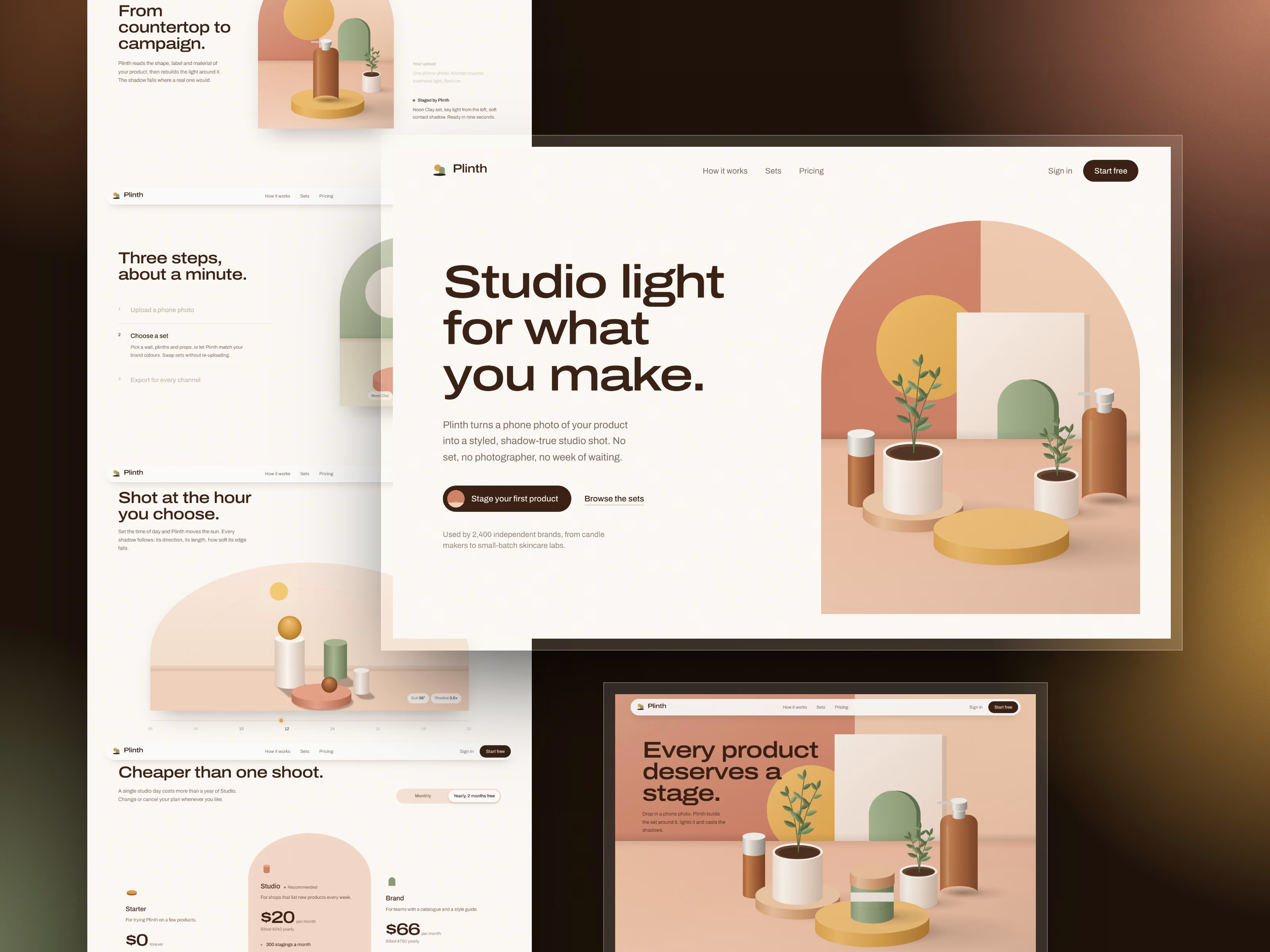
Plinth: Scroll-Animated SaaS Landing Page for Next.js
$0.00
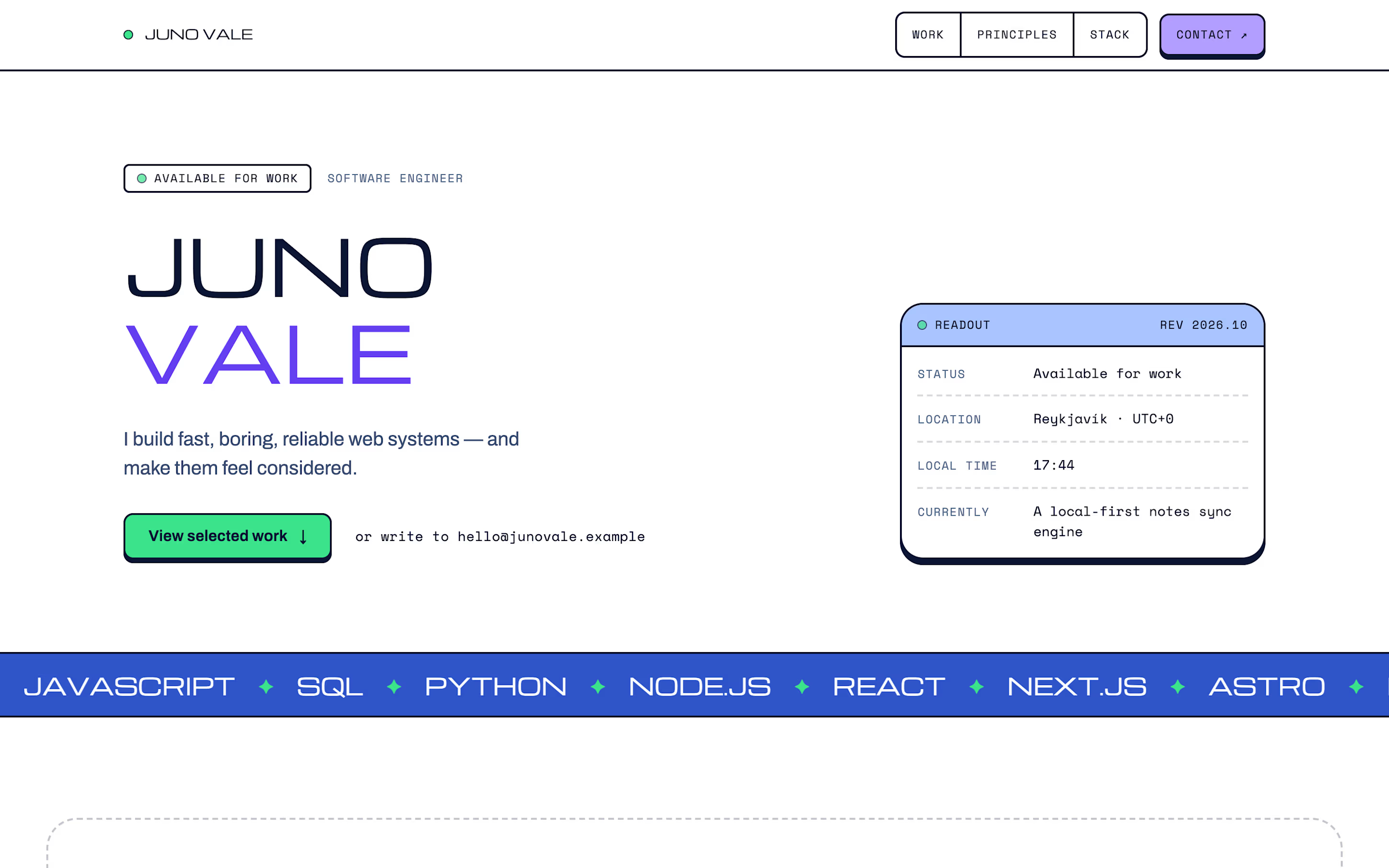
Mission Manual — Retro-Futuristic Portfolio Template for Astro
$0.00
Get it for$70.00
Tags
Next.js
Saas
Tailwind CSS
Landing page
Written for: Contra buyers browsing templates (founders, studios and developers).
Here's the full product description, ready to paste into Contra's description field. Bold lines work as headings in the editor.
Specimen: an X-ray landing page for developer tools and SaaS
Specimen is a landing page that looks like nothing else in its category. Most SaaS templates are a gradient, a dashboard screenshot and three feature cards. Specimen is a lightbox. Every section reads like an X-ray plate, and every animation tells part of one story.
The idea is simple: software bugs, drawn as real bugs. Six insects are drawn in code as radiographs, each one standing for a class of error:
A moth for a memory leak
A bee for an unhandled rejection
A tarantula for a race condition
A beetle for a null reference
A centipede for an N+1 query
An ant with one extra leg for an off-by-one
Colour only appears inside a lens: acid green for focus, teal and red for heat. There are no stock photos and no image files. Everything you see is SVG and CSS.
What's on the page
Hero: a specimen viewer. Rulers run along the edges, crosshairs follow the lens, and a magnifying lens you steer with the cursor re-colours whatever it passes over. A Focus / Thermal switch changes the lens colour. The headline is set across the moth on a diagonal, like a poster.
Tomography. The moth is sliced into a CT stack that fans out in 3D as you scroll. One slice pulls out of the stack in false colour.
Anatomy. A pinned bee is dissected in four scroll stages: antennae for breadcrumbs, head for the stack trace, wings for network requests, abdomen for app state. Each stage shows a realistic data panel.
Scan. A glossy, lacquered beetle shell sits beside the "Something went wrong" toast your users see. A beam turns the shell into X-ray as you scroll. Each body part it crosses opens a callout, and the scan ends with a diagnosis showing the cause chain and a suggested fix.
Archive. A sideways drawer of six specimen plates that bends around a cylinder as it scrolls, with a hover lens on every plate.
Heat. A performance flame graph read through a thermal lens, so the slow path glows red.
Field study. A cinematic camera sequence across a forest of five trees, one per service. The camera glides to each tree, a targeting reticle searches the branches and locks onto the bug, then the camera zooms in while a false-colour reveal and a field note develop. It plays on its own smooth timing instead of jumping with the scrollbar.
Pricing. Three plans with a monthly / yearly switch. The recommended plan is framed as the "focus area".
Finale. The camera flies down an aisle of standing plates over an endless lit floor. The call to action rises out of the light on the horizon, with a one-click install command beside it.
Details throughout. A custom reticle cursor with live coordinates, a depth gauge that tracks your place on the page, film grain, scanlines and a live recording timecode.
Built properly
Next.js 16 (App Router), React 19, TypeScript, Tailwind CSS v4, Motion (Framer Motion) and Lenis smooth scroll
Statically rendered, so it deploys anywhere that hosts Next.js, with no backend needed
Every visual drawn in code: the insects, the forest, the lenses, and even the glossy shell material, which is made from SVG lighting filters
Animations that only move cheap layers (via transforms), with heavy artwork drawn once and reused
Fully responsive, with dedicated phone layouts rather than shrunk desktop ones
Respects reduced motion: every scene has a calm, finished state, and the camera cuts instead of flying
Visible keyboard focus, labelled controls, screen-reader descriptions for the visual scenes, and proper headings and landmarks
Easy to make your own
Colours, fonts and timing are defined in one place, so rebranding takes minutes
Each section is its own small, readable component
The insects are built from a shared kit of parts (shells, hollow limbs, wings, antennae), so you can draw new ones
Lens colours are a single colour table you can retune
Placeholder copy is written for a real product, ready to swap for yours
What you get
The full source code as a ZIP, ready to run with
npm install and npm run devA design document explaining the palette, type, motion and the reasoning behind each section
A README with a map of where everything lives
Favicon and app icons included
Who it's for
Developer-tool and SaaS founders, studios and developers who want a launch page people screenshot and share. It fits especially well with monitoring, debugging, security, analytics and infrastructure products, anything about seeing inside something.
License
One purchase covers one end product, for yourself or one client, including commercial use. Reselling or redistributing the template isn't allowed. Full terms are in LICENSE.md inside the download.
Fardin Omor's other products
Plinth: Scroll-Animated SaaS Landing Page for Next.js
$0.00
Mission Manual — Retro-Futuristic Portfolio Template for Astro
$0.00
$70.00