

A Good Website Is Not Just About Design. It's About How Well It Works.
A business website can look visually impressive and still fail to achieve its purpose.
I've seen this problem repeatedly in website development discussions: too much attention goes into appearance, while important things like navigation, loading speed, mobile responsiveness, and conversion flow are overlooked.
Let's look at a practical example.
Imagine you're building a website for a consulting business.
A potential client visits the homepage. Within a few seconds, they should be able to understand:
What services the business provides.
Who those services are designed for.
Why they should consider the business.
How to take the next step.
Now consider what happens if the website has confusing navigation, slow-loading pages, unclear service descriptions, or a contact form that doesn't work properly.
You could lose a potential customer even if the website looks beautiful.
5 things I consider important when developing a business website
1. Clear website structure
Every page should have a purpose. Your homepage, service pages, about page, and contact page should work together to guide visitors.
2. Mobile responsiveness
A website should work properly across smartphones, tablets, and desktop screens. Visitors shouldn't have to zoom in or scroll sideways to access important information.
3. Website performance
Large images, unnecessary scripts, and poorly optimized resources can affect loading speed. Performance should be considered during development, not treated as an afterthought.
4. Functional contact forms
A contact form should do more than display input fields. It should validate information, handle submissions properly, provide confirmation, and deliver inquiries to the correct destination.
5. Search engine foundations
Proper page titles, meta descriptions, heading structure, descriptive URLs, and image alt text help establish a stronger SEO foundation.
A practical development checklist
Before launching a business website, test the following:
All navigation links work.
Forms successfully submit.
Website displays correctly on mobile.
Images are optimized.
Important pages have clear calls to action.
No broken links or missing pages.
Basic SEO elements are configured.
SSL and security settings are in place.
My takeaway:
A successful website brings together design, functionality, performance, and usability.
Don't just build a website that looks good in a screenshot. Build one that works for the people using it and supports the goals of the business behind it.
Discussion: When evaluating a business website, what matters most to you: design, loading speed, user experience, or functionality?
1
52



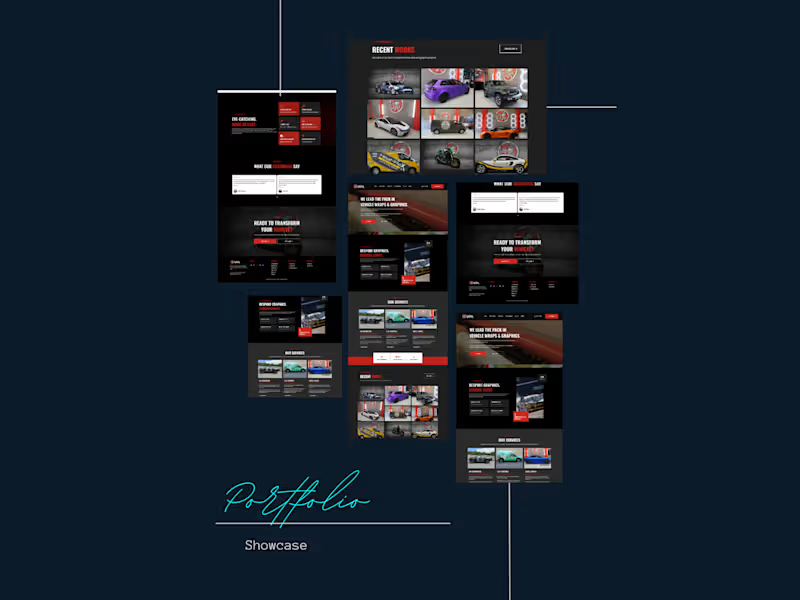
Designed and built a full business website for a veteran vehicle wraps and graphics company serving commercial and personal clients across Surrey and South London.
The site was built to showcase the brand's craftsmanship and convert visitors into quote requests through a bold, high-impact visual design that matches the nature of the work.
What went into it:
Dark, aggressive design using a black and red palette that reflects the bold, custom nature of vehicle wrapping
Service breakdown across three core offerings — Van Signwriting, Fleet Graphics, and Vehicle Wraps — each with its own dedicated section
Visual-first layout with a recent works gallery showcasing real wrapped vehicles to sell through example
Trust indicators built throughout — established since 2003, 5-star rating, approved veteran installers badge, and partner logos including 3M
Stats section highlighting credibility: 7+ years experience, 409+ vehicles wrapped, 2-year warranty
Feature grid covering key buying decision factors — premium materials, expert installers, custom designs, long-lasting films
Customer testimonials section to reinforce trust before the final CTA
"Ready to Transform Your Vehicle?" closing section with dual CTAs — get a quote and view gallery
Built on GoHighLevel with full mobile responsiveness
The goal was a site that felt as premium and bold as the wraps themselves — visual proof first, trust second, conversion last.
0
123