
Professional Web App & Website Developer

A Good Website Is Not Just About Design. It's About How Well It Works.
A business website can look visually impressive and still fail to achieve its purpose.
I've seen this problem repeatedly in website development discussions: too much attention goes into appearance, while important things like navigation, loading speed, mobile responsiveness, and conversion flow are overlooked.
Let's look at a practical example.
Imagine you're building a website for a consulting business.
A potential client visits the homepage. Within a few seconds, they should be able to understand:
What services the business provides.
Who those services are designed for.
Why they should consider the business.
How to take the next step.
Now consider what happens if the website has confusing navigation, slow-loading pages, unclear service descriptions, or a contact form that doesn't work properly.
You could lose a potential customer even if the website looks beautiful.
5 things I consider important when developing a business website
1. Clear website structure
Every page should have a purpose. Your homepage, service pages, about page, and contact page should work together to guide visitors.
2. Mobile responsiveness
A website should work properly across smartphones, tablets, and desktop screens. Visitors shouldn't have to zoom in or scroll sideways to access important information.
3. Website performance
Large images, unnecessary scripts, and poorly optimized resources can affect loading speed. Performance should be considered during development, not treated as an afterthought.
4. Functional contact forms
A contact form should do more than display input fields. It should validate information, handle submissions properly, provide confirmation, and deliver inquiries to the correct destination.
5. Search engine foundations
Proper page titles, meta descriptions, heading structure, descriptive URLs, and image alt text help establish a stronger SEO foundation.
A practical development checklist
Before launching a business website, test the following:
All navigation links work.
Forms successfully submit.
Website displays correctly on mobile.
Images are optimized.
Important pages have clear calls to action.
No broken links or missing pages.
Basic SEO elements are configured.
SSL and security settings are in place.
My takeaway:
A successful website brings together design, functionality, performance, and usability.
Don't just build a website that looks good in a screenshot. Build one that works for the people using it and supports the goals of the business behind it.
Discussion: When evaluating a business website, what matters most to you: design, loading speed, user experience, or functionality?
1
52
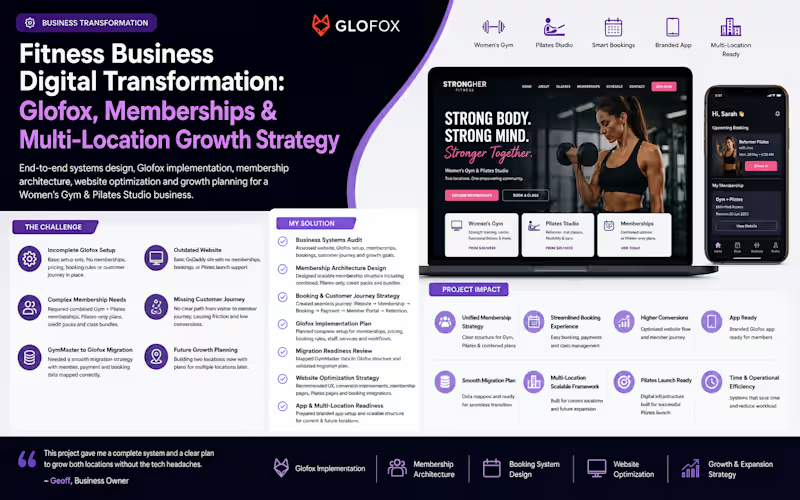
Fitness Business Digital Transformation: Glofox, Memberships & Multi-Location Growth Strategy
Overview
A growing fitness business owner needed a complete operational and technology strategy to support the expansion of a Women's Gym and a new Pilates Studio. The existing systems were fragmented, memberships were not properly structured, booking workflows were undefined, and the business lacked a scalable foundation for future growth.
The objective was to design and implement a unified business ecosystem that would support memberships, bookings, customer journeys, website optimization, app readiness, and future multi-location expansion.
Challenges
Incomplete Glofox Configuration
The Glofox platform had only basic setup completed, with limited staff profiles and no structured membership architecture, booking rules, pricing models, or customer workflows.
Membership Complexity
The business required:
Combined Gym + Pilates memberships
Pilates-only memberships
Credit packs
Class bundles
Flexible pricing options
Creating a scalable membership structure that supported multiple services while remaining easy for members to understand was a major challenge.
GymMaster to Glofox Migration
The business was transitioning from GymMaster to Glofox and needed a migration strategy that would preserve member records, payment structures, membership plans, and operational continuity.
Website Limitations
The existing GoDaddy website lacked:
Membership integration
Booking capabilities
Conversion-focused user journeys
Pilates launch support
Scalability for future expansion
Missing Customer Journey
There was no seamless path connecting:
Website → Membership Purchase → Booking → Payment → Member Portal → Retention
This created friction for both new and existing members.
Multi-Location Growth Planning
The owner was preparing to operate:
Women's Gym Location
Pilates Studio Location
with plans for future expansion, requiring a scalable operational framework from day one.
My Solution
Business Systems Audit
Conducted a full assessment of:
Existing website
Glofox setup
Membership structure
Booking workflows
Customer journey
Growth objectives
Membership Architecture Design
Designed a scalable membership framework that included:
Combined Gym + Pilates memberships
Pilates-only memberships
Credit pack options
Class bundle structures
Future membership expansion capabilities
Booking & Customer Journey Strategy
Developed a streamlined member experience covering:
Website onboarding
Membership enrollment
Class bookings
Payments
Mobile app engagement
Retention pathways
Glofox Configuration Planning
Created a complete implementation strategy for:
Membership setup
Pricing structures
Booking rules
Staff permissions
Service categories
Customer workflows
Migration Readiness Assessment
Reviewed the GymMaster-to-Glofox transition process and mapped business requirements to ensure a smooth migration experience.
Website Optimization Strategy
Developed recommendations for:
Improved user experience
Conversion-focused design
Membership landing pages
Pilates service pages
Booking integrations
Future scalability
Mobile App Readiness
Evaluated app deployment requirements and prepared the business for branded member app adoption through Glofox.
Multi-Location Scalability Framework
Designed a future-proof operational structure capable of supporting:
Multiple locations
Flexible memberships
Shared member access
Business growth and expansion
Results
✅ Clear membership and pricing strategy
✅ Structured booking and customer journey framework
✅ Scalable Glofox implementation roadmap
✅ Migration readiness for GymMaster transition
✅ Website optimization and conversion improvement plan
✅ Pilates launch digital infrastructure strategy
✅ Multi-location growth framework
✅ Improved operational efficiency and future scalability
Skills Used
Glofox Configuration
Business Systems Design
Membership Strategy
Booking System Architecture
Customer Journey Mapping
Fitness Business Consulting
Website Optimization
Digital Transformation
Business Process Design
Multi-Location Planning
Mobile App Readiness
CRM & Membership Platforms
This makes the website look good for business transformation engagement rather than a simple software setup task, which is much stronger for attracting higher-value clients.
2
116

YOU SHOULDN'T HAVE TO SPEND HOURS COLLECTING DATA JUST TO UNDERSTAND YOUR BUSINESS PERFORMANCE.
Many businesses collect information from different sources.
For example:
Sales records are stored in one application.
Customer information is stored in a CRM.
Expenses are tracked in spreadsheets.
Website performance is monitored separately.
The challenge is bringing all this information together.
This is where automated reporting becomes useful.
Imagine this workflow:
Your sales platform records new transactions.
Your expense spreadsheet receives updated information.
Your CRM tracks customer activity.
Data is connected to a reporting dashboard.
Your dashboard displays updated business information.
Instead of manually compiling different reports every time, you can create a system that organizes important information in one place.
What can an automated dashboard help you monitor?
📊 Sales performance.
📊 Customer acquisition.
📊 Business expenses.
📊 Lead conversion.
📊 Team productivity.
Tools such as Google Sheets, Excel, Power BI, and automation platforms can help create connected reporting systems.
Remember: Data is valuable, but organized and accessible data is even more useful when making business decisions.
What business metric would you most like to monitor from one dashboard?
#DataAutomation #BusinessAutomation
0
22
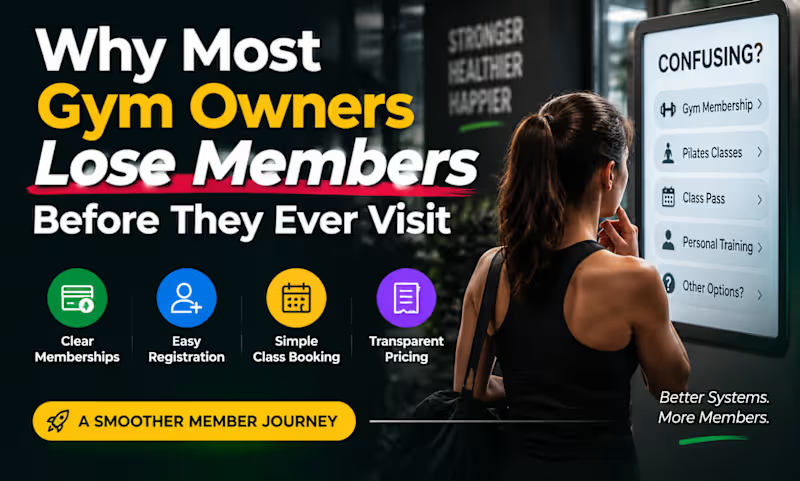
Why Most Gym Owners Lose Members Before They Ever Visit
Last week, I was helping a fitness business prepare for a major system transition.
What looked like a simple CRM setup quickly became a customer experience problem.
A new member should be able to:
✅ Choose the right membership
✅ Register easily
✅ Book classes without confusion
✅ Understand exactly what they're paying for
But small setup mistakes can create friction:
Too many membership options
Confusing booking flows
Classes mixed together without structure
Hidden settings affecting visibility
Technology isn't usually the problem.
The real challenge is designing a system that feels simple for members while staying manageable for staff.
That's where CRM and business automation become valuable not because of the software itself, but because of the experience it creates.
If your business relies on memberships, bookings, appointments, or recurring customers, your systems may be affecting conversions more than you realize.
What customer journey are you currently using?
0
171
