Freelancers using Melius in Warsaw
Freelancers using Melius in Warsaw
Sign Up
Post a job
Sign Up
Log In
Filters
2
Projects
People
Kris Anfalova
pro
Warsaw, Poland
Premium UI/UX & Web Design for Fintech, SaaS & Web3 | Framer
1x
Hired
5.0
Rating
330
Followers
expert
expert
+1
Follow
Message
Premium UI/UX & Web Design for Fintech, SaaS & Web3 | Framer
1
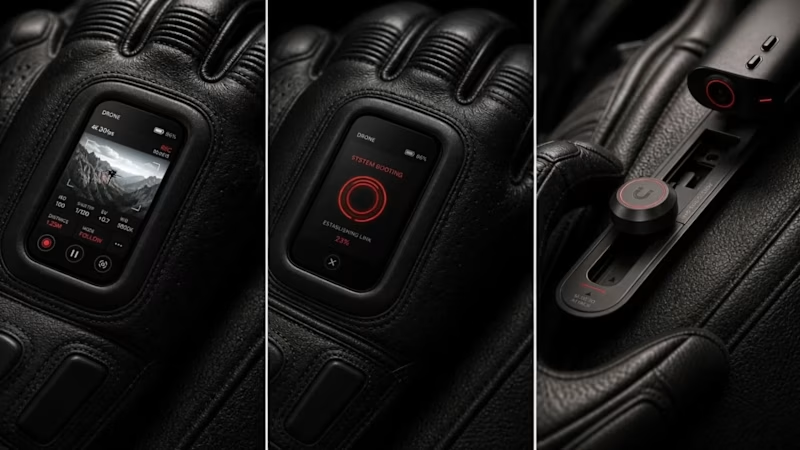
The Smart Shoulder Drone for Motorcycle Passengers After over 100,000 kilometers traveling as a passenger on a heavy Harley-Davidson, I desperately wanted a way to capture the journey without sacrificing safety or the sheer joy of the ride. Holding a phone or a heavy camera at highway speeds is dangerous and exhausting. It’s a compact, magnetic shoulder-mounted drone controlled by a smart leather glove with an embedded micro-OLED screen. My Melius Workflow: I utilized the Melius agent not just to prompt, but to architect a complete production studio on the canvas. Stage 1: Hardware Lock (The Source of Truth). I briefed the agent to generate studio-quality master shots of the drone and the smart glove. I then instructed the agent to hard-wire these specific nodes as global visual references (Image-to-Image/ControlNet) for the rest of the canvas to prevent the model from hallucinating new designs. Stage 2: Storyboarding. The agent built a storyboard branch, placing the locked product designs into realistic environments (highway, golden hour) using precise text nodes to establish the narrative. Stage 3 & 4: Commercial & UGC Video Pipelines. I tasked the agent to build complex Image-to-Video branches. For the promo video, the agent generated sequential keyframes (First, Mid, Last) showing UI interactions and mechanical sliding, which were then routed into video nodes. For the UGC branch, the agent completely shifted the aesthetic to raw, vertical smartphone footage while maintaining the exact hardware design. Stage 5: Assembly. Text nodes were used as a director's script on the canvas to dictate the exact sound design and features (USPs) being highlighted before final video generation. Feedback: As a UI/UX designer, the node-based canvas feels incredibly intuitive. Generative AI usually feels like a chaotic slot machine, but Melius turns it into a structured, production-ready pipeline. The ability to converse with the agent, ask it to build branches based on specific logic, and literally see the "wires" connecting a master reference to a final video output gives an unprecedented level of creative control. It allowed me to act as an Art Director rather than just a prompt engineer. Project flow: https://app.melius.com/projects/b3edd6cc-ec50-49fa-b861-80fbe443ef97/canvas/2aefaa54-3d08-4265-b21b-83233c694be2 X Post: https://x.com/KrisAnfalova/status/2056718110682489214?s=20 Travel more and ride safely!
1
1.1K
7
Cadvel Brand Identity Design
7
38
7
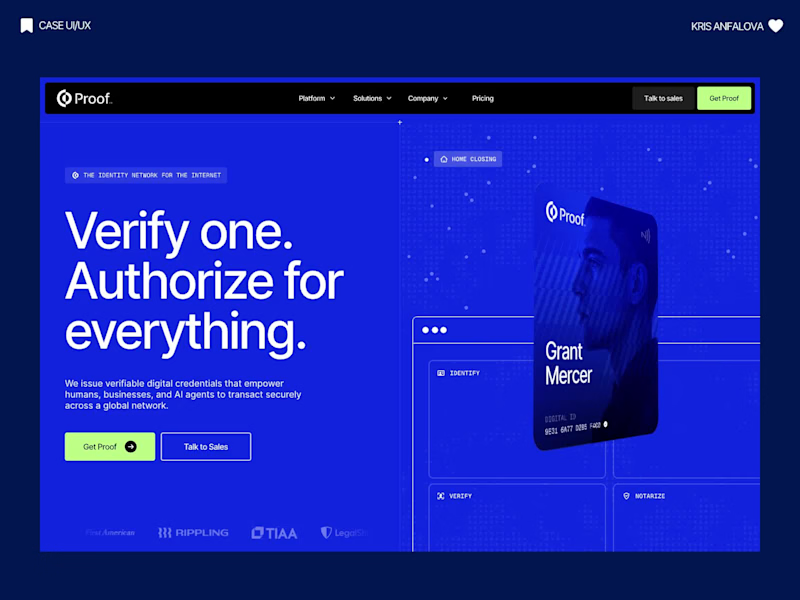
B2B SaaS website design for Proof — an identity platform that lets AI agents act on behalf of real people, built to convert enterprise security buyers. Proof issues cryptographically verified credentials: a human verifies once, and their AI agent is then authorized to sign, notarize or transact for them. The site had to sell a category most buyers had never heard of — agent authorization — to security, compliance and engineering leads at banks, law firms and hospitals, and move them into a sales conversation instead of a bounce. The hero says it in five words — "Verify one. Authorize for everything." — next to a live credential card, so an abstract protocol becomes something you can see in two seconds. The page alternates near-black, white and electric blue, and every switch marks a new argument: the risk, the mechanism, the network, the platform, the API. That rhythm keeps a 14-section B2B SaaS website scannable in a single scroll. I built 20+ Lottie animations for the parts copy can't carry — credential signing, the authorization handshake, the global network map — kept light enough not to cost load time. For imagery I wrote a style recipe for AI generation (one lens, one lighting setup, one grade) so the finance, legal and healthcare scenes read as one commissioned shoot rather than stock AI. Technical buyers get a real code block with real API calls, because that section is what they scroll to find. 14+ sections, desktop and mobile designed separately, a component library, Lottie files ready for the dev team, and a written art-direction guide for generating new imagery in-brand.
6
7
242
16
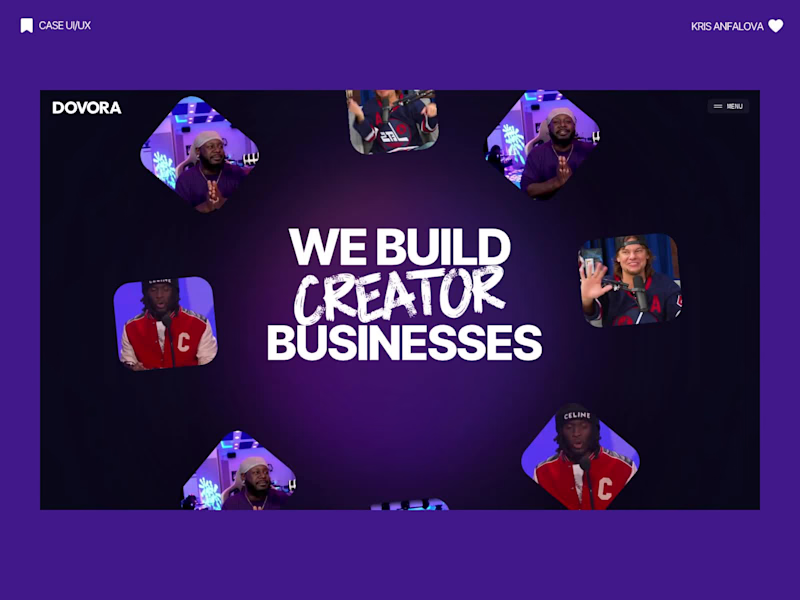
Designed the website for Dovora — an agency that builds businesses for creators, not brand deals. "We don't represent brands, we don't split focus" is basically the whole pitch, and I wanted the site to feel just as uncompromising. So no polished stock creator-economy visuals. The hero is a wall of real streamer/podcast footage arranged in overlapping diamonds and rounded frames — actual creators, mid-stream, mid-laugh — with a glowing gradient orb behind bold "WE BUILD CREATOR BUSINESSES" type. It reads more like a highlight reel than a landing page, which felt right for an audience that lives on camera. The second section flips the energy completely — dark, minimal, almost aggressive typography ("BUILT EXCLUSIVELY FOR CREATORS. FULL STOP.") paired with huge chrome-and-neon 3D letterforms spelling out CREATORS. It's loud in a completely different way than the hero, and that contrast is intentional — this isn't a buttoned-up agency deck, it's built for people who make content for a living. Genuinely fun brief to lean all the way into.
8
16
588
Melius
(1)
Follow
Message
Explore people