Projects using Manus AI in SydneyProjects using Manus AI in SydneyAI Agentic Systems and the Future of Boutique Accounting Firms:
[PROBLEM]?
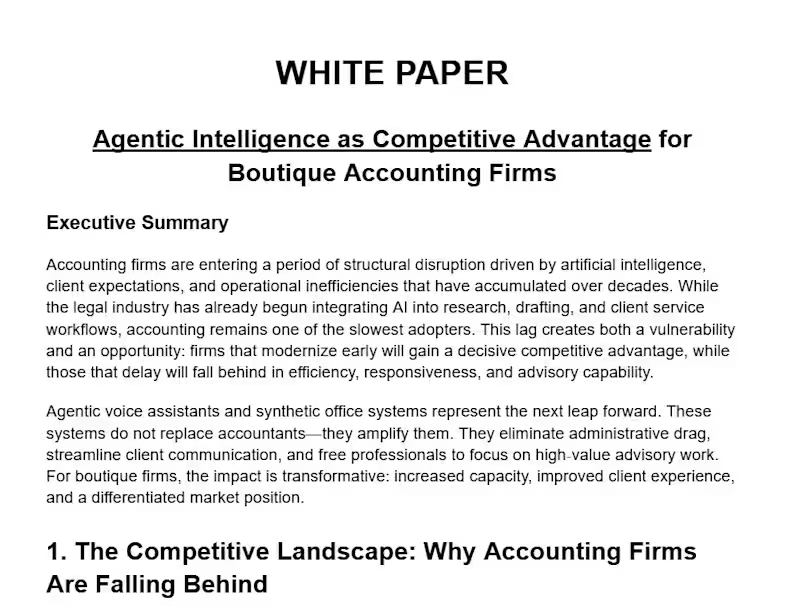
The boutique accounting model is hitting a structural breaking point. Between shrinking margins, offshore labor inconsistencies, and the "seasonal burnout" of compliance deadlines, most firms are operating in a state of permanent operational chaos.
While other professional sectors pivot to autonomous systems, accounting remains trapped in legacy workflows and risk-averse cultures. This gap isn't just an efficiency leak—it’s a terminal threat. If your firm’s growth is still limited by "billable hours" and human bandwidth, you aren't just behind; you’re invisible to the modern market.
[SOLUTION]?
The future of professional services is Agentic. I’ve architected a roadmap for boutique firms to transition from administrative drag to a scalable, "always-on" operational backbone. Learn how to leverage autonomous AI agents to amplify your "Tax Brain" and reclaim 24/7 responsiveness without adding a single line to your payroll.
Introduction: A Profession at a Crossroads
The accounting industry is entering a moment of structural tension. On one side, firms face rising client expectations, shrinking margins, offshore labour dependencies, and the relentless pressure of compliance deadlines. On the other, a new wave of AI — especially agentic systems capable of autonomous action — is reshaping how professional services operate.
While the legal industry has already begun integrating AI‑driven intake systems, automated drafting tools, and client‑facing agents, accounting remains several steps behind. The gap is widening, not because accountants lack intelligence or discipline, but because the industry is built on legacy workflows, risk‑averse cultures, and seasonal bottlenecks that leave little room for experimentation.
Yet the firms that embrace agentic AI now — especially boutique practices with lean teams or offshore staff — stand to gain the most. They can build a 24/7 operational backbone without hiring additional employees, reduce administrative drag, and create a client experience that feels modern, responsive, and deeply professional.
This essay explores how agentic systems can transform boutique accounting firms, and why the shift is not just technological — it is existential.
1.
The Operational Reality of Boutique Accounting Firms
Boutique firms face a unique set of pressures:
No full‑time receptionist
Offshore staff working different time zones
Partners juggling client work, admin, and business development
High email volume with low triage capacity
Missed calls turning into missed opportunities
Seasonal overload (BAS, tax time, EOFY)
Fragmented workflows across multiple apps
In many firms, the partner becomes the bottleneck — not because of lack of skill, but because the operational load is too heavy for one person to carry.
Agentic AI systems directly address this structural imbalance.
2.
What Agentic Systems Actually Do
Unlike traditional automation, which follows rigid rules, agentic AI can:
interpret context
make decisions
take actions
communicate with clients
escalate issues
organise information
and operate continuously
These systems behave less like tools and more like junior staff members — except they never sleep, never forget, and never lose track of a task.
Core agentic capabilities relevant to accounting firms include:
Auto‑responding to emails with context‑aware replies
Answering phone calls through AI voice agents
Taking bookings and syncing calendars
Triaging client messages into correct folders or workflows
Extracting documents and placing them in the right client file
Summarising client requests for the partner
Following up on missing information
Sending reminders for deadlines or outstanding tasks
Routing work to offshore or local staff based on complexity
This is not “chatbot automation.”
This is operational intelligence.
3.
The 24/7 Office: AI as the In‑House Staff You Don’t Have
For boutique firms, the biggest advantage of agentic systems is continuity.
AI agents can:
answer every call
respond to every email
capture every lead
log every message
organise every document
notify the partner instantly
and maintain a professional presence even when the office is empty
This is transformative for firms where:
the partner is often on the road
staff work offshore
no one is available to answer calls
admin tasks pile up
client communication is inconsistent
A voice agent can take a call at 11pm, gather the client’s details, summarise the issue, and send a message to the partner — all before the partner wakes up.
A messaging agent can receive a client’s email, extract the attachments, classify the work (BAS, payroll, tax, advisory), and place it in the correct workflow folder for the offshore team.
This is not the future.
This is available now.
4.
Why Accounting Lags Behind Legal — and Why That’s Changing
The legal industry adopted AI faster because:
client intake is predictable
document drafting is repetitive
firms are used to outsourcing
margins allow for experimentation
partners are accustomed to tech‑enabled workflows
Accounting, by contrast, is:
compliance‑heavy
deadline‑driven
risk‑averse
margin‑sensitive
culturally conservative
But the pressure is building.
Clients expect:
instant replies
digital onboarding
clear communication
transparent workflows
faster turnaround
And firms cannot meet these expectations with offshore labour alone.
Agentic AI fills the gap.
5.
The Agent‑Enabled Accounting Firm: A Practical Blueprint
Here is what a boutique firm can implement today.
A. AI Voice Receptionist (24/7)
answers calls
verifies identity
takes messages
books appointments
sends summaries to the partner
routes urgent matters instantly
B. AI Email Triage Agent
reads incoming emails
extracts documents
identifies the nature of work
sorts into correct client folders
drafts replies for approval
flags urgent items
C. AI Workflow Router
assigns tasks to offshore staff
categorises work by complexity
tracks progress
sends reminders
escalates delays
D. AI Client‑Communication Agent
sends deadline reminders
requests missing documents
follows up automatically
maintains a consistent tone
E. AI Knowledge Assistant
answers internal staff questions
retrieves client history
summarises financial documents
drafts advisory notes
This is the agentic accounting stack — a full operational layer that supports the partner without adding headcount.
6.
The Strategic Advantage: Why This Matters Now
Firms that adopt agentic systems gain:
speed
consistency
professionalism
scalability
client satisfaction
reduced admin load
lower operational costs
better offshore coordination
But the real advantage is this:>>>
Agentic AI gives boutique firms the power of a mid‑sized practice without the payroll.
This levels the playing field.
Conclusion:
The Future Firm Is Hybrid, Not Human‑Only
AI agents will not replace accountants.
They will replace the administrative drag that prevents accountants from doing their best work.
The firms that thrive in the next decade will be those that:
embrace agentic systems
build 24/7 operational layers
reduce manual bottlenecks
integrate offshore teams more intelligently
and deliver a client experience that feels modern and responsive
The legal industry moved first.
Accounting will move next.
And the firms that adopt early will define the new standard...!!!! DONT GET LEFT BEHIND.......
Victor, Creative AI Producer, MIntB,BComm
#AgenticAccounting
#BoutiqueFirmScale
#TaxBrainAutomation
#ProfessionalServices2026
#PracticeModernization [PROBLEM]
Most organizations rarely fail because of a poor strategy. They fail because of poor alignment around that strategy. Leaders assume that once a vision is communicated, it’s understood—but communication is not comprehension.
The default state of any company isn't unity; it's fragmentation. While the executive team sees a clear roadmap, the frontline is often operating on "narrative battlegrounds" where competing department stories quietly undermine execution. This "Strategic Blind Spot" is the silent killer of productivity and growth in modern enterprise.
[SOLUTION]
Strategic alignment is not a passive byproduct of a quarterly roadmap—it’s a weekly discipline of Contextual Stitching. I’ve architected a deep dive into how leaders can move beyond the "Illusion of Shared Understanding" to build a unified organizational narrative that actually scales.
The Leader’s Blind Spot:
Why Most Organizations Fail at Strategic Alignment "Strategic alignment is the most overused phrase in business and the least understood. Most leaders assume alignment is a natural byproduct of a good strategy. It isn’t. In fact, the default state of any organization is misalignment—and it spreads silently until it kills execution."
We’ve all seen it: Finance tells a story of cost control while Product tells a story of experimentation. When your teams are operating on fragmented narratives, your strategy becomes mere noise. You aren't failing because the plan is bad; you're failing because your organization is a narrative battleground of competing priorities.
" Alignment isn't a kick-off meeting; it’s a weekly discipline of Contextual Stitching. I’ve architected a deep dive into the "Leader’s Blind Spot," revealing how to move from the illusion of shared understanding to a unified strategic narrative that scales." It is not passive. It is not the default state of an organization. In fact, the default state is misalignment — and most leaders don’t realize how quickly it spreads, how quietly it compounds, or how deeply it undermines execution.
The uncomfortable truth is this: organizations rarely fail because of poor strategy. They fail because of poor alignment around the strategy. And the root cause is almost always the same — a leadership blind spot around how humans interpret information, incentives, and narrative.
1. The Illusion of Shared Understanding
Most leaders assume that once a strategy is communicated, it is understood. But communication is not comprehension. A strategy that feels obvious to the executive team often feels abstract, distant, or irrelevant to frontline employees. The further a message travels down the hierarchy, the more it fragments.
This is not because employees are disengaged — it’s because humans interpret information through the lens of their role, pressures, and incentives. A product manager hears the strategy differently than a sales director. A customer success lead hears it differently than a finance analyst. Without deliberate translation, the strategy becomes a collection of competing interpretations rather than a shared mental model.
Leaders underestimate how much contextual stitching is required to turn a strategic idea into a unified organizational narrative.
2. Narrative Fragmentation: The Silent Killer of Alignment
Organizations are storytelling ecosystems. Every team tells a story about what matters, what success looks like, and how decisions should be made. When these stories conflict, alignment collapses.
A company may claim to prioritize innovation, but if:
Finance tells a story about cost control
Operations tells a story about risk avoidance
Marketing tells a story about speed
Product tells a story about experimentation
…then the organization becomes a narrative battleground.
Alignment requires one coherent story — a strategic narrative that every team can translate into their own context without distorting the core message. Without narrative coherence, even the best strategy becomes noise.
3. The Priority Paradox: When Everything Matters, Nothing Does
One of the most common leadership blind spots is the belief that more priorities create more progress. In reality, more priorities create more fragmentation.
When leaders articulate too many priorities, teams default to local optimization:
“What helps my department?”
“What protects my metrics?”
“What keeps my team safe?”
This is how organizations drift — not through dramatic failures, but through thousands of micro‑decisions made in isolation.
Alignment requires ruthless prioritization. Leaders must define:
What matters most
What matters next
What doesn’t matter at all
Without this clarity, teams fill the ambiguity with their own assumptions, and alignment dissolves.
4. The Missing Feedback Loop
Most organizations treat strategy as a one‑way broadcast: leadership speaks, the organization listens. But alignment is not a speech — it’s a conversation.
High‑alignment organizations build feedback loops that surface misalignment early:
Are teams interpreting the strategy correctly?
Are priorities understood the same way across functions?
Are decisions being made in alignment with the narrative?
Are incentives reinforcing or undermining the strategy?
Without feedback loops, leaders operate in an echo chamber. They assume alignment because no one is telling them otherwise. But silence is not alignment — silence is a lack of psychological safety.
5. Cognitive Bias: The Leader’s Hidden Enemy
Leaders often assume their perspective is the organization’s perspective. They underestimate how much context they possess and how little context others have. This creates a gap between intention and interpretation.
Leaders think in frameworks. Teams think in tasks. Leaders think in horizons. Teams think in deadlines. Leaders think in narratives. Teams think in deliverables.
Alignment is not achieved when leaders think clearly — it is achieved when everyone thinks clearly. And that requires leaders to decentralize understanding, not just delegate execution.
6. The Organizations That Get Alignment Right
The companies that master alignment share three traits:
A. They communicate strategy as a narrative, not a document.
They don’t rely on slides. They rely on story. They articulate:
the problem
the stakes
the opportunity
the path forward
the role each team plays
Narrative creates coherence. Coherence creates alignment.
B. They operationalize priorities with precision.
They don’t say “everything is important.”
They say “this is what matters now.”
They define:
the one priority that drives the next 90 days
the metrics that matter
the trade‑offs they are willing to make
This eliminates ambiguity and accelerates execution.
C. They build alignment as a continuous practice.
Alignment is not a kickoff meeting.
It is not a quarterly ritual.
It is a weekly discipline.
High‑alignment organizations:
revisit priorities
recalibrate narratives
reinforce context
adjust based on feedback
communicate relentlessly
Alignment is maintained through rhythm, not intensity.
7. The Leadership Imperative
In a world where complexity is rising and attention is shrinking, alignment is no longer a “nice to have.” It is a competitive advantage. It determines:
speed
clarity
execution quality
employee engagement
customer experience
organizational resilience
Leaders who master alignment build organizations that move as one — fast, focused, and confident. Leaders who ignore alignment build organizations that move in fragments — slow, confused, and reactive.
The difference is not strategy.
The difference is clarity.
The difference is narrative.
The difference is leadership.
SHARE or forward the full Executive White Paper: [Insert Bitly Link]
strategiccopywriting (https://contra.com/community/topic/strategiccopywriting)
fintechdesign (https://contra.com/community/topic/fintechdesign)
agenticarchitecture (https://contra.com/community/topic/agenticarchitecture)AI Agent Engineer (https://contra.com/community/topic/ai-agent-engineer)AI Automation (https://contra.com/community/topic/ai-automation)AI Fact Checking (https://contra.com/community/topic/ai-fact-checker)
Google Gemini (https://contra.com/community/topic/google-gemini)
Mural (https://contra.com/community/topic/mural)
synthflow Ai (https://contra.com/community/topic/synthflow-ai) 
![Cover image for [PROBLEM]
Most organizations rarely fail because](https://media.contra.com/image/upload/w_800,q_auto/u5d4hn0lr81uyopbrwzb.avif)