Filmmaking Projects in São PauloFilmmaking Projects in São PauloA SMALL MERCY
30 seconds. One act of kindness. One unbroken take.
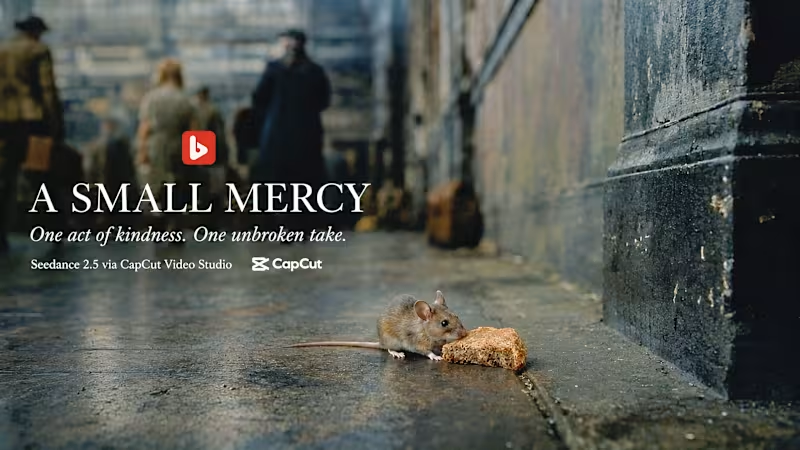
While the whole station rushed toward the next train, one little girl quietly shared her bread with the smallest life. 🐭🍞 Sometimes humanity survives in the quietest moments.
A SMALL MERCY is a 30-second wartime short about tenderness surviving inside urgency.
Set in a winter London railway station in the 1940s, the film begins high above a vast world of soldiers, civilian travelers, luggage, steam, orders, and constant movement.
In one uninterrupted physical camera move, the perspective gradually descends from the scale and pressure of the station to the vulnerable world of a small mouse at floor level.
The mouse moves almost unnoticed through the crowd. Its struggle is quiet, physical, and easy for the larger world to overlook.
Eventually, it reaches the torn shoe of a little girl waiting beside her grandmother at the ticket window.
The camera rises naturally to reveal the girl quietly eating a small piece of coarse bread. When she notices the mouse, her response is deliberately simple: no speech, no dramatic reaction. She simply recognizes another living creature in need and shares part of what little she has.
Because the bread itself is scarce, the gesture carries weight.
Her compassion is not grand or performative.
It is instinctive.
The girl’s worn clothing and torn shoe are intentional. They are not simply period details; they place her within the same wartime world of scarcity and vulnerability as the mouse.
The mouse first reaches her through the damaged part of that shoe — a visible sign that she, too, is living with less.
That makes the bread more important.
She is not giving from excess. She is sharing something that has value to her.
The mouse first encounters her vulnerability, and then her mercy.
What begins as an instinctive act of survival — the mouse nibbling at the torn shoe — becomes an encounter between two vulnerable lives when the girl chooses to offer it part of her own food instead.
The gesture matters precisely because she has little to spare.
The One-Take Language
Camera choreography: high → descend → track → rise → observe → descend → hold.
The uninterrupted take is not simply a technical device. It is the storytelling itself.
The camera begins with the scale of the station, then physically lowers our attention toward something almost invisible within it.
As the camera moves closer to the mouse, the sound perspective narrows too — from the huge reverberation of the railway station to boots, footsteps, floor vibrations, fabric, dry bread, and small movements.
When the girl notices the mouse, the camera does not isolate the moment from the world around it.
The grandmother’s ticket transaction continues quietly in the background.
Trains still wait.
People still move.
Orders are still given.
The station remains urgent.
Nothing stops for this moment.
Yet, for a few seconds, the girl creates a small space of care within it.
The guiding thought behind the film was:
“In a world moving too fast to notice, someone noticed.”
The line is never spoken or displayed. It is simply the principle beneath the film.
The final camera decision is essential to that idea.
When the girl and her grandmother leave, the camera does not follow them.
It stays behind.
The station continues moving in the background while the mouse remains beside the wall, eating the bread she left for it.
The film does not resolve the war.
It does not transform the station.
It does not suggest that one small gesture can change the world.
It simply allows that gesture to exist.
And for one small life, for one brief moment, that is enough.
Production Approach
The process began with crafting the story, followed by visual research using archival references of 1940s London railway stations to establish the period, architecture, scale, and atmosphere.
From there, dedicated visual references were developed for the girl, grandmother, and mouse, alongside period-specific research and reference material for British soldiers, civilian travelers, wartime clothing, footwear, luggage, weapons, and supporting props.
Before generation, the station geography and character blocking were mapped with precise timing across the full 30 seconds — defining exactly when the camera would discover the mouse, follow its journey, reach the girl, reveal the human relationship, observe the act of compassion, descend again, and settle into the final frame.
The complete camera choreography and cinematography were then defined: lens character, camera height, physical movement, composition, depth, winter lighting, atmospheric treatment, and the restrained pale blue-grey visual language of the film.
The storyboard was designed not as a sequence of separate shots, but as one uninterrupted 30-second take, mapping a single physical camera journey from the high architecture of the station to the final mouse-level hold.
Music and sound design were also planned before generation.
The sound perspective was designed to move with the camera — from the large reverberant environment of the station to the intimate world of boots, floor vibrations, fabric, bread, and the mouse — while the restrained score follows the same emotional progression without becoming sentimental.
Story → archival research → visual references → blocking & timing → camera choreography → cinematography → continuous-take storyboard → music & sound design → generation
This structured pre-production became the foundation for the final execution.
The core 30-second film was achieved in the very first generation, demonstrating how detailed filmmaking decisions made before generation can shape a coherent one-take result rather than leaving storytelling, performance, and camera language to chance.
Created with Seedance 2.5 via CapCut Video Studio.
Note: the opening title was generated as part of the film itself.
Links🚀
X: https://x.com/Berikystudios/status/2089171298664546759
TikTok: https://www.tiktok.com/@berikystudios/video/7674809187699805458
https://www.tiktok.com/@berikystudios/video/7674814580530482450
Instagram:
https://www.instagram.com/p/DcH39B8gkgH/
https://www.instagram.com/p/DcH4WpygYzK/
Youtube:
https://youtu.be/R7Z2UWulVlw
LinkedIn:
https://www.linkedin.com/feed/update/urn:li:ugcPost:7494945424458276864/
https://www.linkedin.com/feed/update/urn:li:ugcPost:7494946347880714241/