Freelance Filmmakers in São PauloFreelance Filmmakers in São Paulo
Cover image for Seedance 2.0 — Cinematic Stress Test #6 Cross-Genre Identity...
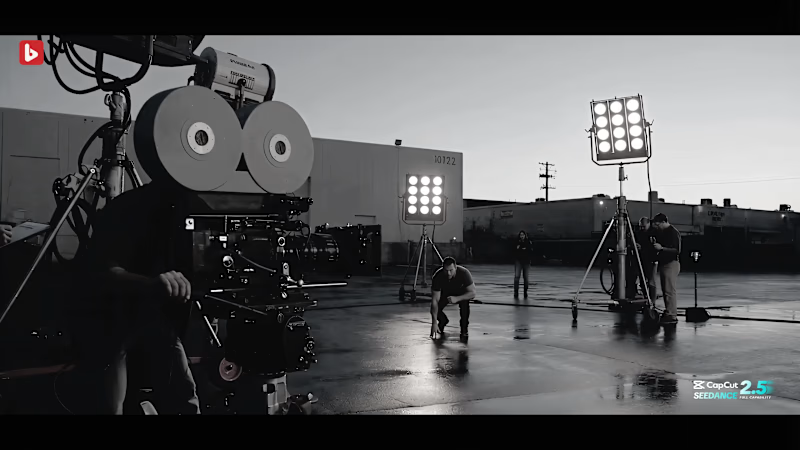
Seedance 2.0 — Cinematic Stress Test #6 Cross-Genre Identity Performance Who remains when the genre changes? Frames 1–6 were generated in a single continuous 15-second prompt. One character. Five genre shifts. No cuts. Romantic → Horror → Courtroom → Fantasy → Psychological tension. Lighting recalibrated. Atmosphere transformed. Emotion evolved in layers. The face did not drift. Micro-expressions progressed. Breathing shifted. Tension accumulated. That was the structural test. Then came the deliberate intervention. The final shot — revealing the set, visible cameras, the director calling “Cut” — was integrated intentionally as a separate controlled generation. Not to add spectacle. But to close the authorship loop. Because identity retention is not only about facial geometry. It is about narrative coherence across layers. The character survived five genre transformations. Then she survived exposure. And in doing so, she returned to the origin of this entire stress test — the fire location from Demo 1. The fire remained. The smoke remained. The world remained. Only the layer of reality shifted. What was once narrative danger became production space. What felt like cinematic chaos revealed itself as constructed illusion. The location did not change. The authority did. And that is the real threshold. Identity is not only facial consistency. It is the ability to remain coherent when the hierarchy of the frame collapses — when fiction dissolves and authorship steps into view. AI can simulate environments. But directing the transition between narrative reality and production reality — without fracturing identity — that is cinematic control. The frame shifts. Authorship becomes visible. And the system holds. The full 15-page structured can be requested via the original reel post here: https://lnkd.in/dRQDM46M (https://lnkd.in/dRQDM46M)🔎 Explore Full Cinematic Stress Test Series: Test #1 https://lnkd.in/dw5KH9xj (https://lnkd.in/dw5KH9xj)Test #2 https://lnkd.in/dZZc_vPG (https://lnkd.in/dZZc_vPG)Test #3 https://lnkd.in/dG-qukW6 (https://lnkd.in/dG-qukW6)Test #4 https://lnkd.in/dJ_cMbXp (https://lnkd.in/dJ_cMbXp)Test #5 https://lnkd.in/dqTw_qeQ (https://lnkd.in/dqTw_qeQ)Test #6 https://lnkd.in/deVc3yw2
1
29
Cover image for Seedance 2.0 — Cinematic Stress
Seedance 2.0 — Cinematic Stress Test #5 Who Controls the Frame in AI Cinema? This is not a film scene meant to entertain. It’s a stress test for authority & perspective reversal. In traditional cinema, authorship is structured: The director frames. The editor controls time. The audience interprets. In AI cinema, authorship destabilizes: Is it the model? The prompt? The dataset? — Or the director? This test is a structural experiment in perspective. From frame one, we are inside a cinema hall: An audience is watching a film. On the screen, a woman speaks with emotional intensity — her gaze feels aimed at the theatre audience, maybe even at us. And yet something else is present: A post-production desk is visible from the start — embedded in the hall, easy to ignore. The frame carries layered authority: Layer 1 — An audience watching a film. Layer 2 — A character seemingly breaking the fourth wall. Layer 3 — Riot police revealed inside the film. Layer 4 — The edit room constructed inside the cinema space itself. What makes this scene — not just narrative — is the dual camera logic. The scene begins by tracking in toward the screen, pulling the viewer into the woman’s gaze — so it feels like she is speaking to us. But inside the film (on the screen), the movement resolves in the opposite direction: a track-out that reveals the riot police line. Same performance. Two camera hierarchies. The frame doesn’t just move — it reallocates power. When the camera crosses into the screen, hierarchy shifts: She is not speaking to us. She is speaking to power. Then the gaze is reassigned again — from protagonist to officer. Authority reframed. And then: The screen shuts down. The illusion collapses. The edit desk — visible from frame one — becomes the dominant layer. This was never about spectacle. It was about authorship under layered perception. Seedance 2.0 sustained: • Crowd alignment precision • Direct-gaze realism • No-cut spatial continuity • Emotional performance stability • Multi-layer environmental coherence But realism is only half the test. Control is the other half: Can a director invert authority inside an AI system — and still steer perception across layers? Because in AI cinema, the frame doesn’t belong to the model. It belongs to whoever can architect perception. That’s the difference between generating images and directing systems. The next era of AI filmmaking won’t be led by prompters. It will be led by directors who understand where control truly resides. The full 15-page structured case study can be requested via the original reel post: https://lnkd.in/dRQDM46M (https://lnkd.in/dRQDM46M)🔎 Explore Full Cinematic Stress Test Series: Test #1 https://lnkd.in/dw5KH9xj (https://lnkd.in/dw5KH9xj)Test #2 https://lnkd.in/dZZc_vPG (https://lnkd.in/dZZc_vPG)Test #3 https://lnkd.in/dG-qukW6 (https://lnkd.in/dG-qukW6)Test #4 https://lnkd.in/dJ_cMbXp (https://lnkd.in/dJ_cMbXp)Test #5 https://lnkd.in/dqTw_qeQ (https://lnkd.in/dqTw_qeQ)Test #6 https://lnkd.in/deVc3yw2
1
22
Cover image for Seedance 2.0 — Cinematic Stress
Seedance 2.0 — Cinematic Stress Test #4 Continuous World Morphing Without Cuts This was not a transition test. It was a spatial coherence stress test. A single forward camera push. No cuts. No hidden wipes. No stitched segments. One continuous 12-second evolution across four radically distinct cinematic worlds: War → Sci-Fi → Medieval → Cyberpunk The camera begins in a destroyed battlefield. Smoke, fire, debris, collapsing structures. Without a cut, the smoke restructures into digital haze. Metallic walls form. Blue neon corridors emerge. The camera continues forward. Cold steel geometry reshapes into medieval stone architecture. Torches replace LEDs. Banners replace panels. Warm firelight recalibrates the entire scene. Then the stone dissolves. Rain was there in Cyberpunk scene. Neon reflections spread across wet asphalt. A cyberpunk city forms around the same camera path. No cut. No reset. No camera jump. The stress points were precise: • No-cut environmental transformation • Lighting adaptation across genre shifts • Particle-to-architecture logic • Texture continuity • Camera path integrity Under radical genre mutation, most systems fracture. Perspective drifts. Scale warps. Edges tear. Light loses logic. Here, spatial continuity held. The forward push remained intact. World logic recalibrated instead of collapsing. Textures evolved without tearing. Lighting adapted without distorting geometry. This was not about stylistic change. It was about whether the world itself could transform while respecting cinematic physics. Which makes the result even more revealing: Even under partial generation pressure, structural coherence did not collapse. Cinema is not only character. It is space. And space must behave. The full 15-page structured case study can be requested via the original reel post here: https://lnkd.in/dRQDM46M (https://lnkd.in/dRQDM46M)🔎 Explore Full Cinematic Stress Test Series: Test #1 https://lnkd.in/dw5KH9xj (https://lnkd.in/dw5KH9xj)Test #2 https://lnkd.in/dZZc_vPG (https://lnkd.in/dZZc_vPG)Test #3 https://lnkd.in/dG-qukW6 (https://lnkd.in/dG-qukW6)Test #4 https://lnkd.in/dJ_cMbXp (https://lnkd.in/dJ_cMbXp)Test #5 https://lnkd.in/dqTw_qeQ (https://lnkd.in/dqTw_qeQ)Test #6 https://lnkd.in/deVc3yw2
2
26
Cover image for Seedance 2.0 — Cinematic Stress
Seedance 2.0 — Cinematic Stress Test #3 Meta-Layer Narrative Collapse Across Generations This was not a visual test. It was a narrative rupture test. The sequence begins as a high-intensity action scene: • Handheld motion. • Explosion physics. • Lip sync under emotional stress. • Slow-motion beat. • Firelight flicker interacting with emergency lights. Then the structure shifts. The action scene is revealed to be playing inside a post-production studio. Film → Monitor → Edit room → Character awareness. The woman on screen stops running. She turns toward the camera. “You’re watching me.” At that moment, the storytelling layer collapses. This test required the model to sustain: • Explosion physics under motion • Lip sync accuracy under emotional intensity • Screen-within-screen realism • Seamless continuation across two separate generations • Precise timing of narrative layer collapse • Controlled overexposure without structural distortion Most generative systems can produce action. Fewer can maintain continuity while structurally shifting narrative context. Under these constraints, coherence held. The monitor reflections behaved naturally. The transition between generations remained seamless. The character identity did not fracture across layers. The overexposure expanded without tearing geometry. This is not image generation. It’s structural storytelling under meta-layer pressure. Cinema is not only about movement. It’s about layers — and whether those layers survive collapse. The full 15-page structured case study can be requested via the original reel post here: https://lnkd.in/dRQDM46M (https://lnkd.in/dRQDM46M)🔎 Explore Full Cinematic Stress Test Series: Test #1 https://lnkd.in/dw5KH9xj (https://lnkd.in/dw5KH9xj)Test #2 https://lnkd.in/dZZc_vPG (https://lnkd.in/dZZc_vPG)Test #3 https://lnkd.in/dG-qukW6 (https://lnkd.in/dG-qukW6)Test #4 https://lnkd.in/dJ_cMbXp (https://lnkd.in/dJ_cMbXp)Test #5 https://lnkd.in/dqTw_qeQ (https://lnkd.in/dqTw_qeQ)Test #6 https://lnkd.in/deVc3yw2
2
28
Cover image for Seedance 2.0 — Cinematic Stress
Seedance 2.0 — Cinematic Stress Test #2 A 12-Second Multi-Shot Trailer Generated in One Prompt A trailer is not a scene. It’s controlled narrative compression. This wasn’t edited. It wasn’t stitched from multiple generations. It wasn’t assembled shot by shot. This entire 12-second multi-shot trailer was generated from a single prompt. Three characters. Wide shots. Close-ups. Flashback insert. Backlit silhouette. Explosion beat. Pre-climax charge. Slow motion before impact. All inside one continuous generation. Trailer pacing is where most generative systems begin to fracture. Faces drift. Costumes mutate. Lighting shifts distort geometry. Continuity collapses under compression. Here, identity remained stable. The hero in second one is the same hero in second twelve. Costume integrity held. Micro-expressions evolved. The slow-motion frame amplified narrative tension while preserving anatomical coherence under dynamic motion. The contrast between kinetic aggression and static dominance elevated the confrontation beyond physical action. This is not about generating “cool shots.” It’s about whether AI can sustain editorial compression without external stitching. Montage is the real test. And under that test — structural coherence held. The full 15-page structured case study can be requested via the original reel post here: https://lnkd.in/dRQDM46M (https://lnkd.in/dRQDM46M)🔎 Explore Full Cinematic Stress Test Series: Test #1 https://lnkd.in/dw5KH9xj (https://lnkd.in/dw5KH9xj)Test #2 https://lnkd.in/dZZc_vPG (https://lnkd.in/dZZc_vPG)Test #3 https://lnkd.in/dG-qukW6 (https://lnkd.in/dG-qukW6)Test #4 https://lnkd.in/dJ_cMbXp (https://lnkd.in/dJ_cMbXp)Test #5 https://lnkd.in/dqTw_qeQ (https://lnkd.in/dqTw_qeQ)Test #6 https://lnkd.in/deVc3yw2
1
26
Cover image for Seedance 2.0 — Cinematic Stress
Seedance 2.0 — Cinematic Stress Test #1 Structural Endurance Across Action, Fall & Transformation in a Continuous One-Shot Sequence This 45-second sequence wasn’t built to “look cool.” It was built to break the system. It was designed and structured as a continuous one-shot escalation under cinematic pressure. No narrative reset. No perspective shift. No structural relief. The sequence begins with: • High-intensity handheld tracking • Realistic explosion physics • Running into a slow-motion emotional beat • Synchronized dialogue under slow motion • Firelight flicker interacting with emergency lighting Already — multiple instability triggers. Then the pressure compounds: Action → Physical stumble → Ground-level fall → Locked vertical mechanical lift → Non-gory face peel transformation All inside what behaves as a single unbroken shot. Each stage pressures a structural constraint — not just image generation. The objective wasn’t spectacle — but to test whether the model could sustain: • Continuity • Physics • Mechanical obedience • Anatomical realism • Tension control Under these compounded constraints, structural stability held. The fall preserved weight and balance. The vertical lift respected its mechanical restriction. The transformation maintained anatomical coherence. The final freeze retained identity without distortion. Technically, the sequence was generated across three separate 15-second outputs. But it was architected — and perceived — as one continuous shot. No intervention inside the generated shots themselves. Only structural linking between outputs. In the edit, I used a brief micro-black flicker at the segment boundary as a deliberate transition device — a perceptual blink — to preserve the one-shot intensity and pacing. The second-to-third handoff required no additional treatment; continuity held naturally. When a system sustains escalating cinematic pressure inside a perceived one-shot structure, it demonstrates something rare: Cinematic controllability under structural escalation. That is the threshold that matters. Not “Can it generate?” But “Can it endure direction?” The next wave of AI filmmaking won’t be led by prompters. It will be led by directors who understand structure, perception, and control. The full 15-page structured case study can be requested via the original reel post: https://lnkd.in/dRQDM46M (https://lnkd.in/dRQDM46M)🔎 Explore Full Cinematic Stress Test Series: Test #1 https://lnkd.in/dw5KH9xj (https://lnkd.in/dw5KH9xj)Test #2 https://lnkd.in/dZZc_vPG (https://lnkd.in/dZZc_vPG)Test #3 https://lnkd.in/dG-qukW6 (https://lnkd.in/dG-qukW6)Test #4 https://lnkd.in/dJ_cMbXp (https://lnkd.in/dJ_cMbXp)Test #5 https://lnkd.in/dqTw_qeQ (https://lnkd.in/dqTw_qeQ)Test #6 https://lnkd.in/deVc3yw2 (https://lnkd.in/deVc3yw2)
1
25