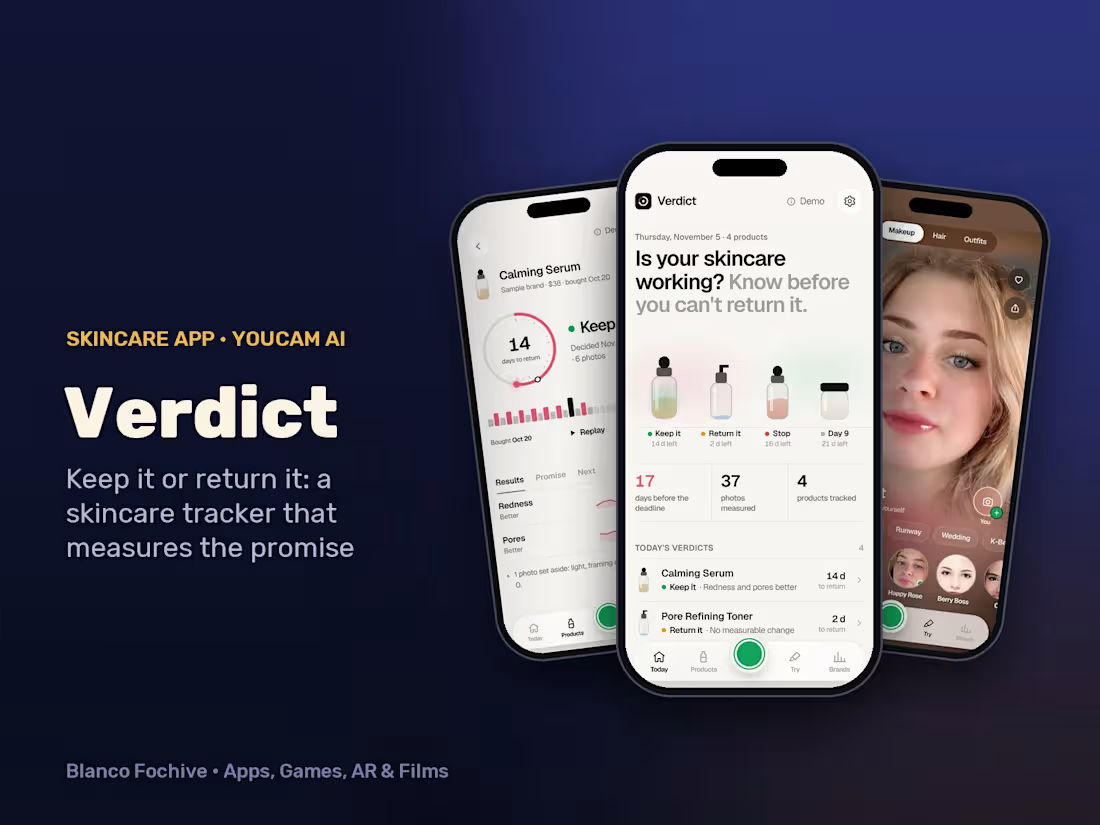
Verdict — know if your skincare works before you can't return it
You buy a serum that promises "less redness in 14 days". On day 27 of a 30-day return window you still can't tell. Verdict measures only what the product promises and tells you to keep it or return it, in time.
What I built
• Label scan: the camera reads the product's promise and keeps only the concerns it makes
• Guided camera: on-device face tracking checks framing, angle and light, and takes the photo itself when it is comparable
• YouCam AI Skin Analysis on the promised concerns, plus Skin Simulation of the promised result on the same photo
• A daily verdict (Keep it, Return it, Stop using) computed on the raw scores against a noise floor, with a day-by-day replay
• Virtual try-on (makeup, hair, outfits) on your own photo, and a Brands view of which claims deliver
Result
• Live YouCam API integration with real analysis, simulation and try-on calls, and a unit budget that cannot be drained
• 83 automated tests, iPhone, iPad and desktop layouts, light and dark mode
• Built for the YouCam API Skin AI & eCommerce hackathon
My role: Product design, UX/UI, front-end, back-end, API integration, demo film
Stack: Next.js, React, TypeScript, YouCam AI Skin Analysis, Skin Simulation and virtual try-on APIs, MediaPipe, Gemini, Vercel
Watch the demo: https://youtu.be/n5KUtNIoHUs | Code: https://github.com/blanco1er/verdict
1
0
69
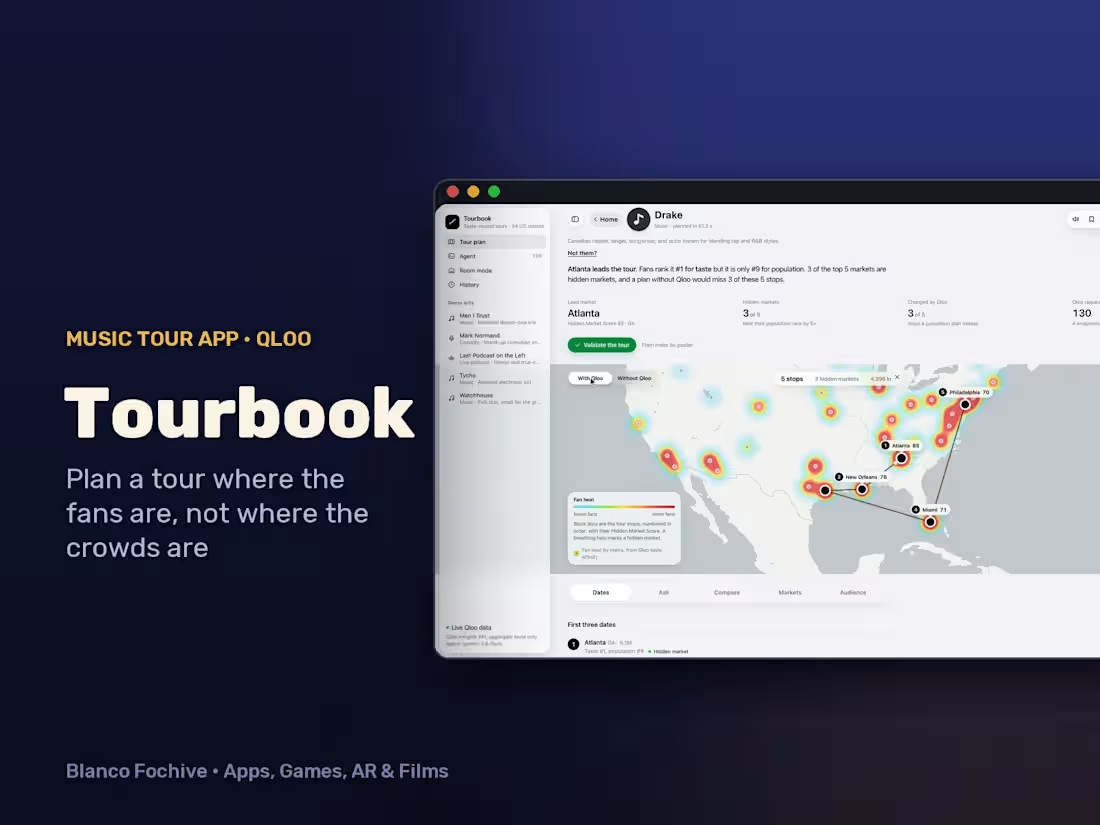
Tourbook — tour routing by taste, not population
Indie tours are routed by population: New York, Los Angeles, Chicago, the biggest rooms and the highest costs. The fans of a mid-size act often over-index in cities no booking agent would put first.
What I built
• A planning agent that ranks 34 US metros with a Hidden Market Score: taste against population
• A fan heat map, a route, and a With / Without Qloo toggle that shows what taste data changed
• A dossier for each date: room, opener, sponsor, after-show spot and crowd brief, each citing its source
• Ask Tourbook: one change in plain words, verified by the server before it applies
• Room mode for venues, a tour poster, a phone layout, light and dark, English and French
Result
• Tested live on Qloo data: one plan makes 30 to 31 Qloo calls across 5 endpoints, 0 rejected parameters
• Ask Tourbook: 15 of 15 requests valid, 60 of 60 independent checks pass
• Built for the Qloo Agentic Hackathon 2026; open source (MIT)
My role: Product design, UX/UI, agent design, front-end, back-end, demo film
Stack: Node.js, Express, JavaScript, MapLibre GL, Qloo Insights API, Google Gemini, Server-Sent Events, Render
Watch the demo: https://youtu.be/5O4NPcu1zE0 | Code: https://github.com/blanco1er/tourbook
0
19
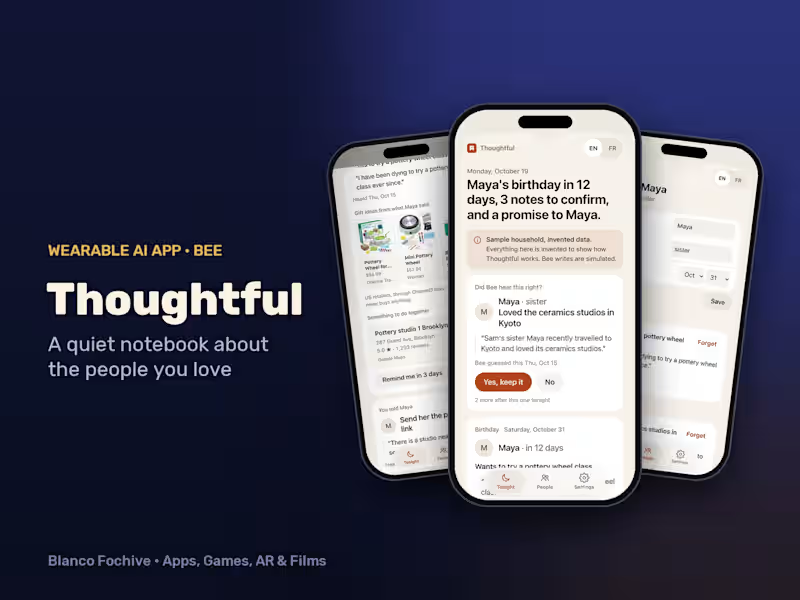
Thoughtful — remember what the people you love care about
A wearable hears that your sister wants to try a pottery class. Two weeks later, at her birthday, that detail is gone. Thoughtful keeps it and gives it back at the right moment, without ever interrupting a conversation.
What I built
• One calm evening card on an Echo Show or an iPhone: a note to confirm, an occasion coming up, a promise you made
• Every note shows the exact words the Bee wearable heard; nothing is used without your yes
• Real gift ideas from her own words, a real place nearby, hidden on shared screens
• A reminder the next day, only after 20 minutes of silence, and a family view on the TV on Sunday
Result
• Reads and writes the Bee wearable's data through its official library (facts, to-dos with alarms, live stream)
• Extraction benchmark on 10 invented conversations: 79 to 93 % recall, 0 private-topic leaks in every run
• Spending cap in code; 50 automated tests; open source (MIT)
• Built for Amazon's Build, Ship, Shape hackathon (Bee track)
My role: Product design, UX/UI, front-end, back-end, privacy design, demo film
Stack: Node.js, Bee CLI library, Amazon Bedrock (Nova 2 Lite), MCP, MCP Apps, Channel3, Google Places, OpenStreetMap
Watch the demo: https://youtu.be/H8SHlFrmOVI | Code: https://github.com/blanco1er/thoughtful
0
13
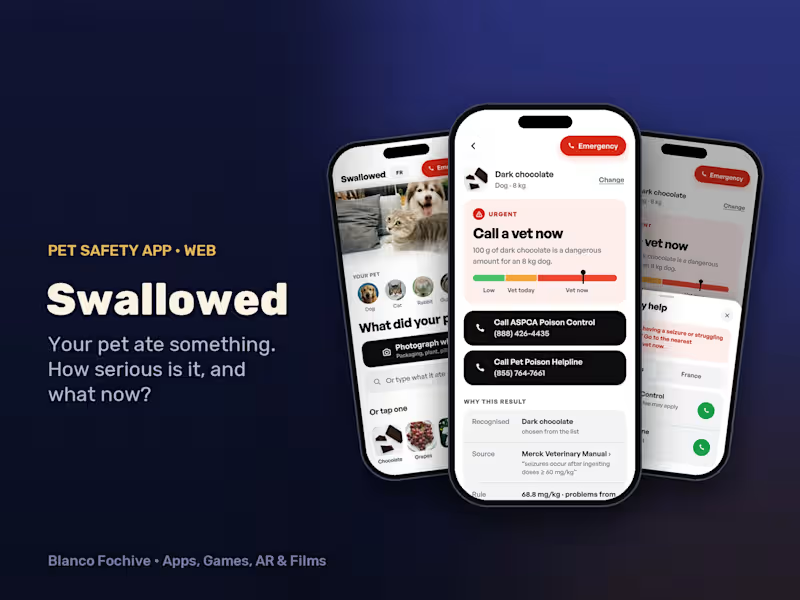
Swallowed — pet poison triage in seconds
Your pet just ate something. You need one answer: is it an emergency for this animal, at this weight and this amount?
What I built
• Three ways to say what happened: photograph the packaging, plant or pill, type it, or say it
• A clear verdict (call a vet now, call your vet today, or watch at home) with the reason and the veterinary source behind it
• The dose math shown step by step, updating live when the amount or the weight changes
• An "I don't know what it ate" path that turns visible signs into an urgency level
• US and France emergency numbers, a note for the vet, English and French
Result
• Verdicts come only from curated data: 48 common pet poisonings across 5 kinds of animal, each cited (Merck Veterinary Manual, ASPCA, Pet Poison Helpline, VCA)
• The AI only recognises the item from a photo; it never decides what is dangerous
• Open source (MIT), installable on iPhone as a web app, with automated tests
• Built for the Build With AI: Basics hackathon on Devpost
My role: Product design, UX/UI, front-end, back-end, veterinary data curation, demo film
Stack: JavaScript, Node.js, Express, Google Gemini API, Web Speech API, GitHub Pages, Render
Watch the demo: https://youtu.be/9cUUELaeMVU | Code: https://github.com/blanco1er/swallowed
0
10