AI Writing Projects in Odesa
AI Writing Projects in Odesa
Sign Up
Post a job
Sign Up
Log In
Filters
2
Projects
People
Message
2
Yevheniia Smahlii Humenko
AIORO — Landing Page with Integrated OSINT Tools Developed a functional landing page that combines persuasive copywriting with built-in security utilities. Instead of a static brochure site, I integrated real-time tools directly into the interface: SSL certificate verification, Hash Tools for data integrity checks, and DNS Lookup for domain analysis. Key features implemented: 🔹 Seamless integration of OSINT tools without leaving the page 🔹 AI-powered workflow design for instant digital footprint audits 🔹 Multi-language support (UA/EN/RU/PT) with sticky navigation 🔹 Conversion-focused layout optimized for technical clients This project demonstrates my approach to building websites that serve as both marketing assets and practical security instruments. Tags: Web Development, Landing Page, OSINT, Cybersecurity, AI Integration, SSL, DNS, Hash Tools, Automation, UI/UX Design, Frontend Development, Security Tools, Multi-language, n8n, Groq API
2
347
Message
2
Yevheniia Smahlii Humenko
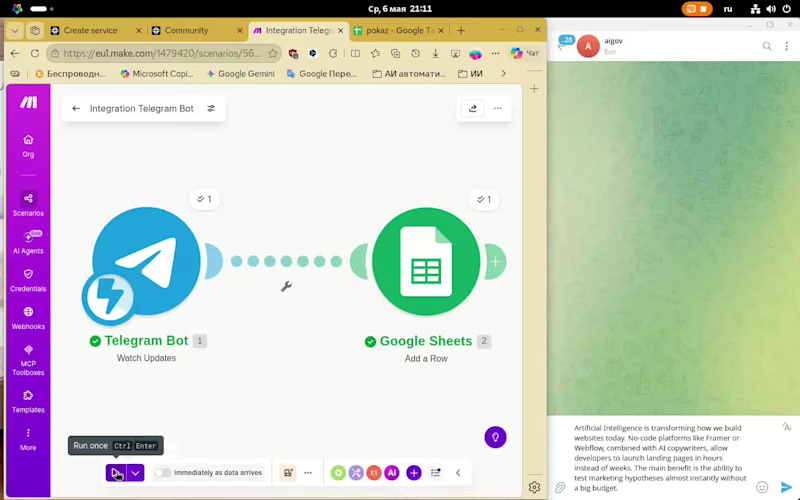
A webhook trigger catches every message from your Telegram bot. The Add Row module in Google Sheets records it instantly — date, user ID, username, and text. Two modules, two operations per message, zero polling. The script writes messages from Telegram to a spreadsheet.
2
499
Message
1
Yevheniia Smahlii Humenko
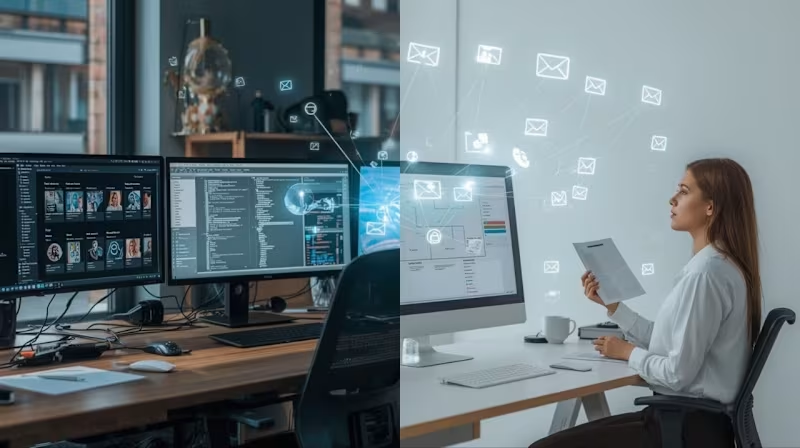
The Illusion of Automation: Why Are We Still Working at Computers? Every time you open your news feed, you see the same things: "AI will replace everyone," "neural networks have revolutionized," "billions of dollars in investments." But if you close the news tab and look at the real desktops around you, the picture changes. Managers still copy data from one tab to another, marketers manually transfer leads from spreadsheets to CRMs, and entrepreneurs are drowning in operating systems. A strange paradox arises. Technology already allows AI to write code, analyze gigabytes of data, and generate strategies. So why are most of us still using ChatGPT simply as an advanced search engine or a polite email generator? We've fallen into the trap of "manual AI." Interface Failure: The problem isn't the capabilities of the models, but how we interact with them. A dialog box is the worst interface for business. To get results, a person must come, write a prompt, wait, copy the response, check it, and transfer it somewhere. This isn't automation. It's the addition of another employee who needs constant instructions. Real evolution begins when humans break out of the chain of intermediate actions. Think of the process not as a chat, but as the invisible nervous system of a company. A client submits a request, a trigger runs a script on Make, and AI, without your intervention, analyzes the client's website, understands their pain points, writes a personalized proposal, and saves the draft in your inbox. All you have to do is click "Send." AI shouldn't be a conversationalist, but the glue between your work tools (CRM, messengers, databases). Role shift: from performer to architect. The most difficult barrier to automation is mental. We're used to measuring efficiency by hours spent in front of a screen. "I'm busy, I'm sorting through the client database, so I'm working." Automation requires a shift in thinking. You need to stop being an algorithm executor and become its architect. Ask yourself: What basic steps does my day consist of? Where am I simply a copy-paste artist? What business rule determines my next action? Once you break down the chaos of your routine into clear, logical blocks, it turns out that 80% of your "unique" work can be described by a single flowchart and delegated to a combination of APIs and no-code platforms. What's next? The tools have become accessible. Writing an integration today is no more difficult than assembling a Lego set. The main deficit now is not computing power, but the human ability to critically examine their daily actions and delegate them to code. Automation isn't about saving money on staff. It's about returning people to their core function: thinking, creating meaning, and making decisions, leaving the mechanical work to machines. If you look at your daily tasks, what action do you repeat most often, feeling like you're wasting time?
1
435
Explore projects