Freelancers using Paper in Mumbai
Freelancers using Paper in Mumbai
Sign Up
Post a job
Sign Up
Log In
Filters
2
Projects
People
Rohit .
pro
Mumbai, India
Modern web developer helping brands grow online.
$1k+
Earned
1x
Hired
149
Followers
Follow
Message
Modern web developer helping brands grow online.
6
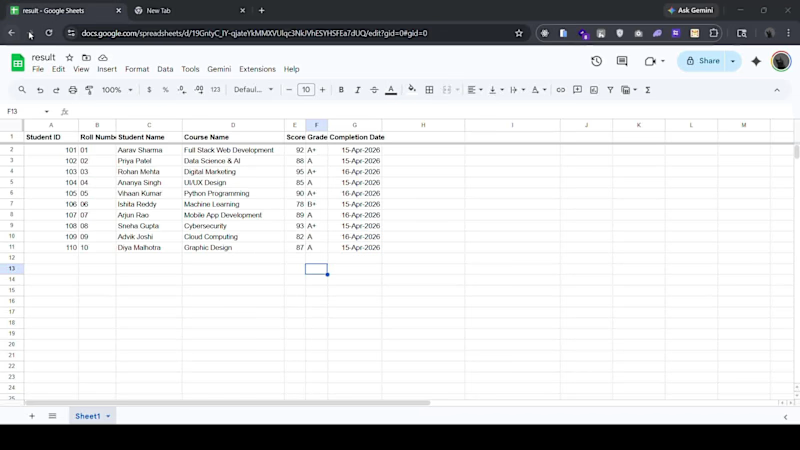
Introducing PaperCert — an automated certificate generation system inside Paper canvas. Here’s what it does 👇 • Designed a clean, professional university-style master certificate template • Connected it to Google Sheets via Zapier for seamless student data flow • An agent detects new entries and auto-duplicates the master template • Dynamically fills in student details — name, course, score, grade, date, roll number • Instantly generates consistent, high-quality certificates • Updates the sheet with “Certificate Status: Generated” 💡 Why this matters: Paper canvas is no longer just a static design space — it becomes a living, automated workflow. You keep full creative control with a single master template, while agents handle the repetitive work with perfect consistency. 🎯 Real-world impact: Perfect for educators, cohort-based courses, training programs, and anyone issuing certificates at scale. No more manual edits. No more formatting errors. Just smooth, automated credentialing.
6
352
24
Building a Zero-Touch Design Feedback Loop with Slack and the @Paper MCP What if you never had to manually process a minor design revision again? As designers and developers, we easily waste 30% of our week fulfilling fast client requests—changing button colors, adjusting typography, or tweaking padding. I decided to completely automate this process. In this project, I engineered an autonomous AI-driven workflow that physically alters native UI designs based on conversational Slack messages, proving the massive potential of the Paper MCP. ✨ The Power of the Paper MCP: Historically, AI agents have struggled to actually "see" or edit design files. By deploying the Paper MCP, I gave a raw Large Language Model the ability to programmatically traverse a 2D design canvas. The Setup: I design the initial UI (like a Login Page) using Paper and post the screenshot to the client's Slack channel. The Trigger: The client requests changes natively in Slack by mentioning a custom @DesignBot (e.g., "Make the login button green and change the title to 'Welcome'"). The Execution: Instead of guessing layout geometry, the AI uses the Paper MCP to dynamically query the canvas, isolate the precise target node, and duplicate the master to create a protected variant. It aligns the new design on the canvas grid and updates the styling properties natively. The Delivery: The MCP server intercepts the final render state and pushes a flawlessly formatted screenshot right back into the Slack thread. 🛠️ Technical Stack Used: Paper MCP: The absolute core of the project, enabling rigorous JSON-RPC access to native design layers, text bounds, and styling hooks. Slack Bolt (Socket Mode): For threading logic, instant reaction processing, and conversational memory. Agentic LLM Engine: Used native OpenAI tool-calling to map the complex MCP schemas directly into the AI’s brain so it never hallucinates commands. The Result: Clients experience magical, instantaneous visual revisions directly inside their communication channels, while designers and developers win back hours of completely uninterrupted, deep-focus work. Check out the video demo below to see the AI leverage Paper MCP to parse a layer tree and dynamically manipulate the UI!
4
24
820
6
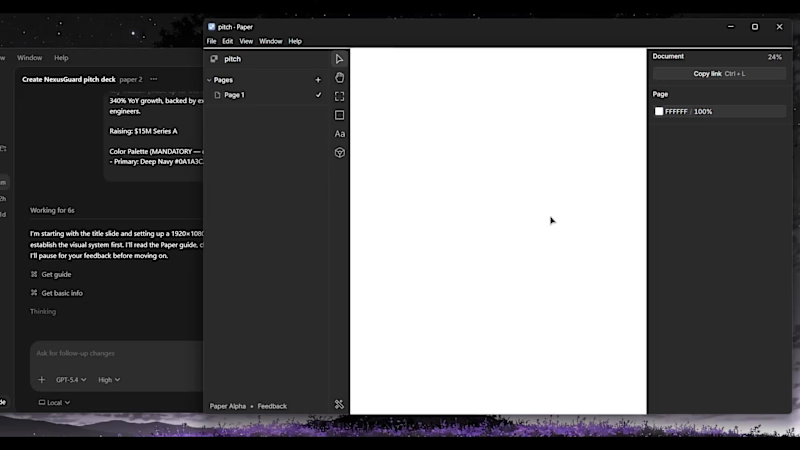
Built our full pitch deck using Codex as the agent and @Paper with MCP. The agent handled everything — created every slide, kept the design consistent, and used a clean dark navy + teal color scheme. No more generic templates or endless manual work.
6
657
18
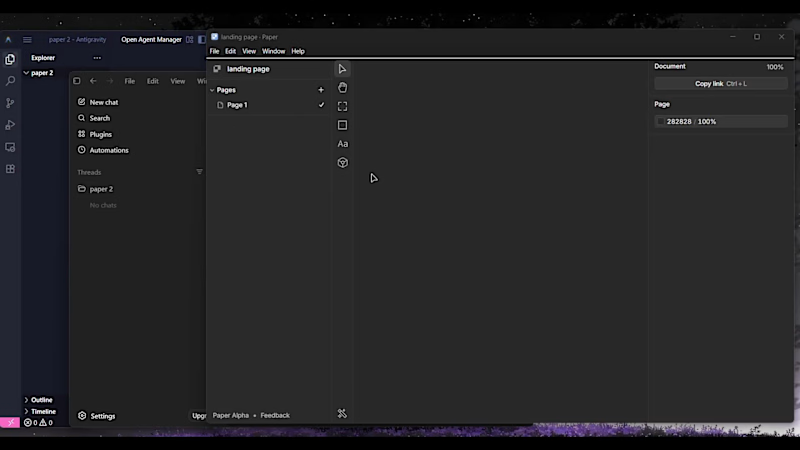
I’ve been experimenting with how AI agents can collaborate instead of working in isolation. For this project, I set up two agents on a shared canvas using @paperdesign: → One agent focuses on UI/UX design → The other turns that design into a working website The interesting part isn’t just the output — it’s the interaction. The design agent creates the system and layout for both desktop and mobile, and the build agent reads directly from the canvas and keeps the live site in sync. There’s no traditional handoff. Everything evolves together in real time. This felt less like using tools, and more like watching a system collaborate. Curious to explore where this goes next.
1
18
1.2K
Paper
(7)
Follow
Message
Explore people