Freelancers using Keras in Mumbai
Freelancers using Keras in Mumbai
Sign Up
Post a job
Sign Up
Log In
Filters
2
Projects
People
Anurag Nagare
Mumbai, India
I’m an AI & Machine Learning engineer with expertise in deve
Follow
Message
I’m an AI & Machine Learning engineer with expertise in deve
0
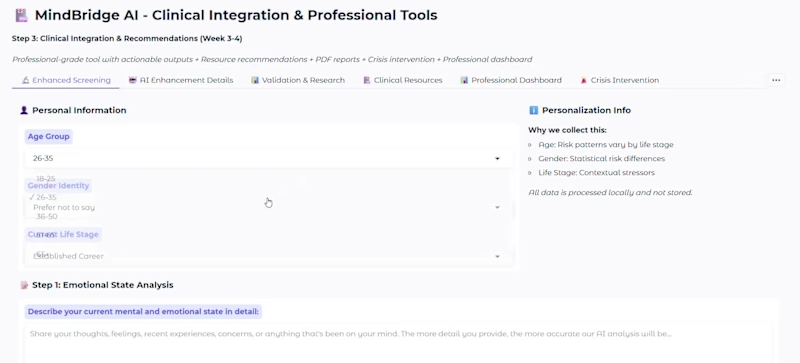
I recently built an AI-powered Mental Health Screening & Clinical Support System designed to assist both individuals and healthcare professionals in early detection and intervention. The system combines patient-reported questionnaires (PHQ-9 & GAD-7) with advanced NLP-based text analysis to assess depression, anxiety, and crisis risk levels. Based on the results, it generates personalized recommendations, safety plans, and professional referral letters, ensuring timely access to the right resources. This solution addresses a critical real-world problem: the growing gap in mental health care access. Many individuals experience symptoms but delay seeking professional help. Ultimately, it helps reduce the risk of untreated mental health crises and improves overall care outcomes.
0
88
0
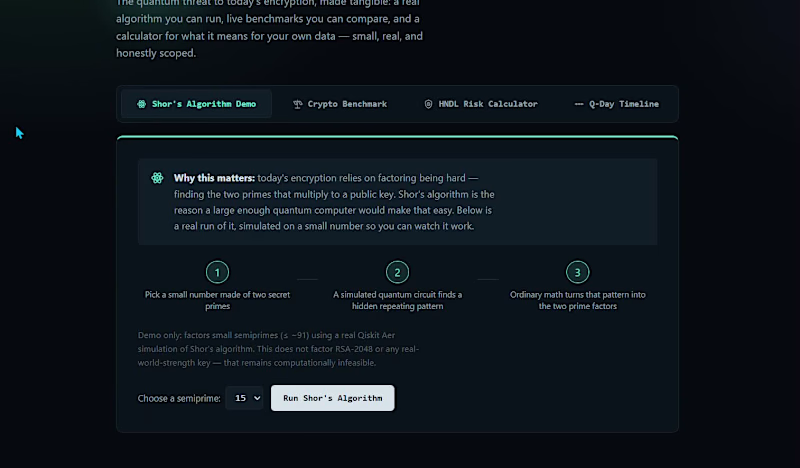
CryptoHorizon an interactive app that makes the quantum threat to encryption real instead of theoretical: a live Shor's-algorithm demo, a classical-vs-post-quantum crypto benchmark, a personal "harvest now, decrypt later" risk calculator, and a sourced Q-Day timeline, all in one dashboard. Defining feature is honesty by design: every number on screen is computed live at request time, never hardcoded RSA-2048 and ECC P-256 keys get generated, benchmarked, and compared against NIST's ML-KEM and ML-DSA in real time, and the quantum demo runs an actual Qiskit circuit against small, pre-validated semiprimes rather than a lookup table dressed up as a result. Only one thing is allowed to leak into the UI's language: a rule baked in from commit one that nothing may imply real-world RSA is broken or claim quantum advantage. Under the hood, Shor's algorithm runs for real superposition over a counting register, controlled modular exponentiation, inverse QFT, continued-fraction extraction, then a classical gcd step to pull out the factors on a FastAPI backend with no shortcuts. The risk calculator checks your required confidentiality window against five independently sourced Q-Day estimates from NIST, Google, and the Global Risk Institute, so "safe until 2035" is a real, cited comparison, not a guess. medium.com/@anuragnagare77/cryptohorizon-i-built-a-quantum-computer-that-factors-91-and-thats-the-whole-point-2c156a00d0da
0
36
0
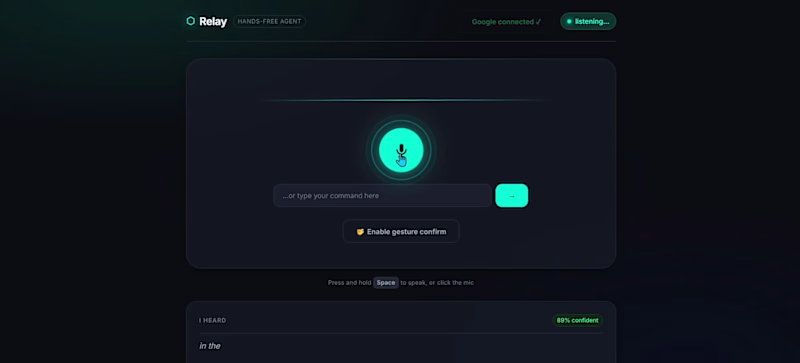
One Gate: Voice-controlled Gmail, Calendar, and Drive that can't fire the wrong thing Every "AI agent" demo shows a voice command turning into a sent email like magic, but almost nobody shows the part that actually matters: what stops it from sending the wrong thing. I built proof: an agent that runs your Gmail, Calendar, Contacts, and Drive by voice reply to a thread, schedule a meeting, archive an email, find a file hands-free end to end, but never fires anything irreversible without you saying so. The honest hard part isn't getting an LLM to sound smart, it's this: a transcript goes to LLM against a strict JSON schema and comes back as an ordered plan, every step tagged reversible or not and exactly one thing in the whole system is allowed to check that flag. Finding a thread, drafting a reply, creating a calendar event: those just run. The result covers real ground without ever feeling like it's guessing: forward or reply to email with the original quoted underneath, archive/label/trash, resolve a name to a real address through your Contacts first and your mail history as fallback, schedule an event that creates quietly and only emails the invite after a second confirmation, answer "what did John say" or "what's on my calendar Thursday" grounded in content actually fetched from your account not hallucinated. No backend, no server anywhere in the loop
0
44
0
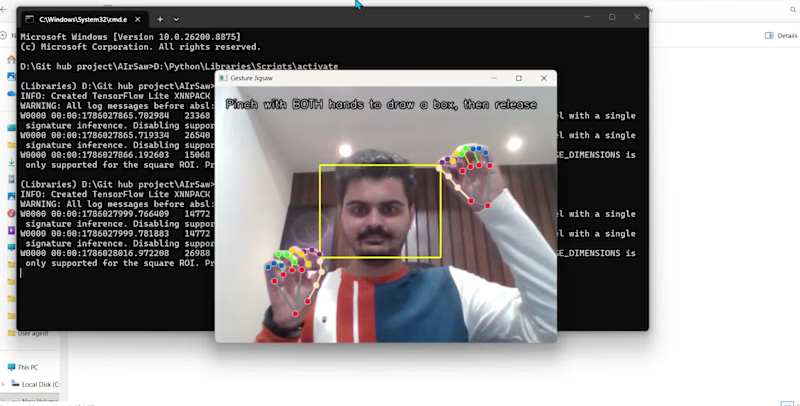
What every "AI gesture control" demo quietly leaves out Everyone films a hand waving at a screen and calls it AI. Almost nobody shows what's underneath that there's usually no gesture model at all. A "grab" is one distance crossing a line. Here's proof. I built a jigsaw puzzle you solve with your bare hands no mouse, no controller, no gesture classifier, no training.
0
88
Keras
(1)
Follow
Message
Explore people