Freelance AI Copywriters in London
Sign Up
Post a job
Sign Up
Log In
Filters
2
Projects
People
Ashish Sandhu
London, UK
Fractional CTO / AI Specialist Award Winning AI Engineer
$5k+
Earned
1x
Hired
8
Followers
Follow
Message
Fractional CTO / AI Specialist Award Winning AI Engineer
7
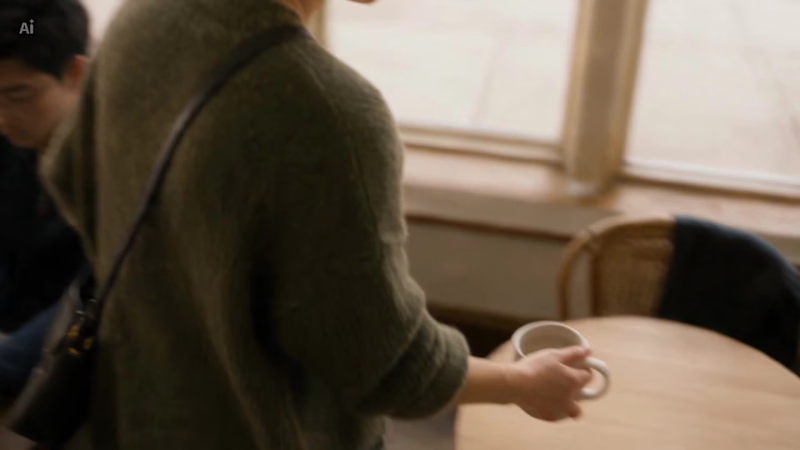
I created THE TABLE because the most uncomfortable human moments deserve to be witnessed without the mercy of a camera cut. We have all seen dramatic cafe encounters on film, but they are usually softened by edits and reaction shots. I wanted to create an experience that traps the audience in a continuous reality, making the viewer feel the tension of a silent conflict unfolding in real time. What if we watched a bizarre fracture between two people in a cozy space, and the camera simply refused to look away? That question became THE TABLE. The Production Workflow I had a vision but no traditional crew. CapCut Video Studio and the Seedance 2.5 model made a complex one-take sequence entirely possible. Prompt-Driven Choreography: I mapped out a 30-second physical space in a single text prompt. Every action, from the walk to the aggressive muffin snatch, was engineered to unfold sequentially. Unbroken Camera Control: To ensure the "one-take" rule was followed, I instructed the AI to use physical camera movements. Seedance 2.5 maintained the spatial consistency flawlessly. The Assembly: The magic of this workflow was the lack of assembly. The final output is a raw, continuous generation with no manual splicing. Platform Feedback Seedance 2.5 brilliantly held the entire world together. When the camera whip-pans back from the street to the interior at the end, Table 1 and Table 2 are exactly where they should be. It felt like directing a steady-cam operator on a live set. One honest piece of feedback: generating timed character interactions in a continuous 30-second shot requires immense trial and error. Optimized rendering costs for long-form visual storytellers would make a meaningful difference, also if specific editing can take place at point notes that will change massive things. Ultimately, Seedance 2.5 helped me protect the awkward silence at the end of the film. X: https://x.com/AshishSandhu/status/2090161080857223462?s=20
4
7
311
3
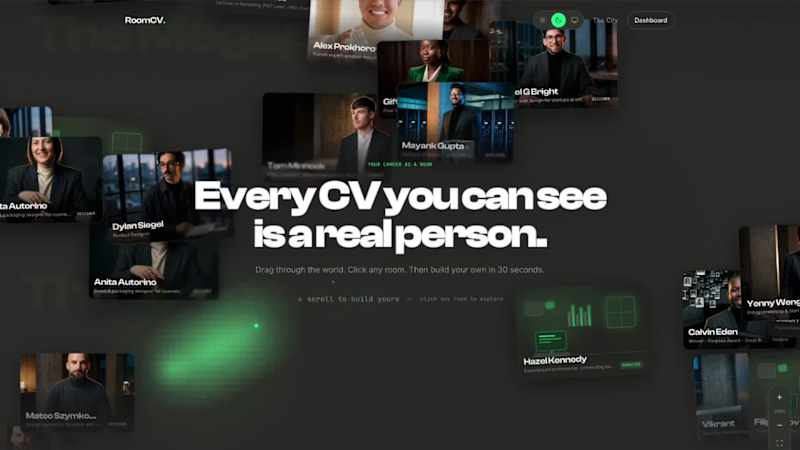
I've spent the last few days building something I genuinely wish existed years ago. When I was job hunting, I had a PDF. A white rectangle with my name, dates, and bullet points. The same format invented in 1482. I was competing with thousands of people who had the exact same white rectangle. I'm a builder. I ship products. I've worked with real companies, shipped real things, have real skills. None of that showed in a CV. It couldn't. A PDF wasn't built to show it. And building a personal website? That's a project in itself. Design it, code it, host it, maintain it. Most people never do. So their career stays a white rectangle forever. So I built RoomCV. (https://roomcv.figma.site/) You don't build anything. You paste your LinkedIn URL, your Contra profile, or upload your CV. In under 60 seconds, your career has a home on the internet. A real one. With your name on the door. Not a template you fill in. Not a prettier PDF. A room that reads your data and builds itself with all your pretty links. And then there are the portraits. The AI photoshoot is unlike anything else in this space. It runs a 3-stage pipeline (thanks to Figma Weave): Stage 1 - A casting director model analyses your reference photo and writes a precise physical description. Hair, skin tone, bone structure, build. This becomes a consistency anchor so every portrait is recognisably you. Stage 2 - A photography director model reads your actual CV. Your job title, your company, your career highlights, your personal note. It writes a bespoke scene brief the way a Vogue photo director would. A founder gets a quiet boardroom at night with a city skyline. A developer gets a dark server room with terminal green glow. A designer gets mood boards and soft daylight. Stage 3 - The image model takes that bespoke brief, your reference photo, and your character anchor and generates 6 editorial portraits. Hero. At work. Thinking. Off duty. Achievement. Environmental. Every portrait is specific to you. Because the AI read their actual careers before picking up the camera. The room is alive. People can visit your room at its permanent URL. They can leave signed notes in your guestbook. They can react with rockets, fire, or lightbulbs. You can see who's browsing right now, live presence, like a real room. Every visit is counted. The whole city of rooms is browsable and is a directory of real people's careers, each one visually distinct. Three visual themes: Cinematic - moody contrast, 35mm grain, deep editorial shadows. Brutalist - harsh direct light, raw concrete textures, technical glitch aesthetic. Minimal - soft diffused window light, high-key, warm neutrals, conversion-focused. The copywriting changes completely per theme too. Same person, three radically different editorial voices. Wieden+Kennedy wrote none of them — Gemini did, with a prompt that bans every CV cliché and demands specific references to real company names, real project names, real skills. What I used to build it: Figma Make - the entire app. Every component, every interaction, every route. Built in natural language, iterated in real time. Figma Weave - the portrait pipeline visualised as a node-based workflow. The casting director, the photography director, the 6 parallel image generation nodes. The hero background video on the landing page. The logo. Figma MCP - connecting the design token system into the Make build so the three themes stayed consistent with the Figma source of truth. Supabase - backend, auth, KV storage, private portrait bucket, signed URLs, edge functions. Gemini - character extraction, photography direction, copywriting, profile parsing, room generation from raw LinkedIn/Contra/CV data. The numbers that matter: 60 seconds from paste to published room. 6 portraits per person, all unique. 3 complete design systems per room. 0 templates. Every room is generated, not filled in. 1 permanent URL per person. Unlimited visitors, reactions, guestbook notes. Who this is for: Designers who are tired of Behance looking like everyone else's Behance. Developers whose GitHub is invisible to anyone who isn't technical. Founders who have a LinkedIn but not a story. Freelancers on Contra who want their profile to stop at the URL and start in the room. Anyone who has ever felt like their career deserved better than a white rectangle. Yesterday a dev called Andrei pasted his LinkedIn URL. 30 seconds later he had six editorial portraits and a career room that looked like the cover of Wired. He sent me a voice note. He said it was the first time his career had felt like his, and here it is for everyone to try. Try it. Paste whatever you have. LinkedIn URL, Contra URL, raw CV text, PDF. Your room is waiting. roomcv.figma.site (http://roomcv.figma.site)Figma Make: https://www.figma.com/make/3kpbdErsXVZqPSkZS2LdvY/Design-RoomCV-Creatively?t=ZnnNnUei4aE16P6e-1 Figma Weave: https://app.weavy.ai/flow/RK8qIG0eKBpyoJLOg4JgrC Figma Community: https://www.figma.com/community/file/1649649240602428392/roomcv?fuid=1004476920505329686 X: https://x.com/AshishSandhu/status/2067821599223316662 (https://x.com/AshishSandhu/status/2067821599223316662?s=20)https://x.com/AshishSandhu/status/2067824940154269961 Drop your room link in the comments. I want to see every single one. Built for the Figma Config Makeathon. Figma Make + Figma Weave + Figma MCP + Supabase + Gemini. #ConfigMakeathon #Figma #FigmaMake #AI #Portfolio #CareerDesign
2
3
249
8
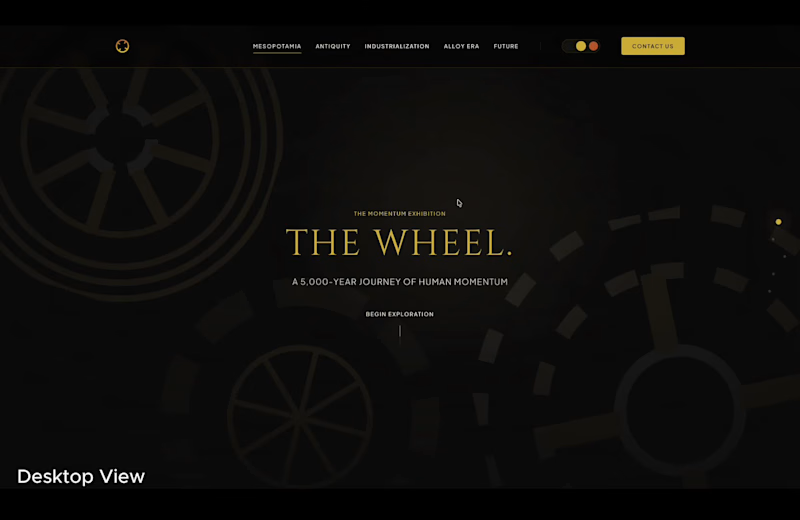
Reinventing the wheel 🛞 for Google. Designed with Google Stitch for all platforms Desktop, Mobile, and Tablets. I’m a engineer and founder with tech experience but not design, and going into this challenge, my real question was simple: Can an AI-native interface builder actually handle deep-time narrative storytelling and high-fidelity, scroll-linked interactions without turning into a complete mess? To stress test the absolute limits of the platform, I didn't feed it an established design, or any files right away. I wanted to see exactly how Stitch thinks, handles design drift, and iterates from scratch. I gave it a massive, conceptually complex prompt: Build a highly cinematic, ultra-polished, deep-time historical timeline mapping the evolution of the wheel, from primitive Mesopotamian stone discs to active, computational morphing hub systems in 2026. How Stitch Fit into the Workflow The streaming generation on the canvas is easily one of the most hypnotic interactions I've seen in a design tool. It genuinely feels like watching a remote design partner building on your screen through AnyDesk. Instead of staring at a loading spinner and waiting for a static layout, I was reacting to a living interface taking shape in real time. Instead of keeping things static, I ended up executing three distinct modes across this project to see how Stitch adapts to different workflow mindsets: I pushed a light but descriptive prompt system to build out a strict, zero-color, high-contrast monochrome design philosophy titled "Liquid Slate." Stitch completely conquered the blank page problem, mapping out an editorial-style landing page with absolute black layouts and deep-etched glass elements. The Codebase Sync via Antigravity (The Engineering Bridge) is where it killed it, To see if this could handle a real-world production loop, I leveraged the new MCP skills. I imported stitch into Antigravity straight from Stitch's HTML native canvas, synced those changes, and published a React Website in Minutes to Netlify which was bug free and ready for a Run. The motion authoring surprised me the most. I didn't have to jump out into a secondary motion app or wrestle with standard transition bugs, the native hover states, custom text blur modules (BlurInText), and smooth continuous wheel rotations were all handled seamlessly on the HTML canvas before exporting the build. New Features I Leaned On Streaming generations to canvas: Watched the entire layout materialize and iterated on components before they were even finished rendering. In-place AI edits via prompts + point-and-click: Controlled fine-grain text styles and layout spacing directly on the artboard. Redesign : Got the same design in 3 colours, just wow. Native motion, hover states, and shaders on HTML canvas: Authored complex scroll-linked component rotations and aesthetics. Antigravity Code Integration via MCP: Ran a perfect, bi-directional round-trip sync between my code editor and the visual design canvas. MCP Export: One-click, zero-friction final production deployment. Feedback on the Platform Google Stitch shifts the entire AI design paradigm because it collapses the classic "describe, wait, judge, re-prompt" delay loop into an interaction that feels like direct manipulation. In-place edits genuinely feel like real design work. Two things I'd love to see in future updates: Option to upload/generate videos: it makes it easier for a designer to have their backdrop beautiful just by adding or generating a video which Stitch can definitely add beautifully. A way to save a specific in-place edit style (like the exact blur, noise, and border-radius of my "Liquid Slate" glass cards) into a recipe that I can reapply to other sections instantly without describing it again. Stitch doesn't feel like an AI platform you have to constantly fight against, it feels like a living, interactive canvas that intuitively understands structural design system logic. Check it out: Live Site: https://contragoogle.netlify.app/ Stitch Project Space: https://stitch.withgoogle.com/projects/13302732653849354465 (https://stitch.withgoogle.com/projects/13302732653849354465)X: https://x.com/AshishSandhu/status/2062413585095995813?s=20
9
8
509
9
I created THE GIFT because the most devastating love stories deserve to be felt, not just remembered. O. Henry wrote "The Gift of the Magi" in 1905, and most people know the ending before they finish the first paragraph. Yet I had never seen it made into something that stops your breath. I wanted to create a cinematic experience that makes the audience who already knows the story feel it as if for the first time, and the audience who doesn't feel something they cannot name until the very last frame. What if we watched two people stand quietly in the ruins of their devotion, and simply refused to look away? That question became THE GIFT. The Production Workflow I came into this project with a vision but no pipeline. The Melius canvas workflow changed that completely, making something overwhelmingly complex feel creative and alive. Audio-Driven Pacing: The original score was generated and structured with a strict tempo map in Suno, ranging from a 60 BPM cold open to a 140 BPM climax. Every visual decision followed the music, not the other way around. Master Character Seeding: To ensure 1905 period accuracy and strict character continuity across every scene, I generated a single Master Character Reference node and wired it into every subsequent generation. The candlelit amber interiors, the cold blue gaslit streets, and the period film grain stayed consistent throughout without manual intervention. Extensive Agent Use: I did not just execute instructions. I conversed with the Melius agent. It helped select the right models for the right moments, we even redid the whole canvas midway and restructured, as instead of more nodes, more important was the structure, matched the visual grammar to the emotional register of each scene, and made intelligent decisions I had not anticipated. I was not managing tools. I was directing a film. The Assembly: Melius built the continuous, high-fidelity scene blocks the trailer required. I then brought those outputs into CapCut to execute the rapid sub-second flash cuts that match the music's climax, where the cuts land. Platform Feedback What moved me most was how Melius held the entire world together without me having to manually navigate the technical layer underneath, it took less than 3 hours on this. It chose what each moment needed and delivered it with a consistency that felt less like a platform and more like a collaborator who understood the story. One honest piece of feedback: producing a continuous 2.5 minute cinematic trailer with these state of the art models requires a lot of iterative generation. A higher credit tier or more optimised rendering costs for long-form visual storytellers would make a meaningful difference for projects at this scale. Ultimately, Melius helped me protect the silence at the end of the film when every instinct said to fill it. That restraint is where the whole story lives. A Final Note: I am a software engineer by trade, with zero professional background in filmmaking or the video industry. I came into this project with a feeling I wanted to convey, but no traditional pipeline to execute it. The fact that I was able to direct a period drama of this fidelity is the greatest testament I can give to Melius. https://app.melius.com/projects/1a8d974e-4f5b-4647-844e-adb87b9c5573/canvas/69eb2820-9998-47e3-8059-3bf0450c1290 https://x.com/AshishSandhu/status/2056490013378986101?s=20
6
9
965
AI Copywriter
(1)
Follow
Message
Alexander Skeith
London, UK
Award-winning copywriter and brand voice strategist.

5.0
Rating
31
Followers
Follow
Message
Award-winning copywriter and brand voice strategist.

0
DiscourseLabs: Interactive Historical Conversations
0
37
1
Sample long-form writing on custom duty, import taxes and VAT <Title Tag> Custom duty and Import tax: Everything you need to know <meta description> Get the full low-down on custom duty and import tax, and find out the easiest way to reclaim these funds on purchases you’re returning to the EU. <Intro body> Custom duty and import tax is a topic that can make even the most experienced online shoppers more than a little nervous. The good news is that once you understand how they work, they’re not nearly as scary as they might seem. And, you’ll be better equipped to pursue a refund whenever you happen to return an online purchase that’s come from overseas. Here’s a quick rundown on everything you need to know about the finer details of custom duty and import tax. <H1> What’s the difference between custom duty and import tax? <body> It’s the job of customs authorities to collect duties and taxes on goods coming into and out of a country. But, when it comes to shipping, the words 'duties' and 'taxes' are very often perceived to mean the same thing. This isn’t actually the case at all. When we say ‘duties’, we’re referring to customs duties or custom charges, which are taxes that are applied to cross-border goods which are collected by customs authorities both to generate revenue and protect local industries. These duties can come in a variety of forms ranging from trade tariffs to excise duties. Crucially, most duties are paid by the importer, with the exception of export duties which are paid by the exporter. Import taxes on the other hand, are fees applied by the government on purchased items coming into a country. These taxes can go by different names in different localities — including value-added tax (VAT), sales tax, and goods and services tax (GST) — but they’re essentially the same thing. Tax rates can vary from 0% to 20% or even higher depending on both the country and product. In almost all cases import taxes are paid for by the importer and are placed on almost all purchases arriving from overseas. You’re likely already very familiar with value-added tax, which is more commonly known as VAT. This is an import tax that works as a kind of consumption charge on goods or services. It plays an important role in business and can be charged on a range of items. VAT is a tax which is ultimately paid by you, the customer, instead of working as a tax on individual businesses. <H2> When are custom duty and import tax applied? <body> You’ll be charged custom duty on all goods worth more than £135 (and all excise goods) that are being sent from outside the UK (or the UK and the EU if you’re in Northern Ireland). In these cases, you’ll need to pay custom duty on both the purchase price of the goods, as well as on postage, packaging and insurance. When it comes to gifts, you’ll generally need to pay 2.5% on goods above £135 and up to £630. Rates tend to vary for gifts over £630. Special rules apply to excise goods — which can be summarised as wine and other exciting intermediate products (like sherry, port and other spirits), tobacco, and mineral oil (such as petrol or diesel oil). Excise duty is applied to all of these items regardless of their purchase cost. <H3> What are custom duty and import tax based on? <body> So, what factors inform the rates being applied to your latest online purchase from overseas? In the UK, import tax and custom duty amounts applicable to a shipment are determined by a number of factors including the HS code (which classifies the type of product), the goods description on the commercial invoice (which includes the product's end-use), as well as the value of the goods (including freight and insurance fees) help customs to determine the custom duty and import tax and to clear your shipment. International trade agreements between certain countries can also have a bearing on the amount import taxes applied to a shipment. Wherever you need to settle these charges you’ll be contacted by Royal Mail, Parcelforce or the courier company and they’ll send you a bill stating exactly what fees you need to pay. They’ll normally hold your parcel for about 3 weeks and, if you haven’t paid the bill by then, your parcel will be returned to the sender. In the past, even calculating the amount you need to pay on custom duty has proved a little taxing (pun intended). This has involved determining the duty percentage rate on the goods being shipped (a rate that varies depending on the country the item is being shipped to). These can be found by visiting the customs or trade tariff page on the government website of the destination country. Then it’s a case of adding up the value of the goods, plus freight costs, insurance and any additional costs, then multiplying the total by the duty rate. Similarly, calculating import tax has traditionally required a bit of number crunching. This has involved finding out the sales tax (VAT) rates of the country the item is being shipped to. For example, the UK has three VAT rates: 0%, 5% and 20%, which is the standard rate for most goods and services. So if the shipment is a men’s sweater, the rate is 20% because clothing for adults falls under this standard VAT rate. Once the VAT on a shipment has been calculated, customers have then had to add up the goods value, freight costs, insurance, and import duty, and then multiply the total by the destination country's applicable VAT rate. Thankfully, we’ve managed to do away with a lot of this heavy lifting. By simply accessing our handy calculator (https://dutyrefunds.co.uk/import-duty-calculator/#calculator) and entering in your purchase price, item description and courier, you’ll be able to find out what custom duty or import tax is set to be applied to your shipped items. <Header> Claiming a refund on custom duty or import tax <body> Historically, customers have had to jump through a lot of hoops to get refunded for custom duty and import tax on returned items. The method of claiming repayment has typically depended on how the initial customs declaration was made. If it was dealt with by the Customs Handling of Import Excise Freight (CHIEF) system, customers are still able to claim repayment online — provided you have a Government Gateway number and are already registered for the service. If the custom declaration was made via the Customs Declaration Service (CDS), customers are able to submit a claim using the CDS version of Form C285. In both these cases you’ll need a whole list of items to tick off including the sales invoice, the packing list, the amount of import taxes paid, and your bank details if the refund is to be paid directly. But did you know, there’s an easier way? If you’ve returned goods purchased from within the EU in the last 365 days, Duty Refunds provides you with a quick and easy solution. In fact, we’re now known as the UK’s leading import VAT and duty specialist. Whether you need to reclaim customs charges (https://dutyrefunds.co.uk/reclaim-customs-charges/), get a customs duty refund (https://dutyrefunds.co.uk/reclaim-customs-charges/customs-duty-refund/) or import VAT Refund (https://dutyrefunds.co.uk/reclaim-customs-charges/import-vat-refund/), we’ve made the process as frictionless as possible.
1
66
2
Saying something that sticks
2
45
17
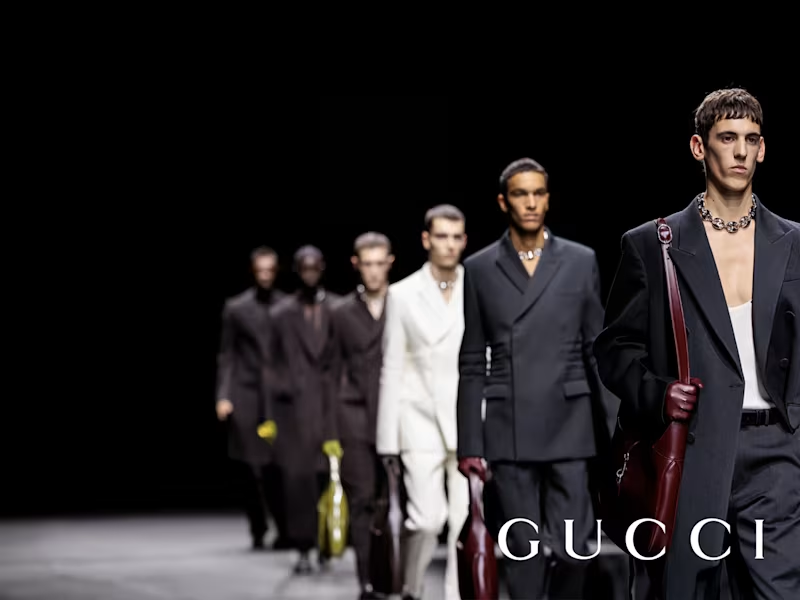
Gucci: Stories to bring high-end fashion to life
17
194
AI Copywriter
(1)
Follow
Message
Jason Cohen
London, UK
AI Video, the right 60 seconds can change you business!

Follow
Message
AI Video, the right 60 seconds can change you business!

0
I Spent £280 on Bars That Didn't Fit... So I 3D Printed My Own
0
7
0
Snuff Cup Pro V3 — No Mess. No Shame.
0
5
0
The Sea Galleri Experience
0
8
0
The $128 Billion Doritos Mistake 😳🔥
0
5
AI Copywriter
(1)
Follow
Message
Explore people