
Financial Accountant, Bookkeeper, IFRS, Tax Consultant
- 5.0
- Rating
- 25
- Followers
Financial Accountant, Bookkeeper, IFRS, Tax Consultant
The hidden value of monthly bookkeeping
Monthly bookkeeping is more than recording transactions. It's financial control. 📚
When your books are updated consistently, you can:
✅ Track income and expenses.
✅ Identify unusual transactions earlier.
✅ Monitor outstanding customer invoices.
✅ Reconcile bank balances.
✅ Prepare more reliable financial reports.
✅ Spend less time searching for financial documents.
When bookkeeping is delayed for months, even simple questions can become difficult to answer.
How much did we spend last month?
Which customers still owe us money?
Are our expenses increasing?
These answers should not require guesswork.
I provide accounting support to help businesses maintain organized records and gain better visibility into their finances.
📩 Message me if you're looking for dependable bookkeeping and accounting support.
#MonthlyBookkeeping #AccountingSupport #FinancialControl #SmallBusinessAccounting
1
2
236
Your business is making sales. So why does your bank account still feel empty? 💰
This is a challenge many business owners face.
Revenue is growing, customers are paying, and the business looks successful from the outside.
But behind the scenes:
Expenses are increasing.
Customer payments are delayed.
Tax obligations are approaching.
Cash flow is becoming unpredictable.
Here's the truth: Revenue is not the same as profit, and profit is not the same as cash.
Without accurate bookkeeping and regular financial reporting, you may not know where your money is going until it's too late.
As an accounting professional, I help businesses bring clarity to their numbers so they can make better financial decisions.
📩 Want a clearer picture of your business finances? Send me a message to discuss your accounting needs.
#Accounting #Bookkeeping #CashFlowManagement #SmallBusiness #BusinessGrowth
2
3
293
Series 1: Things I Notice as an Accountant
Episode 3: What an old unreconciled balance can tell you. 📊
An unreconciled balance sitting in your books for months?
It might look like a small issue.
But as an accountant, I see it as a reason to investigate. 👀
Because an old unreconciled balance can tell you more than you think.
Here are 5 things I look for:
🔹 1. A payment that was never recorded
The money left the bank, but the transaction never made it into the accounting software.
🔹 2. A duplicate entry
The same expense or payment was recorded twice, making the balance inaccurate.
🔹 3. An invoice that was never settled
A customer payment or supplier transaction may have been incorrectly matched or left outstanding.
🔹 4. A transaction posted to the wrong account
The amount might be correct, but it's sitting in the wrong place.
🔹 5. An error carried forward month after month
Sometimes, an old difference is simply ignored during each reconciliation, allowing the problem to continue.
Here's what concerns me most:
When an unreconciled balance keeps rolling forward, it can make the financial reports look correct at first glance while hiding errors underneath.
And the longer it stays unresolved, the harder it can become to trace the original transaction.
My approach?
I don't just try to make the balance match.
I investigate the difference, trace it back to the source, and make sure the correction is supported by evidence.
Because reconciliation isn't just about matching numbers. It's about knowing your numbers can be trusted. ✅
💬 Question for business owners and fellow accountants:
Do you clear old unreconciled balances as soon as you find them, or do they sometimes get carried forward to the next month?
#Accounting #Bookkeeping #BankReconciliation #FinancialReporting #SmallBusiness
1
3
281
Series 1: Things I Notice as an Accountant
Episode 2: A client's expenses suddenly increase. What do I check first? 👀
Imagine this. 👇
Last month, your business expenses were $5,000.
This month, they’re $8,000.
Your first thought might be: “Business is getting expensive!”
But as an accountant, I don't jump to conclusions. I investigate. 🔍
Here’s what I look at first:
📌 1. Which expense increased?
I compare this month's expenses with the previous month to identify exactly where the increase happened.
📌 2. Is it a one-time expense?
Perhaps you purchased new equipment, paid an annual subscription, or incurred a one-off professional fee.
📌 3. Are there duplicate entries?
Sometimes, the same bill is recorded twice. This can make expenses look higher than they actually are.
📌 4. Are personal expenses mixed with business expenses?
This can happen, especially in small businesses where founders use the same account for both.
📌 5. Is it a timing difference?
Maybe an expense relates to a previous month but was recorded this month. Or several bills were entered together.
📌 6. Has the business actually grown?
More sales, more employees, or more customers can naturally lead to higher expenses.
The goal isn't simply to reduce expenses. It's to understand them.
Because higher expenses aren't always a bad sign.
But unexplained expenses? That's where I start asking questions. 👀
As an accountant, I believe every unusual number deserves a closer look before anyone makes a decision.
Business owners, do you compare your expenses month by month, or do you only check them when your profit starts falling?
I'd love to know. 👇
#ThingsINoticeAsAnAccountant #Bookkeeping #SmallBusiness #AccountingTips #FinancialManagement
1
2
253


Accurate Books. Clear Financial Insights. Stress-Free Tax
- 5.0
- Rating
- 65
- Followers
Accurate Books. Clear Financial Insights. Stress-Free Tax
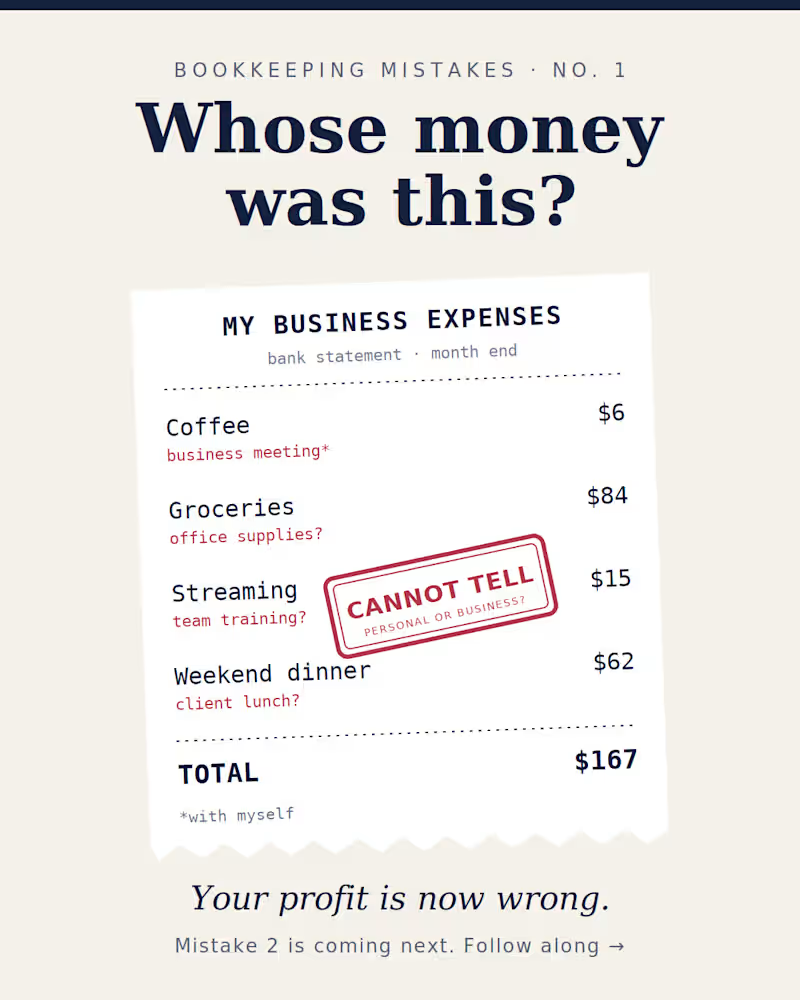
I am calling this the "Mistake post".
Wait. Did I post this by mistake?....
No, I promise. This is a bookkeeping post about the mistakes that quietly cost business owners money. There are many, so I will take one mistake at a time. This post is only about Mistake 1.
Mistake 1: Mixing personal and business spending One coffee here, one grocery bill there, and by the end of the month nobody knows whose money was spent. Yes, that coffee was a "business meeting". With yourself.
It looks small. It is not. Here is what it quietly does to your business:
Your profit becomes wrong. Personal costs sit inside business expenses, so the numbers do not show how the business is really performing.
Your bank reconciliation becomes slow. Every personal payment needs an explanation before your books can match the bank statement.
Your tax work becomes harder. When costs are mixed, it is difficult to prove which expenses truly belong to the business.
You lose clarity. You cannot tell how much the business earned and how much you took out for yourself.
Check your statement once a week. Small habit. Clean books. Much less stress at year end.
Mistake 2 is coming in the next post, so follow along so you do not miss it.
1
2
329
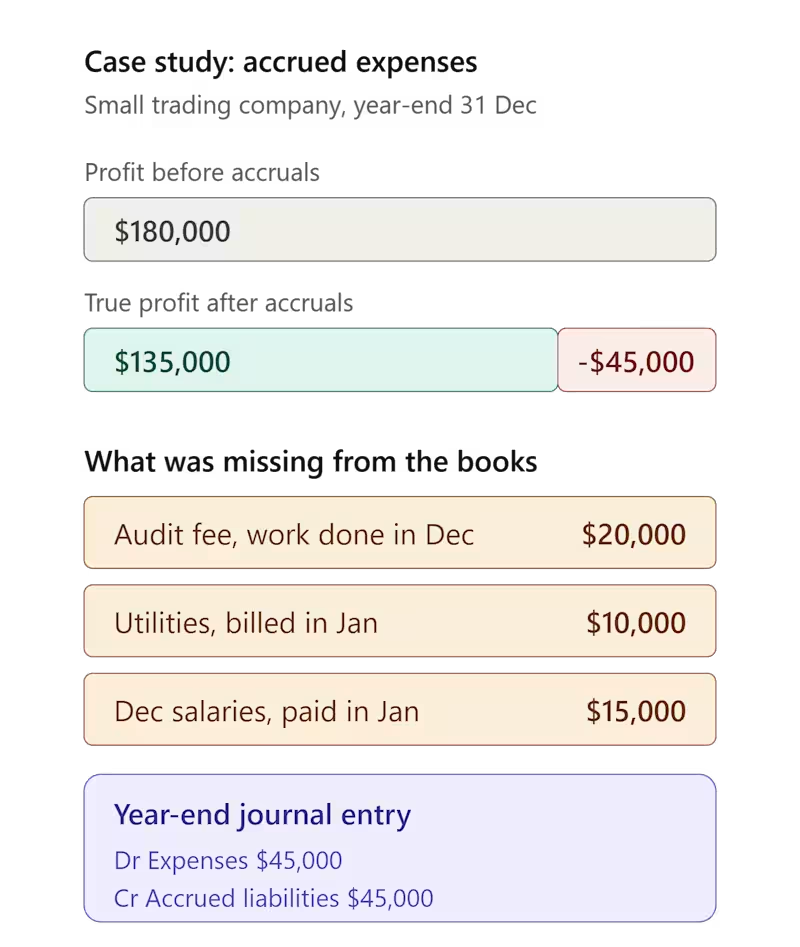
Your books say $180,000 profit. Reality says $135,000. 😬
Episode on accrual expenses 👇
The case: A small trading company came to us at year-end. Their profit looked great, but they had only recorded bills they had already paid.
What was missing:
✅ Audit fee: work done in December, invoice not yet received ($20,000)
✅ Utilities: December usage, bill arrives in January ($10,000)
✅ December salaries: paid in January ($15,000)
That is $45,000 of expenses that belong to this year but never touched the bank account, so they never hit the P&L.
The fix:
Dr Expenses $45,000
Cr Accrued liabilities $45,000
The lesson: Accrual accounting records an expense when you incur it, not when you pay it. If you only look at your bank, your profit is overstated, your tax is wrong, and your decisions are built on a number that isn’t real.
💬 Comment “ACCRUAL” and I’ll send you a simple month-end accruals checklist.
Follow for the next contra episode 🎬
Hashtags:
#Accounting #AccrualAccounting #AccrualExpenses #Bookkeeping #AccountingTips #FinancialLiteracy #SmallBusiness #Entrepreneur #Startup #Founders #Finance #CFO #Accountant #ACCA #LearnAccounting #BusinessTips #AccountingCaseStudy #contra #CountingCrux
2
299
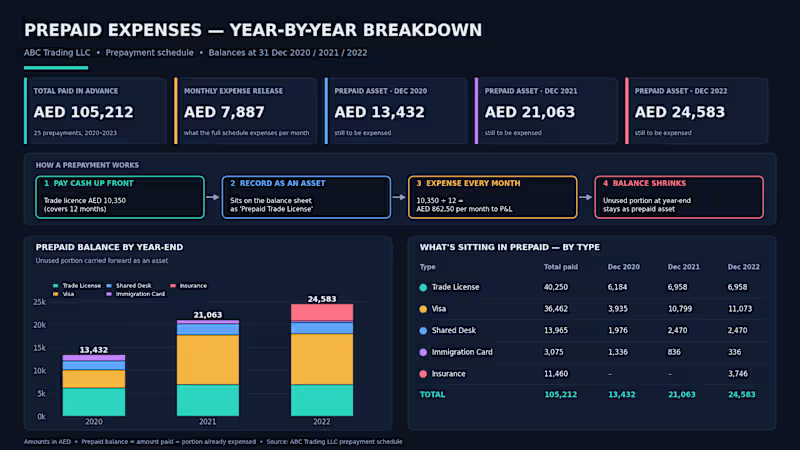
A client asked me last week: “Why is there still a balance sitting in prepaid? I already paid all of it.”
Fair question. Honestly, it’s one of the most common things business owners get confused about.
Here’s how I explained it. When you pay your trade licence for the year, that money has left your bank. But you haven’t used the whole year yet. So the unused part isn’t an expense yet. It’s something you’ve paid for and still own, like a credit waiting to be used.
Say you pay 10,350 for a 12 month licence. Each month, 862.50 moves into expenses. Whatever hasn’t been used by 31 December stays on the balance sheet as prepaid.
The client still wasn’t fully getting it from the schedule alone, so I broke it down year by year. 2020, 2021, 2022. Same prepayments, just showing how much was used and how much was still left at each year end.
That’s when it clicked for them.
The visa, shared desk, insurance and licence costs all work the same way. Pay now, use over time, expense a little each month.
If your accountant keeps saying “prepaid” and you nod along, ask them to show you a schedule like this. It’s your money, you should be able to see where it is.
This is part of my contra series, where I explain accounting without the jargon.
#accounting #prepaidexpenses #smallbusiness #UAE
Check it out (https://contra.com/p/N2MscqgY-prepaid-expenses-explained-the-way-i-explained-it-to-my-client)
2
6
660

UK Accountant & Financial Expert
UK Accountant & Financial Expert


View more →

CPA | Streamlining Your Finance |QuickBooks | XERO
CPA | Streamlining Your Finance |QuickBooks | XERO


View more →

Accounting & Bookkeeping Specialist
Financial Planning & Management Reporting
I help founders go beyond basic bookkeeping.
I deliver monthly management reports that show: Where your money went, where it's going, and how to grow it.
Includes: P&L by project, Budget vs Actual, Cash Flow Forecast & KPI Dashboard.
Clean books + Clear insights = Smarter decisions.
DM "REPORT" for a sample pack.
0
101

Budgeting & Forecasting Specialist
I help founders turn past numbers into future plans.
What you get: 12-Month Budget + 13-Week Cash Flow Forecast + Budget vs Actual Dashboard in Excel.
No more cash surprises. Just clear numbers.
DM me "FORECAST" for a preview.
0
82
I'm not a general accountant. I'm a BOOKKEEPING SPECIALIST.
What does that mean for you?
Most accountants try to do everything - taxes, payroll, audit, consulting.
I do ONE thing perfectly: I keep your books 100% accurate, reconciled, and reporting-ready every single month.
As your Bookkeeping Specialist, I handle:
✅ Daily/Monthly Categorization in Xero, QBO, Odoo
✅ Bank & Credit Card Reconciliation - to the penny
✅ AP/AR Tracking - Never miss a payment or invoice
✅ Month-End Close in 5 Days
✅ Clean P&L, Balance Sheet & Cash Flow - CPA-Ready
I DON'T do: Year-end only cleanup, random data entry, or messy Excel-only work.
I DO: Systematic, confidential, on-time bookkeeping that your CPA will thank you for.
If your books are 2+ months behind, your bank balance doesn't match, or your P&L makes no sense - I specialize in fixing that.
DM me "BOOKS" - I'll audit your current Xero/QBO for FREE and show you exactly what's wrong in 15 mins.
0
45

Senior Accountant for US, UK & Australian Businesses
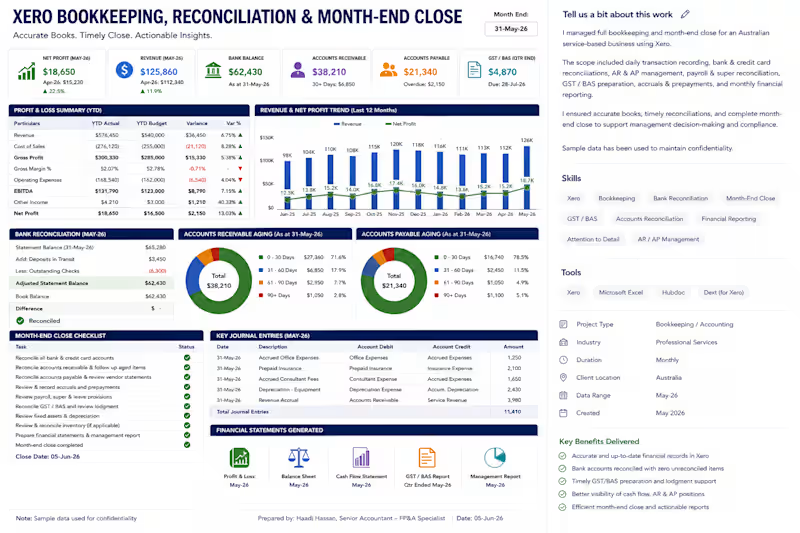
I managed the complete monthly bookkeeping and month-end close process in Xero for Australian service-based businesses.
The work included bank and credit-card reconciliations, accounts receivable and payable reviews, payroll and superannuation checks, accruals and prepayments, GST/BAS review, intercompany reconciliations, and investigation of outstanding or incorrectly classified transactions.
I also prepared Profit and Loss, Balance Sheet, cash-flow reports, and management summaries to give clients clear visibility into profitability, cash position, receivables, payables, and compliance obligations. A structured close checklist was used to ensure accurate records, timely reporting, and completion of all month-end activities.
Sample data has been used to maintain confidentiality.
0
64
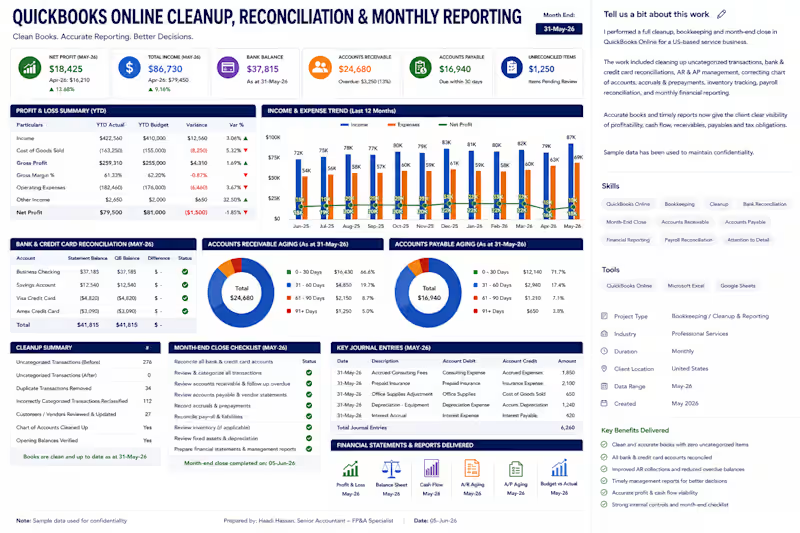
I performed a full QuickBooks Online cleanup, reconciliation, and month-end close for a US-based service business.
The work included reviewing and correcting transaction classifications, cleaning up uncategorized and duplicate entries, reconciling bank and credit-card accounts, reviewing accounts receivable and payable, updating the chart of accounts, and recording accruals, prepayments, depreciation, and other adjusting journal entries.
I also prepared monthly Profit and Loss, Balance Sheet, cash-flow, AR aging, AP aging, and budget-versus-actual reports. The completed cleanup gave management more reliable financial information, clearer visibility into cash flow and profitability, and a structured process for future monthly reporting.
Sample data has been used to maintain confidentiality.
1
117
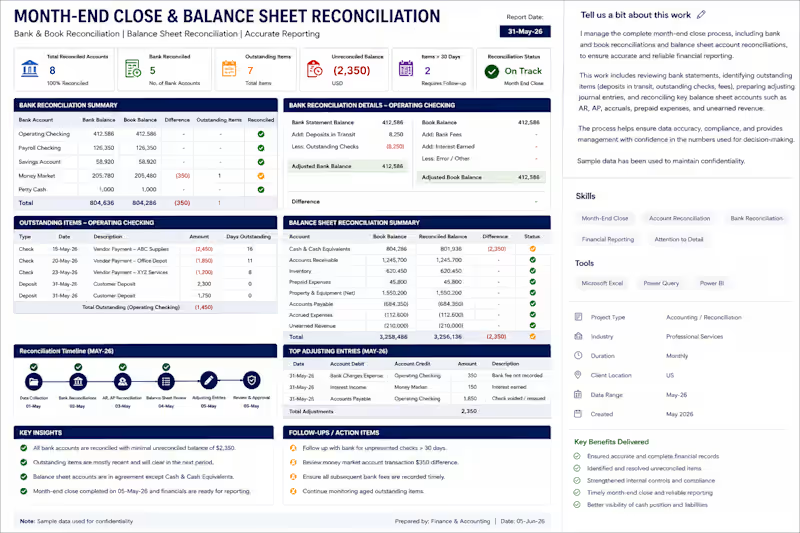
I managed a structured month-end close and balance-sheet reconciliation process to ensure the financial records were complete, accurate, and ready for management reporting.
The work included bank and credit-card reconciliations, accounts receivable and payable reviews, accrual and prepayment entries, fixed-asset and depreciation updates, deferred-revenue analysis, intercompany reconciliations, and investigation of unusual general-ledger balances. These activities align with my experience directing close processes and maintaining supporting accounting schedules.
I also maintained a reconciliation tracker to monitor account balances, supporting documents, unresolved differences, review status, ownership, and completion deadlines. This helped identify outstanding issues, strengthen financial controls, and support accurate and timely reporting.
Sample data has been used to maintain confidentiality.
0
113
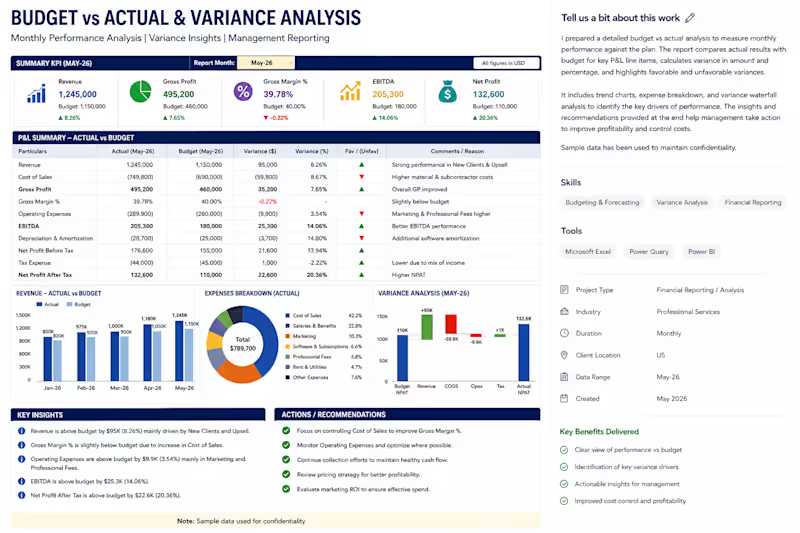
I prepared a detailed budget-versus-actual analysis to help management evaluate monthly and year-to-date financial performance against plan.
The report compares actual results with budget across revenue, cost of sales, gross profit, operating expenses, EBITDA, and net profit. It calculates both value and percentage variances, identifies favorable and unfavorable movements, and explains the main drivers behind each significant variance.
I also included trend analysis, visual summaries, management commentary, and recommended actions to support cost control, profitability improvement, and better financial decision-making. The model was designed as a reusable monthly reporting tool that can be updated after each accounting period is closed.
Sample data has been used to maintain confidentiality.
0
100

Bookkeeper & Accountant | QuickBooks, Xero & Construction
New to Contra
Bookkeeper & Accountant | QuickBooks, Xero & Construction
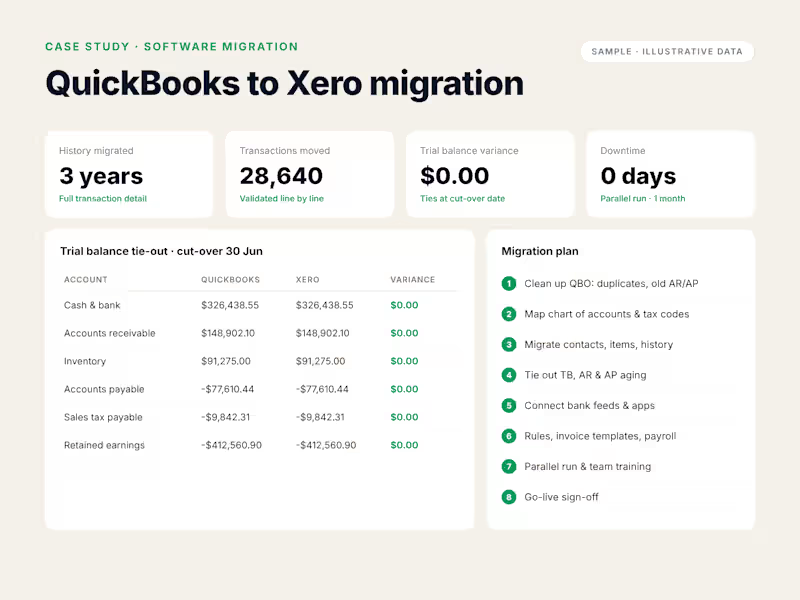
QuickBooks Online to Xero migration for a product business: three years of history (28,640 transactions) moved and validated line by line. Chart of accounts and tax codes mapped, AR/AP aging and trial balance tied out to $0.00 at cut-over, bank feeds and apps connected, and the team trained during a one-month parallel run with zero downtime. (Sample with illustrative data.)
1
0
62
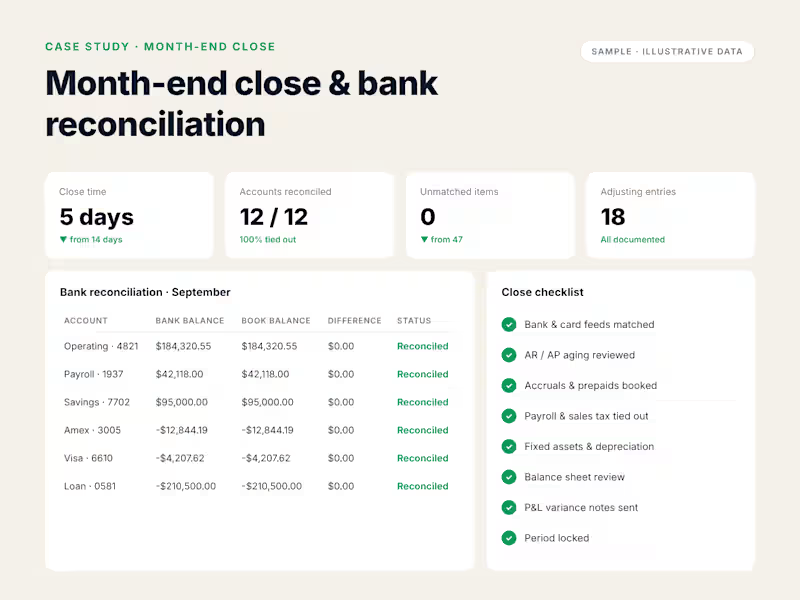
Month-end close and bank reconciliation for a growing small business: all 12 bank, card and loan accounts reconciled to $0.00 difference, AR/AP aging reviewed, accruals and prepaids booked, payroll and sales tax tied out, and the period locked. A documented close checklist cut close time from 14 days to 5. (Sample with illustrative data.)
0
68
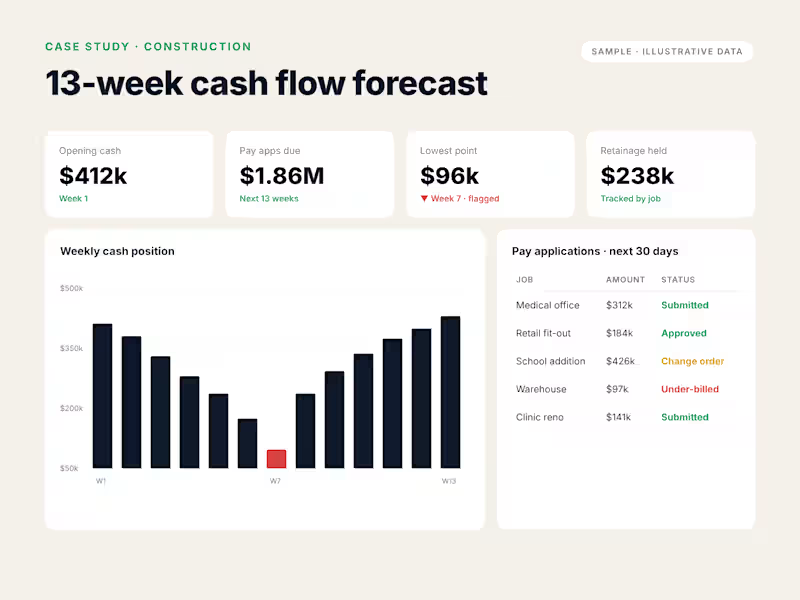
13-week cash flow forecast for a commercial contractor running five active jobs: opening cash, scheduled pay applications, payroll, subcontractor and supplier payments, and retainage tracked by job. The forecast flagged a week-7 low point early, so under-billed work and a pending change order were pushed through before the gap hit. (Sample with illustrative data.)
0
55

Financial Controller | Bookkeeper | Financial Consultant
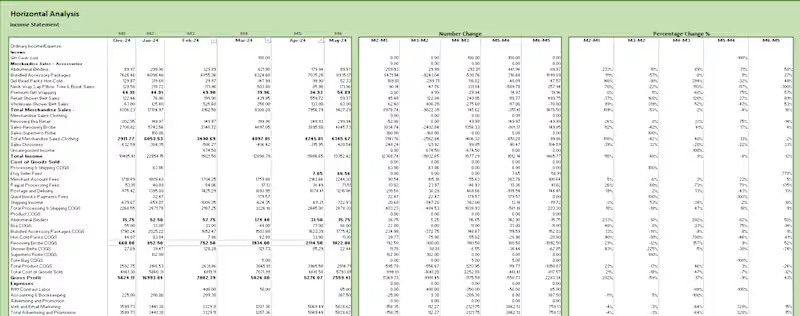
Developed financial projections to support the client’s capital-raising efforts. Analyzed QuickBooks Online and Xero data, identified business trends, and built forecasting assumptions. Deliverables included monthly revenue and expense projections, financial statements, an amortization schedule, and a dashboard summarizing key financial metrics.
0
50
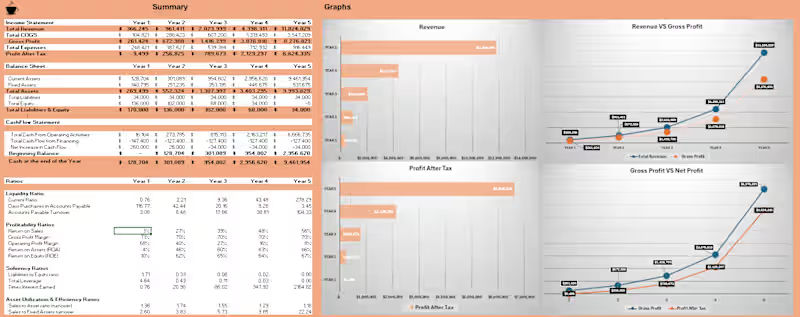
Developed financial projections for a café seeking investment, including revenue forecasts, expense budgets, cash flow projections, and profitability analysis. The model outlined funding needs and helped the owner present the café’s financial potential to investors.
0
45
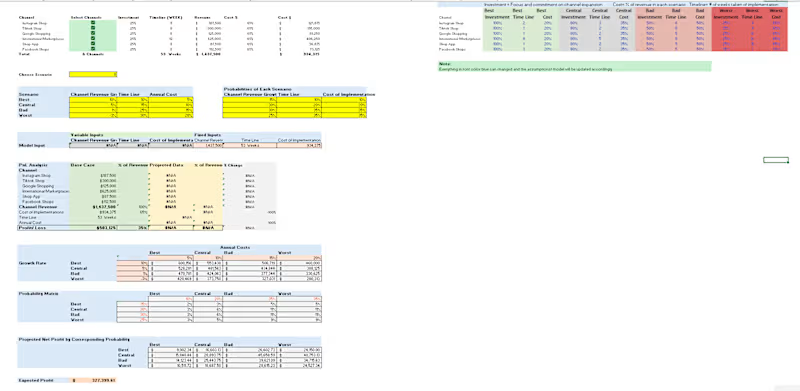
Developed a comprehensive financial model for a Shopify e-commerce business, using historical performance to build projections and assess future profitability. The model included sensitivity and scenario analyses to show how changes in key assumptions could affect revenue, expenses, and financial results.
I also created a dashboard that consolidated key financial performance indicators, giving the client a clear view of business trends. Together, the model and dashboard helped the client evaluate growth scenarios and make informed planning decisions.
0
37
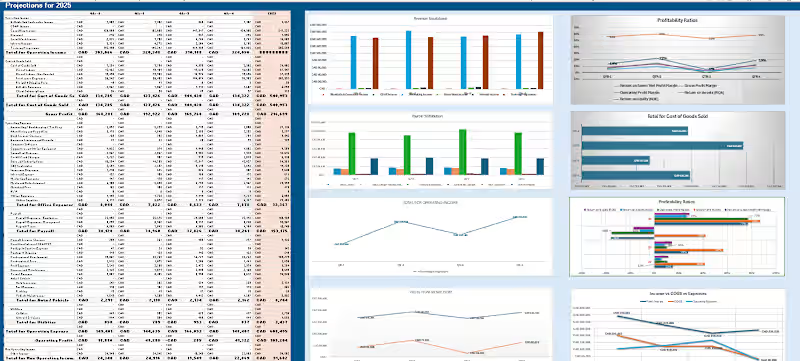
The client hired me as a Financial controller and needed me to manage bookkeeping and develop Dashboards so that he can understand financial performance and how the contractors he hired will affect the future revenue. I worked for the business for 8 months and develop different projections and scenarios for him to understand the impact of changing revenue on the fixed and variable expenses of the business. This project was to understand what expenses should the business decrease to be viable with the changing business revenue.
0
55