Projects using Easy Lens in LahoreProjects using Easy Lens in Lahore🕹️ What I Built
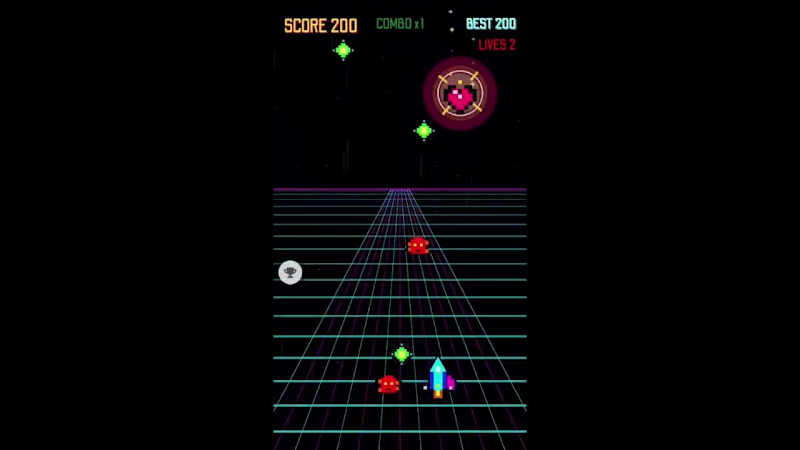
I created Neon Byte Runner, a fast-paced retro arcade game Lens for Snapchat inspired by classic endless dodgers and 80s neon aesthetics. Built entirely using prompt-based iteration in EasyLens, the game includes:
Procedural Pixel-Art Visuals: Glowing neon ships, data bugs, energy bytes, and background scanlines drawn in real time for crisp rendering across all screen sizes.
Drag-and-Dodge Controls: Intuitive mobile steering where players dodge incoming "data bugs" and collect "energy bytes" for score multiplier points.
Dynamic Damage System: A three-life mechanic where taking damage physically breaks off spaceship parts (wings and tail) with visual particle flares.
Magical Heart Repairs: Rare falling heart powerups that grant an extra life and visually repair broken spaceship parts back onto the ship.
Chiptune Audio & Global Leaderboard: Custom-generated arcade music and sound effects paired with an integrated HUD and leaderboard to drive replayability.
💡 Why I Built It
Reimagining Classic Arcade Mechanics for AR:
I wanted to capture the instant-play energy of old-school arcade cabinets and adapt it into a social, mobile-first Snapchat Lens. The goal was to create a game that takes seconds to learn, but offers enough depth and escalating difficulty to keep players saying, "Just one more run."
Visual & Emotional Damage Feedback:
Instead of relying on a standard health bar, I wanted players to feel the stakes. Making the ship parts physically break off and scatter across the screen creates an immediate, dramatic feedback loop when you make a mistake—and grabbing a rare heart to repair your ship feels genuinely rewarding.
Pushing the Boundaries of Prompt-Based Game Design:
As a developer, I wanted to explore how far prompt engineering inside EasyLens could go. I set out to prove that you can build complete, highly polished game systems—including state management, procedural rendering, sound synthesis, and dynamic damage states—purely by guiding AI with precise multi-step prompts.
✨ How EasyLens Made It Possible
Using EasyLens, I didn't need to hop between traditional 3D software, external audio workstations, or manual script compilers. I iterated through targeted prompts to handle:
Generating procedural visual assets on the fly.
Setting up custom arcade music and dynamic sound triggers.
Fine-tuning game controls, collision boxes, and damage states.
EasyLens handled the heavy lifting, allowing me to focus on game feel, pacing, and player experience