
Financial Accountant, Bookkeeper, IFRS, Tax Consultant
- 5.0
- Rating
- 25
- Followers
Financial Accountant, Bookkeeper, IFRS, Tax Consultant
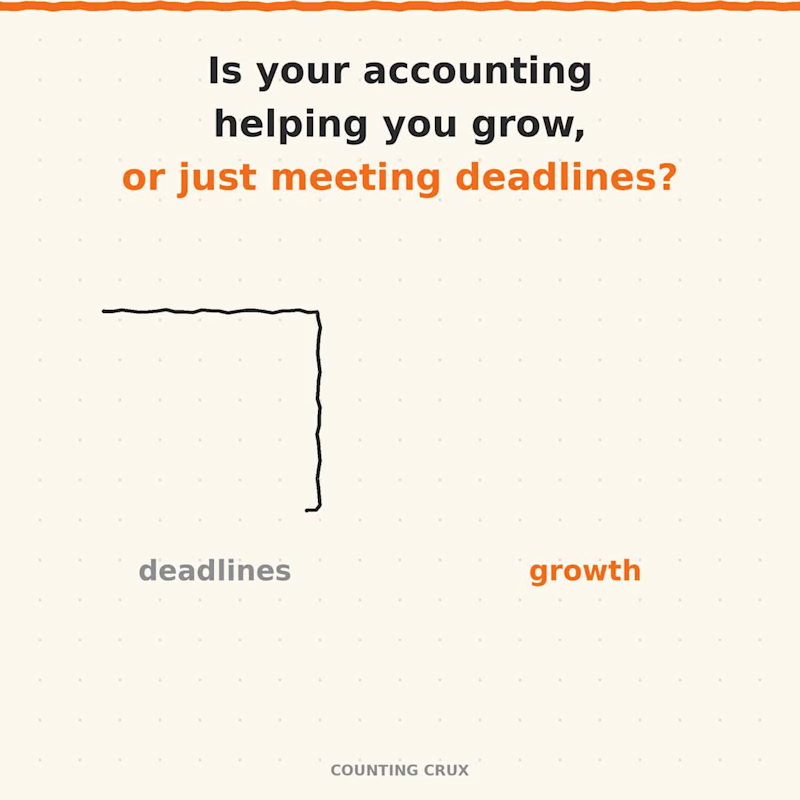
Creative business owners: Is your accounting helping you grow, or just helping you meet deadlines?
If you run a design studio, creative agency, or marketing business, you know that growth means more than landing new clients and delivering great work.
It’s also about knowing whether your business is actually making money.
You might have a full client roster, exciting projects, and growing revenue — but do you know which clients are most profitable? Whether your pricing covers your true costs? Or how much you can afford to invest in your next big move?
As an accountant, I believe your numbers should do more than keep you compliant. They should help you make smarter business decisions.
Here’s what good financial management can help you do:
📊 Understand your profitability — Know which services, projects, and clients are generating real returns.
💰 Price your services with confidence — Make sure your rates reflect your costs, time, and business goals.
📈 Manage cash flow — Plan for quieter months, cover operating expenses, and avoid unnecessary financial stress.
🎯 Make better growth decisions — Know when you can hire, invest in marketing, upgrade your tools, or expand your studio.
Because a busy agency isn’t always a profitable one. And more revenue doesn’t automatically mean more money in your pocket.
Your creativity builds the business. Your financial clarity helps you grow it.
If you run a design studio, creative business, or marketing agency and want to move beyond simply keeping your accounts up to date, let’s talk.
I’d love to help you turn your numbers into a tool for growth — not just another deadline to meet.
#CreativeBusiness #MarketingAgency #DesignStudio #AccountingForBusiness #BusinessGrowth #FinancialClarity
2
2
249
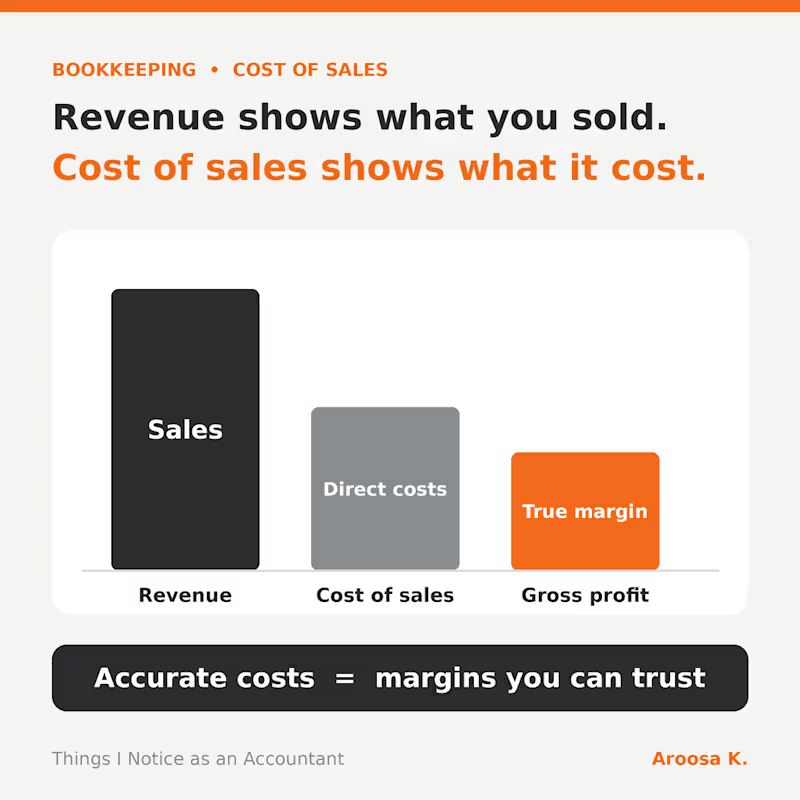
I worked with a small business that needed a clearer picture of its profitability.
The challenge wasn't just recording transactions. It was making sure purchases, direct costs, and operating expenses were classified correctly.
When cost of sales isn't calculated accurately, gross profit can be misleading — and business owners may make pricing and purchasing decisions without knowing their true margins.
Here's what I focused on:
✅ Reviewing purchase transactions and cost classifications
✅ Separating direct costs from operating expenses
✅ Checking inventory and cost of goods sold, where applicable
✅ Improving the accuracy of gross profit reporting
✅ Making financial reports easier to understand and use
The biggest takeaway?
Revenue tells you how much you sold. Cost of sales helps you understand what those sales actually cost your business.
Accurate bookkeeping isn't just about keeping records up to date. It's about giving business owners numbers they can confidently use to make decisions.
If you're a small business owner struggling to understand your cost of sales or gross profit, let's connect.
I can help you turn confusing financial records into clear, meaningful reports.
#Bookkeeping #Accounting #CostOfSales #FinancialReporting #SmallBusiness
1
2
212
The hidden value of monthly bookkeeping
Monthly bookkeeping is more than recording transactions. It's financial control. 📚
When your books are updated consistently, you can:
✅ Track income and expenses.
✅ Identify unusual transactions earlier.
✅ Monitor outstanding customer invoices.
✅ Reconcile bank balances.
✅ Prepare more reliable financial reports.
✅ Spend less time searching for financial documents.
When bookkeeping is delayed for months, even simple questions can become difficult to answer.
How much did we spend last month?
Which customers still owe us money?
Are our expenses increasing?
These answers should not require guesswork.
I provide accounting support to help businesses maintain organized records and gain better visibility into their finances.
📩 Message me if you're looking for dependable bookkeeping and accounting support.
#MonthlyBookkeeping #AccountingSupport #FinancialControl #SmallBusinessAccounting
1
2
233

Accurate Books. Clear Financial Insights. Stress-Free Tax
- 5.0
- Rating
- 63
- Followers
Accurate Books. Clear Financial Insights. Stress-Free Tax
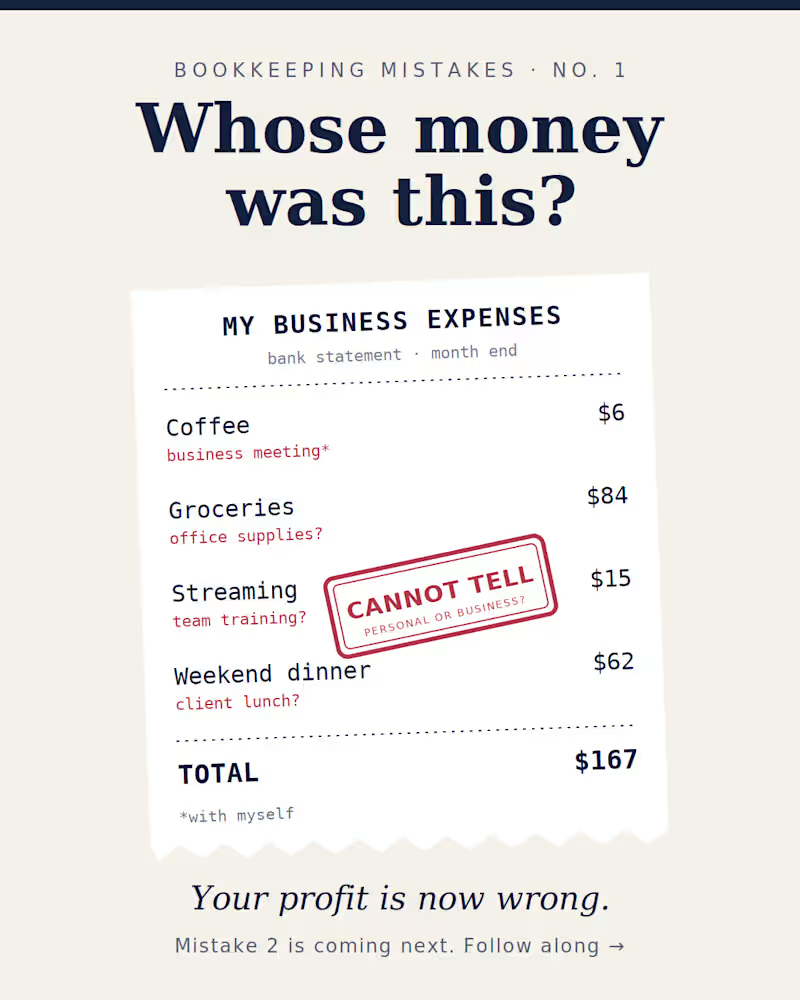
I am calling this the "Mistake post".
Wait. Did I post this by mistake?....
No, I promise. This is a bookkeeping post about the mistakes that quietly cost business owners money. There are many, so I will take one mistake at a time. This post is only about Mistake 1.
Mistake 1: Mixing personal and business spending One coffee here, one grocery bill there, and by the end of the month nobody knows whose money was spent. Yes, that coffee was a "business meeting". With yourself.
It looks small. It is not. Here is what it quietly does to your business:
Your profit becomes wrong. Personal costs sit inside business expenses, so the numbers do not show how the business is really performing.
Your bank reconciliation becomes slow. Every personal payment needs an explanation before your books can match the bank statement.
Your tax work becomes harder. When costs are mixed, it is difficult to prove which expenses truly belong to the business.
You lose clarity. You cannot tell how much the business earned and how much you took out for yourself.
Check your statement once a week. Small habit. Clean books. Much less stress at year end.
Mistake 2 is coming in the next post, so follow along so you do not miss it.
1
2
318
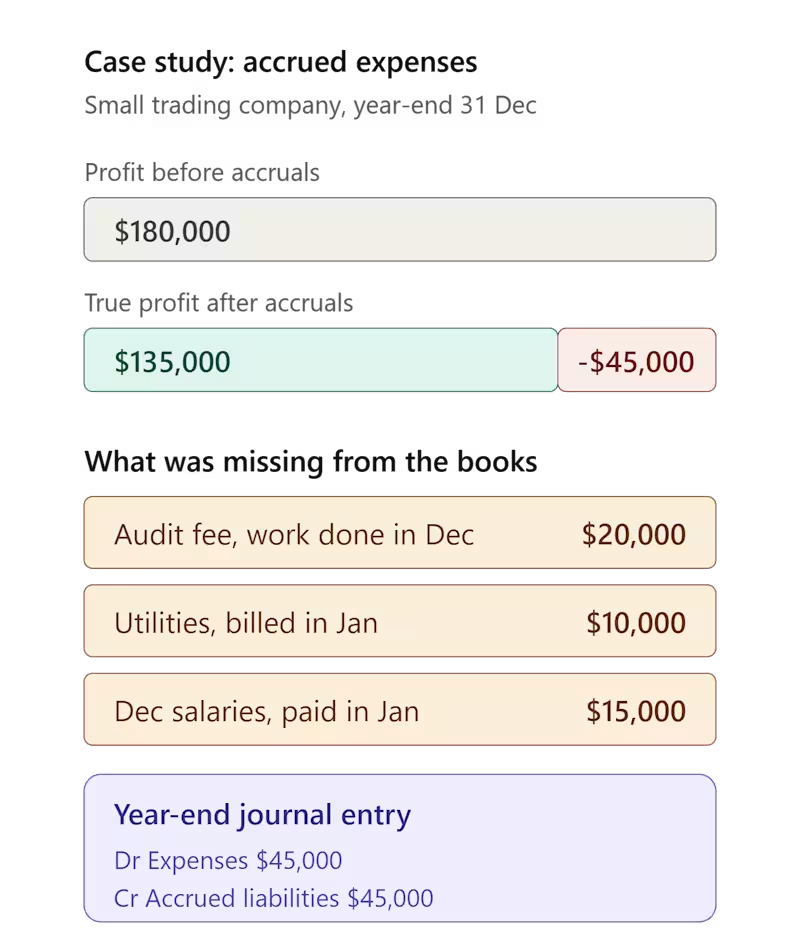
Your books say $180,000 profit. Reality says $135,000. 😬
Episode on accrual expenses 👇
The case: A small trading company came to us at year-end. Their profit looked great, but they had only recorded bills they had already paid.
What was missing:
✅ Audit fee: work done in December, invoice not yet received ($20,000)
✅ Utilities: December usage, bill arrives in January ($10,000)
✅ December salaries: paid in January ($15,000)
That is $45,000 of expenses that belong to this year but never touched the bank account, so they never hit the P&L.
The fix:
Dr Expenses $45,000
Cr Accrued liabilities $45,000
The lesson: Accrual accounting records an expense when you incur it, not when you pay it. If you only look at your bank, your profit is overstated, your tax is wrong, and your decisions are built on a number that isn’t real.
💬 Comment “ACCRUAL” and I’ll send you a simple month-end accruals checklist.
Follow for the next contra episode 🎬
Hashtags:
#Accounting #AccrualAccounting #AccrualExpenses #Bookkeeping #AccountingTips #FinancialLiteracy #SmallBusiness #Entrepreneur #Startup #Founders #Finance #CFO #Accountant #ACCA #LearnAccounting #BusinessTips #AccountingCaseStudy #contra #CountingCrux
2
288
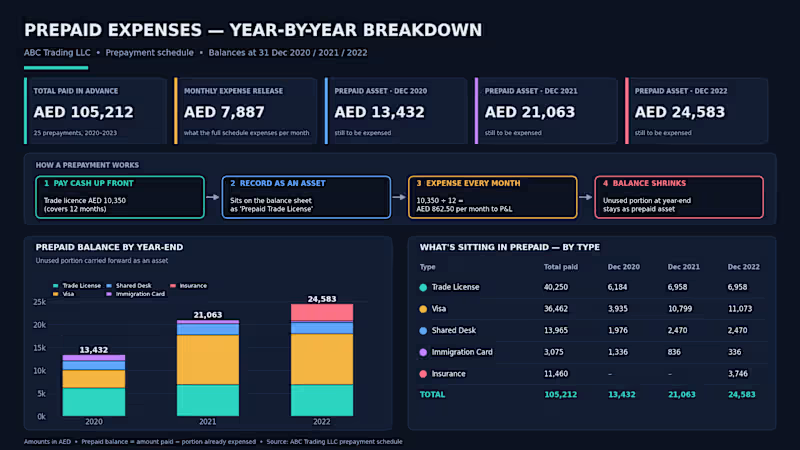
A client asked me last week: “Why is there still a balance sitting in prepaid? I already paid all of it.”
Fair question. Honestly, it’s one of the most common things business owners get confused about.
Here’s how I explained it. When you pay your trade licence for the year, that money has left your bank. But you haven’t used the whole year yet. So the unused part isn’t an expense yet. It’s something you’ve paid for and still own, like a credit waiting to be used.
Say you pay 10,350 for a 12 month licence. Each month, 862.50 moves into expenses. Whatever hasn’t been used by 31 December stays on the balance sheet as prepaid.
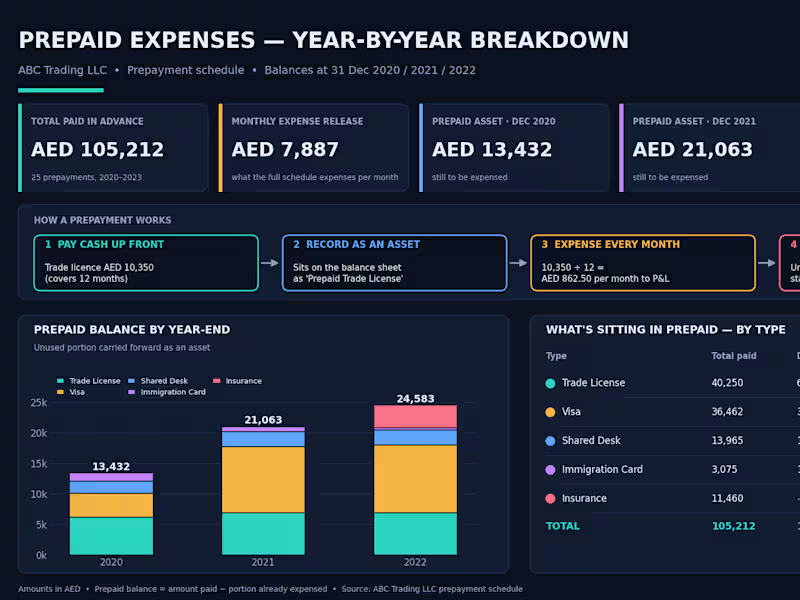
The client still wasn’t fully getting it from the schedule alone, so I broke it down year by year. 2020, 2021, 2022. Same prepayments, just showing how much was used and how much was still left at each year end.
That’s when it clicked for them.
The visa, shared desk, insurance and licence costs all work the same way. Pay now, use over time, expense a little each month.
If your accountant keeps saying “prepaid” and you nod along, ask them to show you a schedule like this. It’s your money, you should be able to see where it is.
This is part of my contra series, where I explain accounting without the jargon.
#accounting #prepaidexpenses #smallbusiness #UAE
Check it out (https://contra.com/p/N2MscqgY-prepaid-expenses-explained-the-way-i-explained-it-to-my-client)
2
6
650

CPA | Streamlining Your Finance |QuickBooks | XERO
CPA | Streamlining Your Finance |QuickBooks | XERO


View more →

UK Accountant & Financial Expert
UK Accountant & Financial Expert


View more →

Senior Accountant for US, UK & Australian Businesses
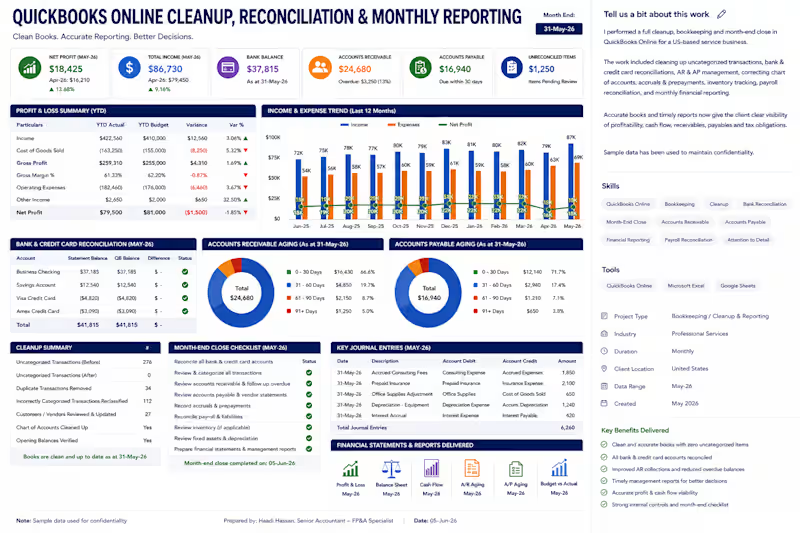
I performed a full QuickBooks Online cleanup, reconciliation, and month-end close for a US-based service business.
The work included reviewing and correcting transaction classifications, cleaning up uncategorized and duplicate entries, reconciling bank and credit-card accounts, reviewing accounts receivable and payable, updating the chart of accounts, and recording accruals, prepayments, depreciation, and other adjusting journal entries.
I also prepared monthly Profit and Loss, Balance Sheet, cash-flow, AR aging, AP aging, and budget-versus-actual reports. The completed cleanup gave management more reliable financial information, clearer visibility into cash flow and profitability, and a structured process for future monthly reporting.
Sample data has been used to maintain confidentiality.
1
117
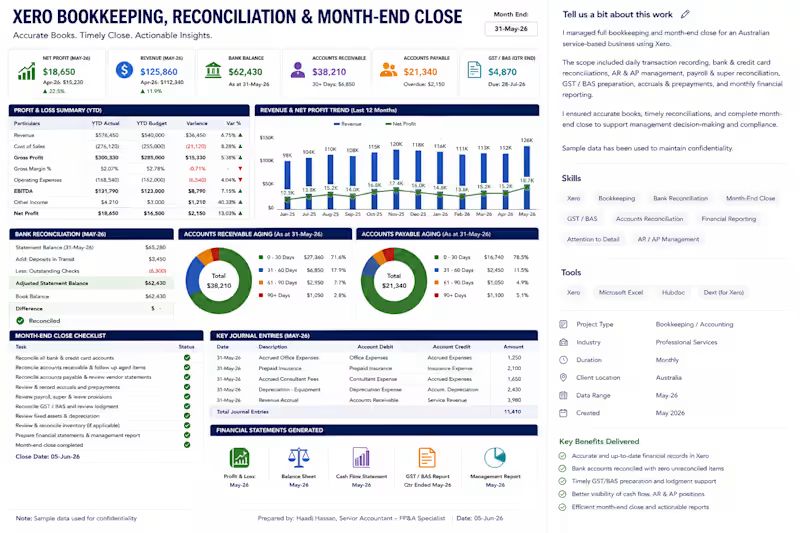
I managed the complete monthly bookkeeping and month-end close process in Xero for Australian service-based businesses.
The work included bank and credit-card reconciliations, accounts receivable and payable reviews, payroll and superannuation checks, accruals and prepayments, GST/BAS review, intercompany reconciliations, and investigation of outstanding or incorrectly classified transactions.
I also prepared Profit and Loss, Balance Sheet, cash-flow reports, and management summaries to give clients clear visibility into profitability, cash position, receivables, payables, and compliance obligations. A structured close checklist was used to ensure accurate records, timely reporting, and completion of all month-end activities.
Sample data has been used to maintain confidentiality.
0
64
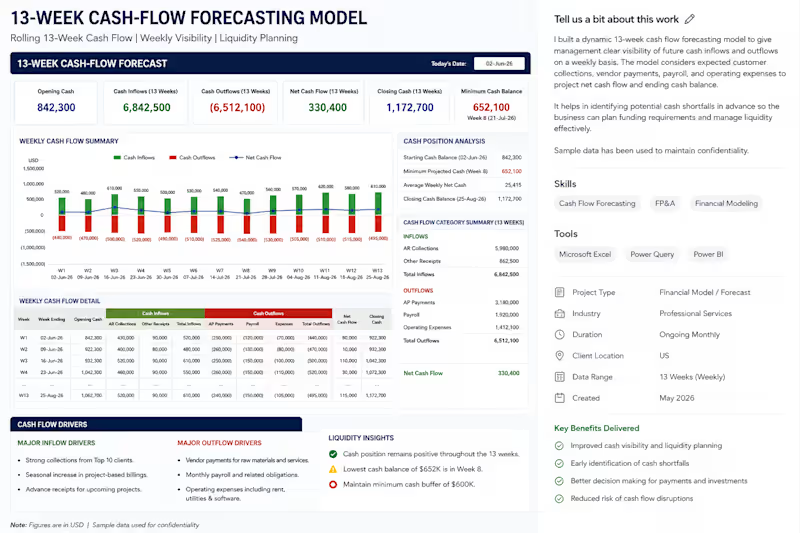
I developed a rolling 13-week cash-flow forecasting model to give management clear weekly visibility into future cash inflows, outflows, and liquidity requirements. The model brings together opening cash, expected customer collections, vendor payments, payroll, taxes, and operating expenses to calculate weekly net cash flow and projected closing balances.
It also highlights the lowest projected cash position, potential shortfalls, and the main drivers of cash movement. The forecast can be updated each week using the latest AR, AP, and operational information, helping management prioritize payments, strengthen collection efforts, and plan funding requirements in advance.
Sample data has been used to maintain confidentiality.
0
120
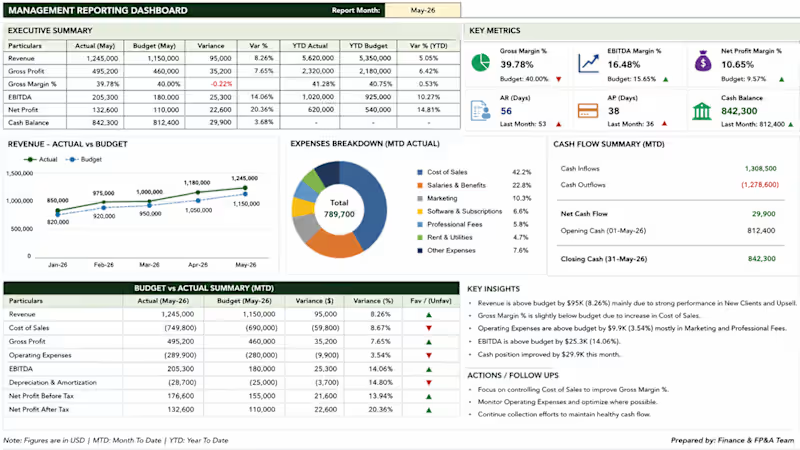
I developed this monthly management reporting dashboard to give leadership a clear view of financial performance in one place. It combines actual vs budget results, YTD performance, profitability margins, EBITDA, cash position, AR/AP days, revenue trends, expense analysis, and monthly cash flow.
The dashboard also highlights favorable and unfavorable variances, explains the key performance drivers, and provides practical follow-up actions for management. It was designed as a reusable Excel-based reporting format that can be updated each month.
1
109

Full Stack Bookkeeper
Full Stack Bookkeeper



View more →

Senior .NET Developer | ERP & SQL Server Expert
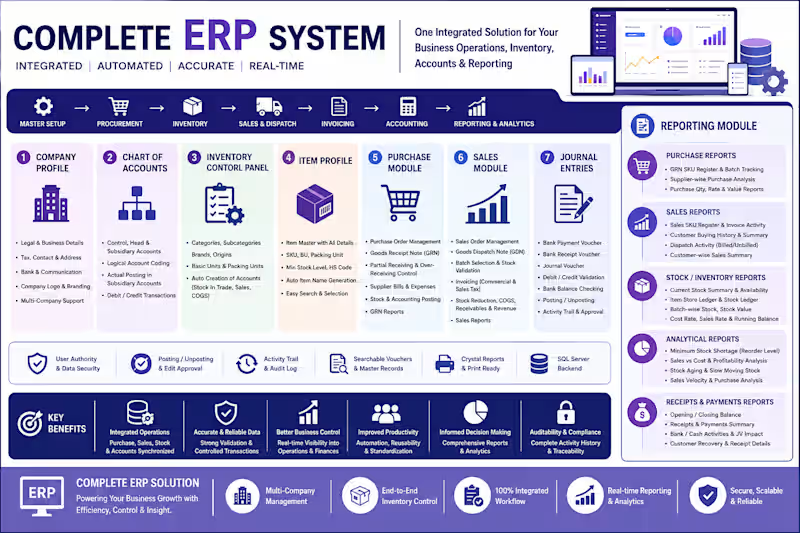
A complete
custom ERP system developed for multi-company business operations, integrating
company management, chart of accounts, inventory setup, item profiling,
purchasing, sales, journal entries, stock control, financial posting, and
advanced reporting.
The system
connects operational workflows with accounting and inventory records, ensuring
that purchases, sales, dispatches, receipts, payments, stock movements, and
financial transactions remain synchronized across the ERP.
It is
designed with SQL Server stored procedures, structured master-detail tables,
VB.NET (http://VB.NET) WinForms interfaces, Crystal Reports, posting controls, user authority
checks, and detailed reporting to support accurate business management,
auditability, and decision-making.
0
45
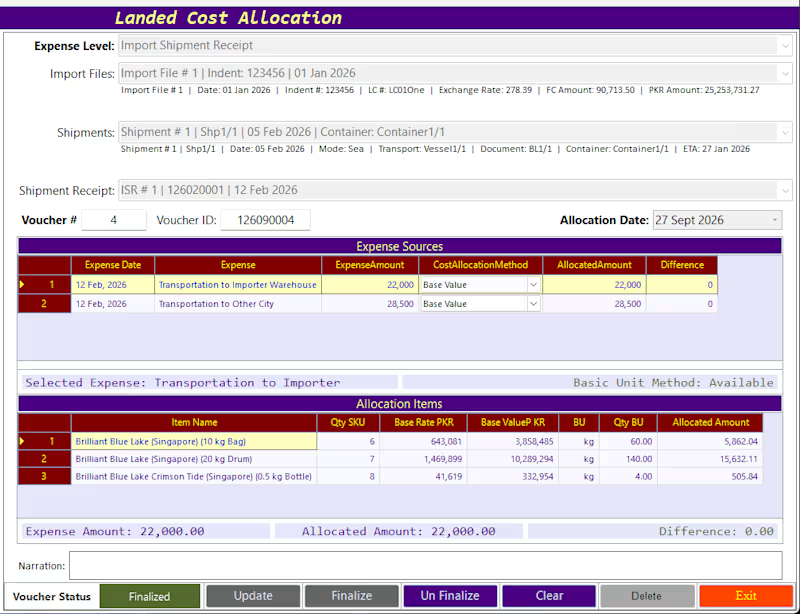
An imported item’s purchase price is only part of its inventory cost. Transport and other related expenses also need to be allocated accurately.
This Landed Cost Allocation screen is part of the custom ERP import module I developed using VB.NET (http://VB.NET) and Microsoft SQL Server.
It allows users to select an import shipment receipt, allocate each expense across received items, and review the allocated total and remaining difference before finalizing.
In this example, a PKR 22,000 transport expense is distributed across three items in proportion to their base values, with no unallocated balance.
The module supports Base Value, Basic Unit Quantity, and Manual allocation methods, helping businesses handle different costing requirements within an integrated inventory and accounting workflow.
Need a similar import-costing module or an enhancement to your existing .NET business software? Let’s discuss your requirements.
#ERP #VBNet #SQLServer #InventoryManagement #LandedCost
1
1
118
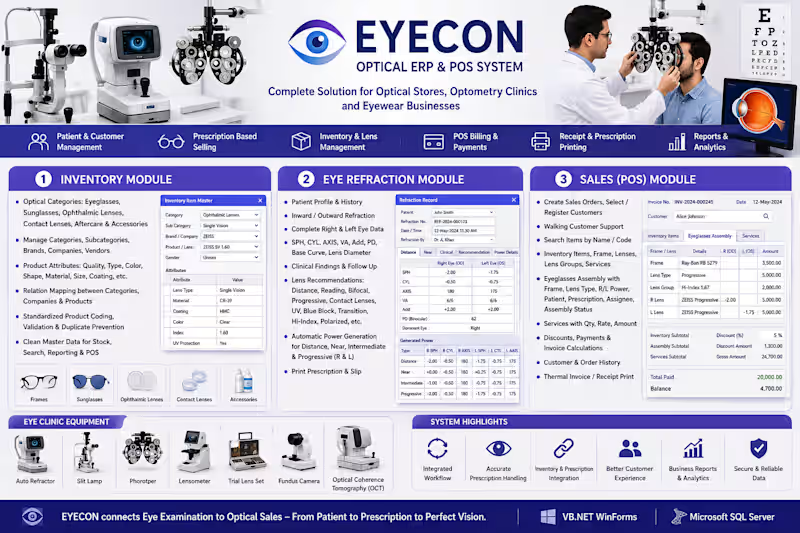
Eyecon | Optical Management System
Eyecon is an intelligent ophthalmic clinic and optical retail management
system designed specifically for optometrists, ophthalmologists, and eyewear
retail stores. The platform combines clinical eye refraction management with
optical product inventory and a fully integrated point-of-sale environment,
enabling clinics and optical shops to manage patient prescriptions, eyewear
products, and sales operations from a single centralized system.
The system maintains a
complete history of patient eye prescriptions, including refractive
measurements such as Sphere, Cylinder, Axis, and additional optical parameters
used in professional eye testing. Eyecon incorporates intelligent logic to
analyse stored prescription data and assist practitioners in determining
appropriate lens power values based on previous refraction records and standard
ophthalmic practices.
Beyond the clinical
environment, Eyecon includes a comprehensive optical retail module that manages
frames, ophthalmic lenses, contact lenses, sunglasses, and eyewear accessories.
The integrated inventory engine tracks product availability, product specifications,
and stock movement while seamlessly connecting with the POS module used for
retail sales.
The POS module allows
optical stores and clinics to sell eyewear products while automatically linking
patient prescriptions with the appropriate lenses and frames. Sales
transactions update stock levels in real time while maintaining accounting
integration for financial tracking.
Built as a cloud-connected
Windows desktop application, Eyecon allows multiple branches or clinics to
operate with a centralized database hosted on a remote server. This
architecture ensures secure data storage, synchronized operations, and
accessibility across different clinic locations.
Key capabilities
include:
• Patient eye
refraction record management
• Intelligent prescription analysis and lens power assistance
• Optical product inventory management
• Integrated optical retail POS system
• Prescription-to-product workflow automation
• Stock tracking for frames, lenses, and accessories
• Accounting and financial integration
• Cloud-connected multi-clinic architecture
Eyecon bridges the gap
between clinical ophthalmic practice and optical retail operations,
providing a unified platform that improves efficiency for eye clinics and
optical businesses
0
39
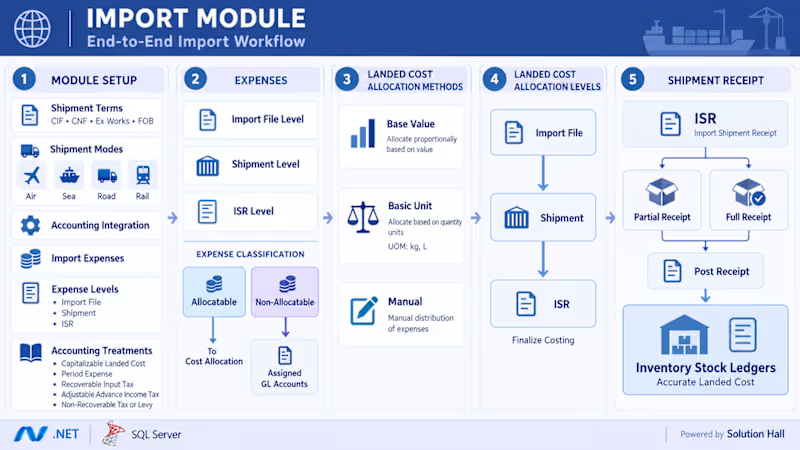
The Import
Module integrates import documentation, shipment management, expense accounting
and goods receipts into a controlled workflow that supports accurate landed
costing and inventory valuation.
Project Brief overview
Developed by
Solution Hall, the Import Module manages the import process from initial setup
and import files through shipments, expense recording and partial or full goods
receipts. It distinguishes capitalizable costs from period expenses and
tax-related amounts, with flexible methods for allocating eligible costs to
imported goods. By linking these activities with accounting and stock records,
the module strengthens financial control, improves cost visibility and provides
reliable information for business decisions.
0
39

Financial Controller | Senior Accountant | Remote Accounting
New to Contra
Financial Controller | Senior Accountant | Remote Accounting
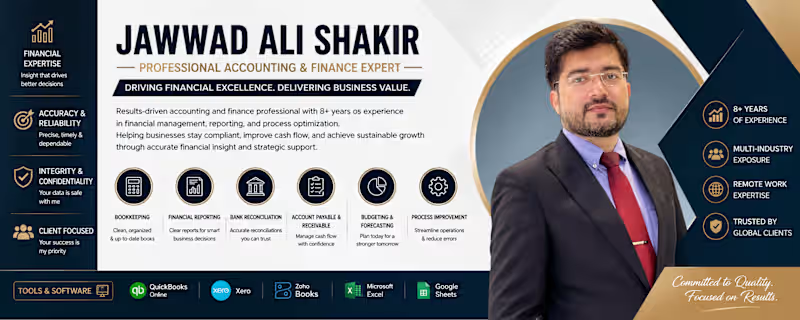
Chartered Accountant (ICAP) with 8+ years of progressive experience leading finance functions for organizations with annual revenues of up to PKR 4 Billion. Proven expertise in financial reporting, bookkeeping, ERP implementation, trade finance, payroll administration for 1,750 employees, IFRS compliance, and international accounting support for UAE and Canadian businesses. Recognized for resolving a PKR 500 Million legacy receivables reconciliation by identifying historical discrepancies, recovering missing invoices, and eliminating unreconciled balances. Highly proficient in QuickBooks Online, Xero, Zoho Books, Oracle, SAP, Microsoft Dynamics 365, and Advanced Excel.
0
34
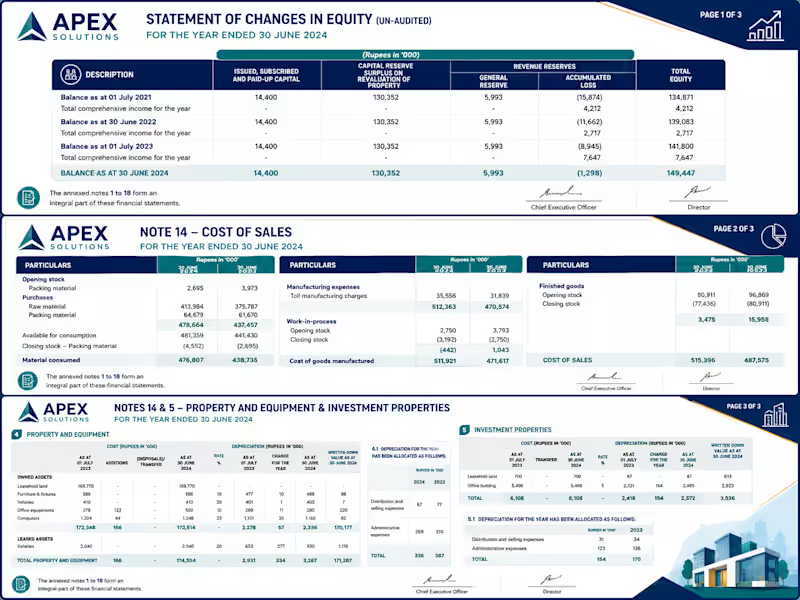
Developed comprehensive financial statement schedules to support the annual financial reporting process, including equity reconciliation, cost of sales analysis, and fixed asset and investment property schedules. The project focused on accurate classification, reconciliation, and presentation of financial data in accordance with applicable reporting standards, delivering clear and reliable information for management review, statutory reporting, and stakeholder communication.
0
85
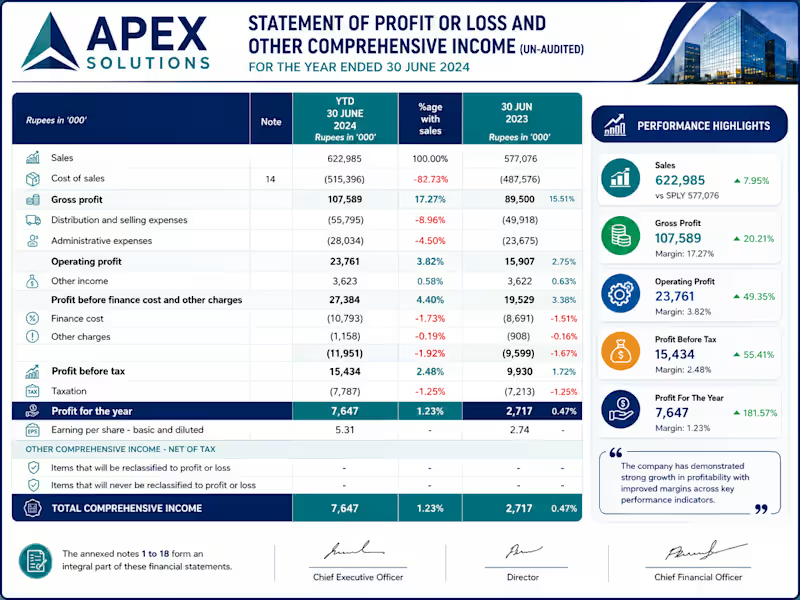
Prepared a comprehensive Statement of Profit or Loss and Other Comprehensive Income by organizing and analyzing the client's financial data in accordance with applicable financial reporting standards. The report presents revenue, operating expenses, profitability, taxation, and comprehensive income in a clear and structured format, enabling management and stakeholders to assess the company's financial performance and make informed business decisions.
0
69
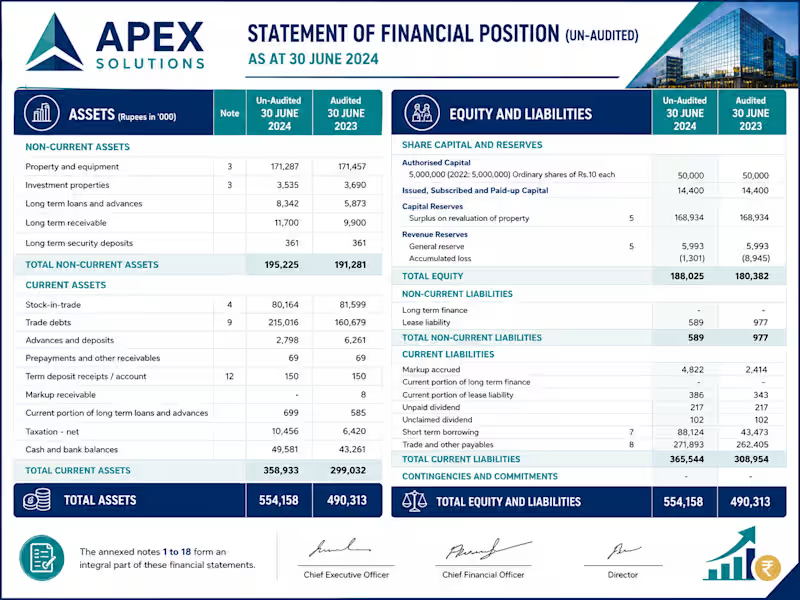
Prepared and presented the client's Statement of Financial Position by consolidating financial records into a structured and compliant financial statement. The project focused on accurate financial reporting, proper classification of balance sheet items, and delivering a professional document suitable for management review, regulatory compliance, and external stakeholders.
0
102