Freelance Technical Writers in Lagos
Sign Up
Post a job
Sign Up
Log In
Filters
2
Projects
People
Opemipo Jokotagba
Lagos, Nigeria
Technical Writer | Documentation Lead | Software Engineer
5.0
Rating
6
Followers
Follow
Message
Technical Writer | Documentation Lead | Software Engineer

1
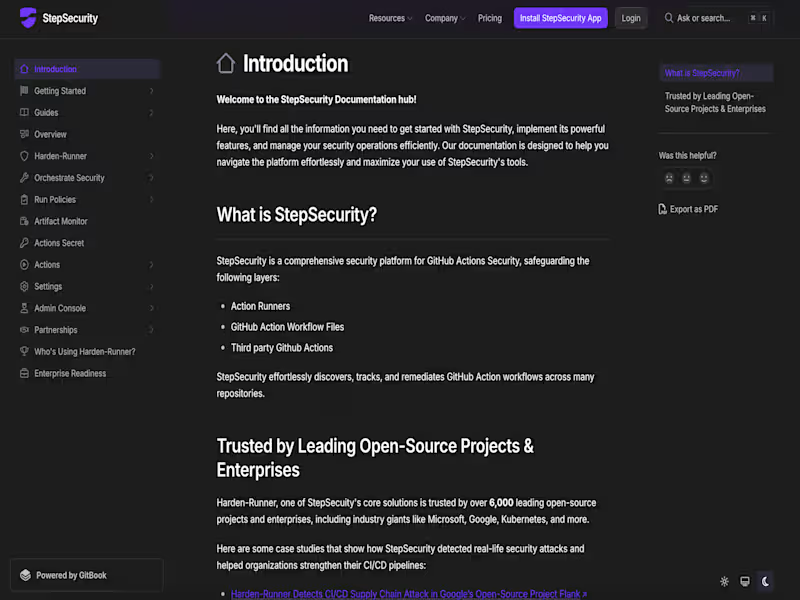
Developer Documentation for CI/CD Security Platform
1
42
0
End-to-End Developer Documentation & Support System
0
14
1
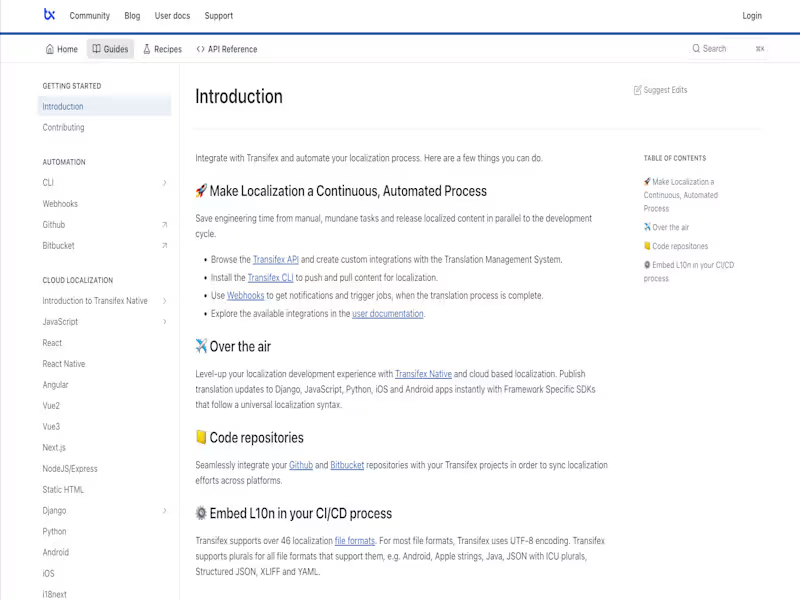
Building a Developer-First Localization Experience
1
19
1
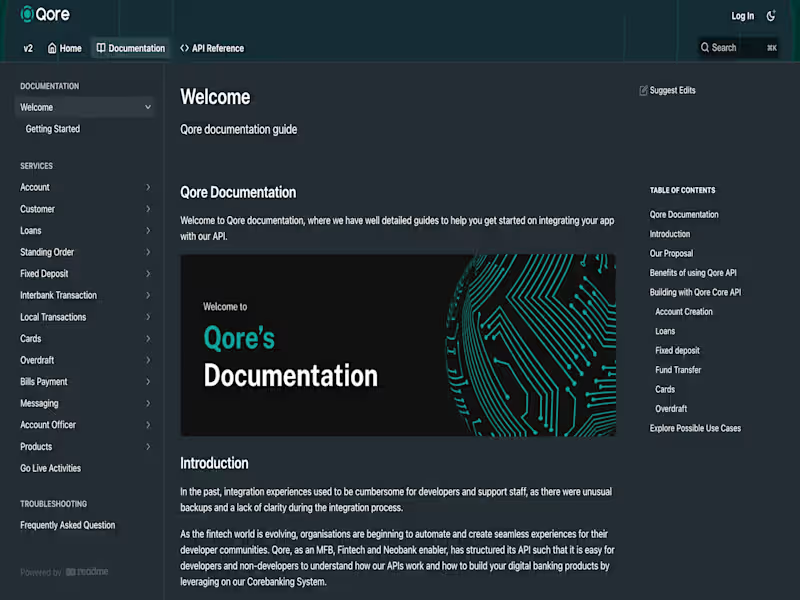
Complexity to Clarity: Qore’s Developer Documentation
1
11
Technical Writer
(5)
Follow
Message
Bukola Aladesulu
Ikeja, Nigeria
Copy, Content and Social media Strategist for Businesses
5.0
Rating
9
Followers
Follow
Message
Copy, Content and Social media Strategist for Businesses

0
Blog Article - Personalized Budget Planning
0
6
0
Blog Article - FunZ Financial Management Enhancement
0
5
0
Blog Article - FunZ Financial Planning App Development
0
2
0
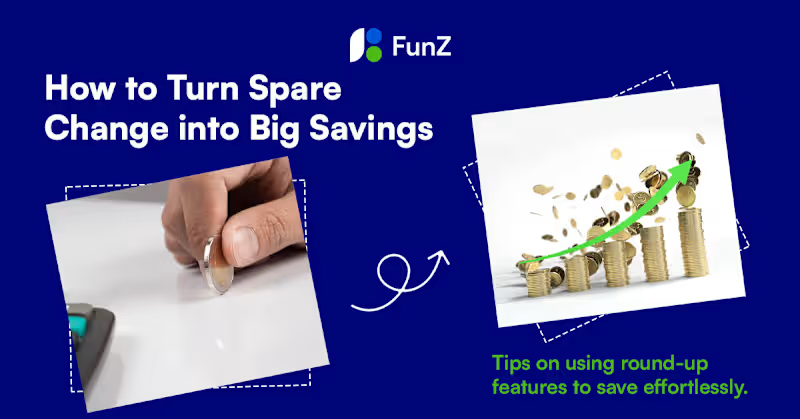
Blog Article - FunZ Round-Up Savings Feature Development
0
4
Technical Writer
(10)
Follow
Message
Olanrewaju Alaba
Lagos, Nigeria
FullStack and Blockchain Developer || Technical Writer
5.0
Rating
3
Followers
Follow
Message
FullStack and Blockchain Developer || Technical Writer

0
Google Authentication in Nodejs using Passport and Google Oauth
0
17
0
Machine Learning Pipeline Architecture
0
15
0
3 Simple Methods To Do Reverse Email Lookup
0
12
1
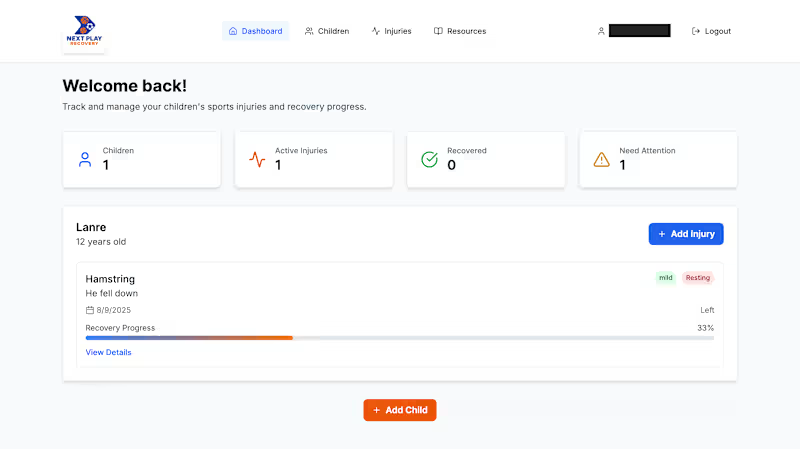
Next Play Recovery
1
6
Technical Writer
(3)
Follow
Message
Victory Nnaji
Lagos, Nigeria
Technical Writer & DevRel | API, AI/ML & SaaS Docs
5.0
Rating
6
Followers
Follow
Message
Technical Writer & DevRel | API, AI/ML & SaaS Docs
0
I just published a practical guide: “How to Choose the Right AI Framework for Your Use Case.” If you're evaluating AI agents (LangChain, CrewAI, no-code tools, etc.), the real question isn’t what’s popular; it’s what fits your business. In this guide, I break down: 1. Team technical capability 2. True cost of ownership 3. Matching tools to real use cases 4. How company size impacts your decision Includes decision flowcharts, cost insights, and a roadmap from prototype to production. Key insight: The winners in AI aren’t chasing hype. They test fast, learn quickly, and scale what works. Read here: Medium: https://shorturl.at/YNyU1 Ready Tensor: https://shorturl.at/X8VgR What’s been your biggest challenge in choosing AI tools?
0
51
1
Understanding Retrieval Augmented Generation
1
10
0
COVID-19 Dashboard for Berlin City
0
17
1
Netflix Recommender System
1
20
Technical Writer
(2)
Follow
Message
Aniekan Akam
Lagos, Nigeria
Web3 Social Media Manager | Brand & Community Strategist

New to Contra
Follow
Message
Web3 Social Media Manager | Brand & Community Strategist
0
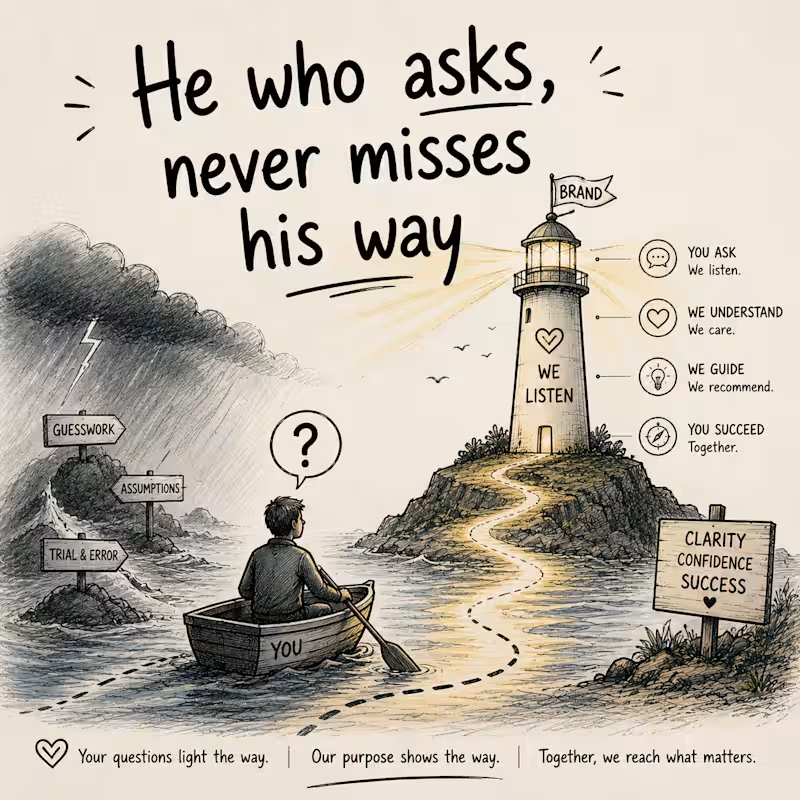
A brand hires a social media manager, gives them the brand logo, maybe a brand guide and a guardrail, and says "grow us." No brand voice. No brand personality. No answer to the question of why anyone should care. The manager posts. They experiment. They try memes, carousels, trending audios and all brilliant ideas. Some things work briefly. Most things flatline. Then the brand calls it underperformance and starts looking for someone new. So you keep firing them, hiring new ones, chasing the latest "growth hack" and virality. More posting and posting but you cannot perform a personality that doesn't exist. Social media is NOT a distribution channel. It's a conversation. And you cannot hold a conversation if you have nothing to say. A better copywriter won't fix it. A higher content budget won't fix it. Hiring someone who "really understands the algorithm" definitely won't fix it. The algorithm is not your enemy. Emptiness is. Social media managers aren't magicians. They can't manufacture a soul for your brand. They can polish your logo, schedule your posts, and reply to complaints with smiley emojis. But if your brand stands for nothing, if you have no real opinion, no personality, no reason for anyone to care, then no amount of posting will save you. Think about the brands you followed and probably still follow because you want to, not because you searched for them. There's always a point of view underneath the content. Something they'd say that their competitor wouldn't. A customer they'd turn down. A position they hold even when it's unpopular. The social media manager is often handed a blank canvas and told to paint something people love. Then, when the painting doesn't go viral, the painter gets blamed. It's a clean narrative. It protects the people who were supposed to define the canvas in the first place. If your social media isn't working, sit with this question first before you post that job listing again: 1. What does your brand actually think? Not what it sells. Not what it does. What does it think about the industry it lives in, the customers it serves or intends to serve, the way things should work versus how they do?
0
13
0
My suya man, your suya man, all of the suya men we've patronized have never advertised a day in their life. No Instagram. No flyers No “link in bio.” No buy-one-get-one-free nonsense. Just a smoky grill, a rusted skewer, and a memory that would shame your CRM. He knows how I like it. He knows when I request for more than my ‘usual’, mood is high or I’ve got friends over. And even when he still knows my ‘usual’, He still asks me every single time: “E get as you want am abi?” That’s not just a small talk, that’s a business strategy that brands spend a four-figure ads budget on and still can’t touch. There is a particular kind of shop owner that we have all probably encountered. They watch you walk in, scan and browse for like seven minutes, clearly confused, but they still see you in your confusion and watch you like Nollywood’s Patience Ozokwor. Then when you leave empty-handed, they act offended and personally betrayed. Everyone loses. Then there’s the other kind. The yaba market type who clocks what you’re holding, asks one sharp question, and thirty seconds later is pulling out exactly what you actually came for from a pile you would never have found on your own. Even if you didn’t plan to spend much, you’ll do and also refer your friends, family, cousins. The difference between these two shop owners is not location, not product, not even price. It is that one of them understands that asking is not weakness. Brands have somehow convinced themselves that talking is the same thing as communicating. So they post, they announce, they run campaigns with big budgets and beautiful visuals, they broadcast into the void and then hold their breath waiting for sales to tell them if they were right. Then on Monday morning, they hold an intense meeting asking why retention numbers are down. It is not just customer service. It is information warfare and in any market, the person with the most accurate information wins. Not the loudest, not the well packaged, not the prettiest, the most informed. Every time a customer tells you what they actually need, they are handing you a competitive advantage wrapped in a complaint or a compliment. But most brands unwrap neither; the complaint goes to a spreadsheet while the compliment becomes a testimonial screenshot. Neither one changes anything about how the business operates. Real asking (the kind the suya man does), is asking with the intention to adjust, to remember, to do something differently because of what you just learned. That feedback loop, boring as it sounds, is the actual engine behind every brand that people stay loyal to through price increases, new competitors, and bad economy. He who asks for directions does not get lost. Not he who knows everything, not he who acts like he knows everything, He who asks. Your brand might not need more reach right now, it might need to ask better questions like: “What almost stopped you from buying today?” “What were you hoping to find that you didn’t?” “Why did you come back?” Not the generic “Thanks for your patronage”, “Hope to hear from you again”, then actually DO SOMETHING about the answers. Not make a post, not write a caption, an actual change. In your packaging, your response time, your product, your process. Something that would make the person who gave you that information feel like they were heard rather than surveyed. That feeling of “this brand actually listens” is not a marketing strategy, it is rarer and more powerful than one. It is the thing that turns a customer into the person telling everyone in their office where they should be shopping. So here is my final question to you and I actually want you to answer it, not just scroll past: What does your brand really know about why its customers stay? I’m not talking about what you assume or what your dashboard says. What do you actually know because someone told you directly, and you listened hard enough to change something? If you don’t have an answer for that, then Go and ask.
0
7
0
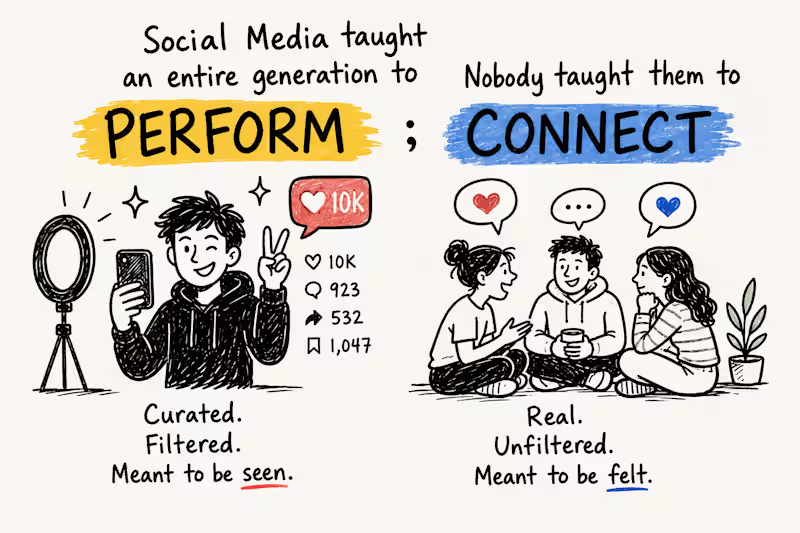
The best social media manager you've ever followed probably has under 10k followers. It’s truly concerning and it’s overlooked. In the “Content Creation” space, we've spent the last five years (or more) rewarding performance over actual understanding. We clap for the person who posts three times a day, goes viral twice a month and has a fancy Notion template for every content format known to man. We call them experts, we pay them like experts, we share their threads. But being loud isn't the same as being good. Loud is just… loud. The people who actually get it, the people who genuinely understand why someone stops scrolling, why a comment section turns into a real conversation, those people are usually just quietly doing their thing. Studying people like it's a second job. They're not trying to look like experts. They're becoming them. The funny thing is most brands are hiring the wrong people and not clocking it. (partly because the brands themselves are more interested in vanity metrics and hype for short term traction). They're hiring people who can talk about engagement instead of people who can actually create it. There's a huge difference between someone who knows what went viral last week and someone who understands the underlying feeling that made it spread. Just think about it, your Iya Beji down the road who sells rice and stew. That woman has never run a single ad in her life. And yet every single customer that buys from her feels like they're her favorite person. She remembers you like your stew with less oil and when you're having a rough day, she says one small thing like "ah, take am easy" or "God go do am" and somehow, it lands exactly where you need it. Meanwhile the new provision store at the junction is blasting music at full volume, has a big fancy banner and is always "doing promo." But you walk out of there and feel… nothing. Just noise. One of them truly understands people. The other just understands how to make enough noise. That's the difference between real connection and just being loud. And on social media, just like on your street, people will ALWAYS come back to the one who made them feel something. That's what good social media management actually is. It's not a megaphone. It's a mirror. The market doesn't reward that kind of connection right away. Real connection takes time, builds slowly, compounds and doesn't make for a great case study. Virality is fast, easy to screenshot and easy to sell in a pitch deck. So brands keep chasing noise, agencies keep hiring performers, and the people who actually understand human behavior stay undervalued and overlooked or worse, they learn to be loud just to survive the industry. We created this problem. The obsession with metrics, follower counts, and "impressions" trained an entire generation of social media managers to optimize for attention instead of connection. And now we're surprised that most brand pages feel empty. Those “most viral” moments leave no memory. People follow accounts for months and feel absolutely nothing. Being loud is easy because it requires no self-awareness. You don't need to understand people, you just have to be seen by them. But being real is rare. Because it requires something most of us actively avoid — sitting still long enough to figure out what someone actually needs to hear. The best social media managers aren't performing for you, they're thinking about you. There's a difference. You feel it.
0
24
0
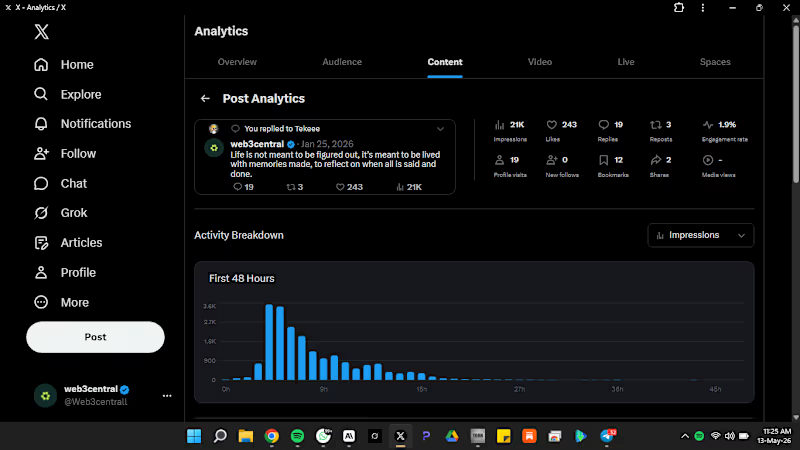
I ran content and community for a Web3 brand account. In under a month, using a completely organic strategy, engagement jumped 557%, 99.8% of our reach came from people who didn’t follow us, and we still landed 62K+ impressions — with zero paid promotions.
0
20
Technical Writer
(4)
Follow
Message
Abdulfatai Adebayo
Lagos, Nigeria
B2B Tech & SaaS Content Writer | Long-Form Articles.
New to Contra
Follow
Message
B2B Tech & SaaS Content Writer | Long-Form Articles.
1
How Notion Turned AI into a Product Strategy
1
0
0
Boosting Orbita's Revenue Efficiency with NexaFlow
0
0
1
Why SaaS Monetization Is a Product Strategy Challenge
1
0
1
Why AI-Native SaaS Products Are Quietly Redefining How Software…
1
0
Technical Writer
(2)
Follow
Message
Olatunde Ibitoye
Lagos, Nigeria
Building responsive, SEO-optimized websites and web apps

Follow
Message
Building responsive, SEO-optimized websites and web apps
0
Krillpay: Dynamic Fintech Platform Developed with Laravel
0
11
0
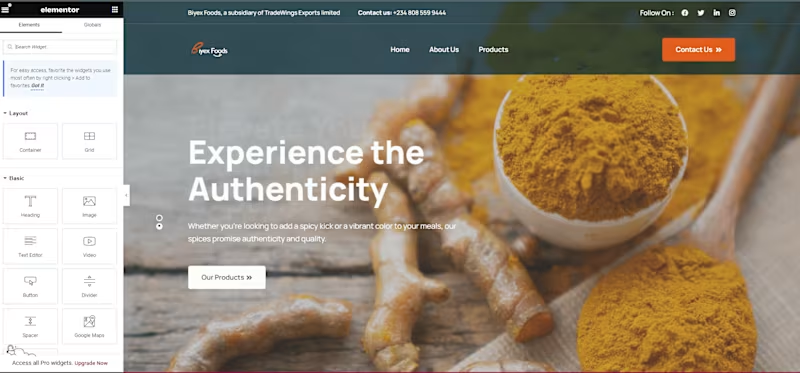
Biyex Foods: Deliciously Crafted with WordPress Elementor
0
21
0
Disguys Design Studio
0
14
0
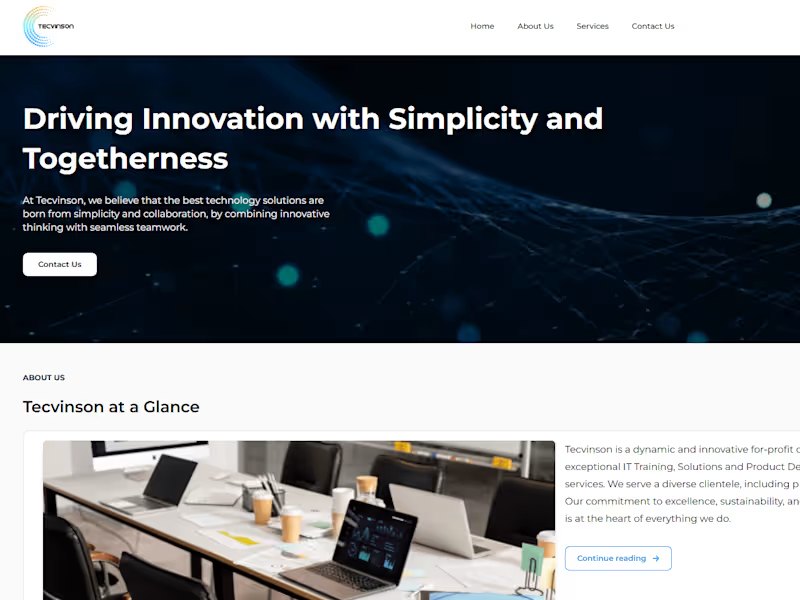
Tecvinson – Full-Stack Web App with Node and React.js
0
6
Technical Writer
(3)
Follow
Message
Blessing Adedeji
Lagos, Nigeria
Web3 & IT Content Writer: SEO & Technical Writing Expert
Follow
Message
Web3 & IT Content Writer: SEO & Technical Writing Expert
0
The Introduction to .NET E-Сommerce Development Services. Part 2
0
6
0
The Introduction to .NET E-Сommerce Development Services. Part 1
0
4
0
Maximizing Growth: The Power of AI in Business Process Automati…
0
20
0
Widely used healthcare software solutions in 2024
0
17
Technical Writer
(5)
Follow
Message
Explore people