
Local & Ecommerce SEO Expert | Boost Rankings

Let Google Find You!
Want more visibility, traffic, and potential customers? A well-optimized website can help your business appear higher in Google search results and reach the right audience.
With effective SEO strategies, you can:
Improve search engine rankings
Increase organic website traffic
Reach more potential customers
Build stronger online visibility
Generate more leads and business opportunities
Don't let your competitors take the spotlight. Optimize your website with SEO and make it easier for customers to find you!
SEO is not just about ranking-it's about getting found by the people who are searching for your services.
🔔 Follow Kamran Hussain
♻️ Repost to help others
📌 Save this
0
68
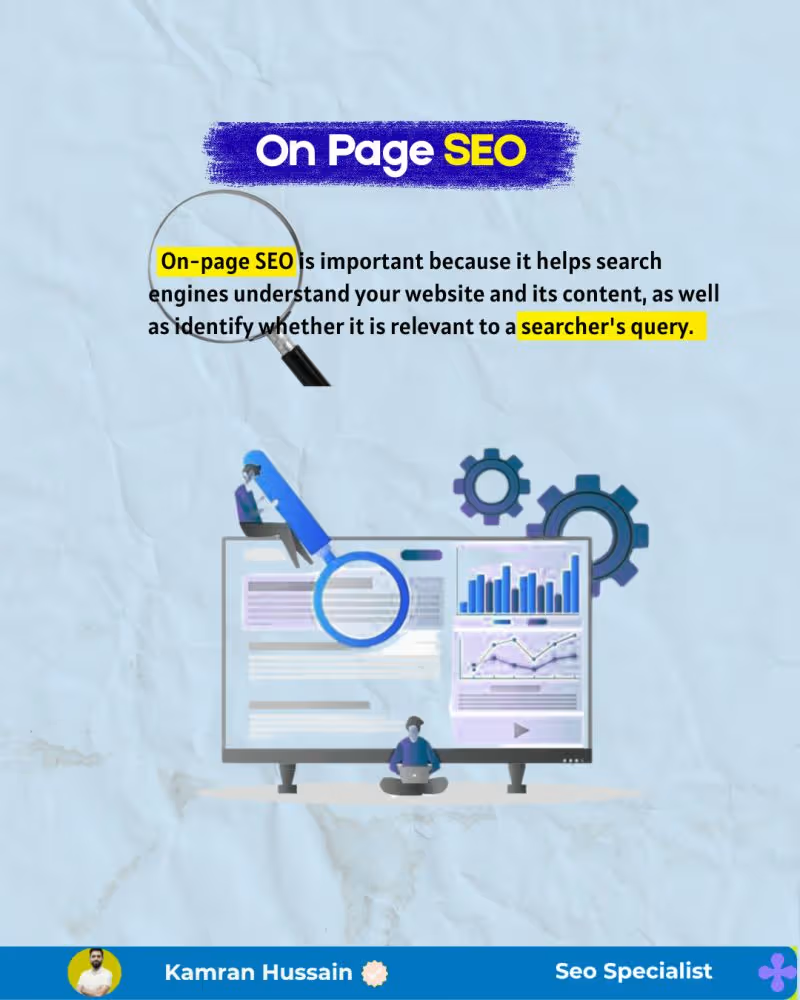
On-Page SEO: the foundation every ranking is built on
Search engines can't rank what they can't understand. On-page SEO is how you tell Google exactly what your page is about and prove it's the best answer to what someone just searched for
The essentials I check on every page:
✅ Title tag & meta description written for clicks, not just keywords
✅ One clear H1, with H2s and H3s that structure the content
✅ Primary keyword placed naturally in the first 100 words
✅ Clean, readable URL slug
✅ Descriptive alt text on every image
✅ Internal links to related pages on your site
✅ Fast load speed and a mobile-friendly layout
✅ Content that actually satisfies search intent
0
110
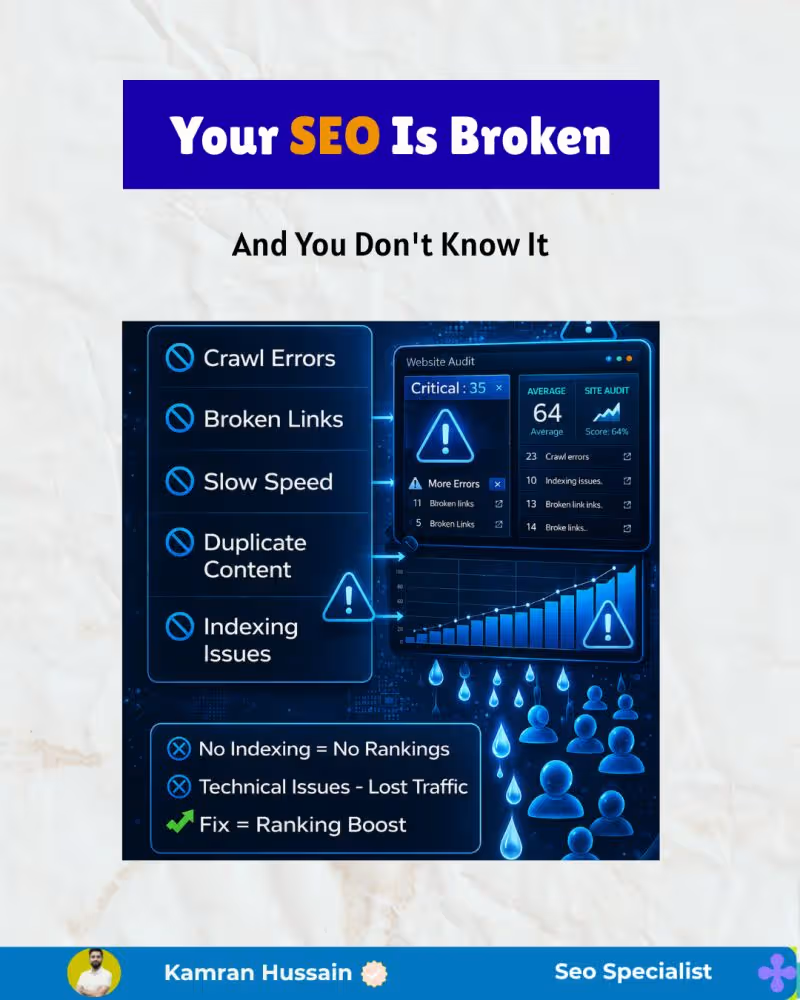
Your SEO could be broken and you might not even know it.
Crawl errors, broken links, slow page speed, duplicate content, and indexing issues can quietly hurt your Google rankings and organic traffic.
A proper SEO audit helps uncover these hidden problems, fix technical issues, improve website performance, and create a stronger foundation for better rankings. 📈🔍
Save this SEO audit checklist and make sure technical issues aren’t costing your website valuable traffic!
🔔 Follow for Kamran Hussain
♻️ Repost to help others
📌 Save this
#SEO (https://www.linkedin.com/search/results/all/?keywords=%23seo&origin=HASH_TAG_FROM_FEED) #SEOAudit (https://www.linkedin.com/search/results/all/?keywords=%23seoaudit&origin=HASH_TAG_FROM_FEED) #TechnicalSEO (https://www.linkedin.com/search/results/all/?keywords=%23technicalseo&origin=HASH_TAG_FROM_FEED) #GoogleRankings (https://www.linkedin.com/search/results/all/?keywords=%23googlerankings&origin=HASH_TAG_FROM_FEED) #OrganicTraffic (https://www.linkedin.com/search/results/all/?keywords=%23organictraffic&origin=HASH_TAG_FROM_FEED) #WebsiteAudit (https://www.linkedin.com/search/results/all/?keywords=%23websiteaudit&origin=HASH_TAG_FROM_FEED) #SEOTips (https://www.linkedin.com/search/results/all/?keywords=%23seotips&origin=HASH_TAG_FROM_FEED) #DigitalMarketing (https://www.linkedin.com/search/results/all/?keywords=%23digitalmarketing&origin=HASH_TAG_FROM_FEED)
0
74
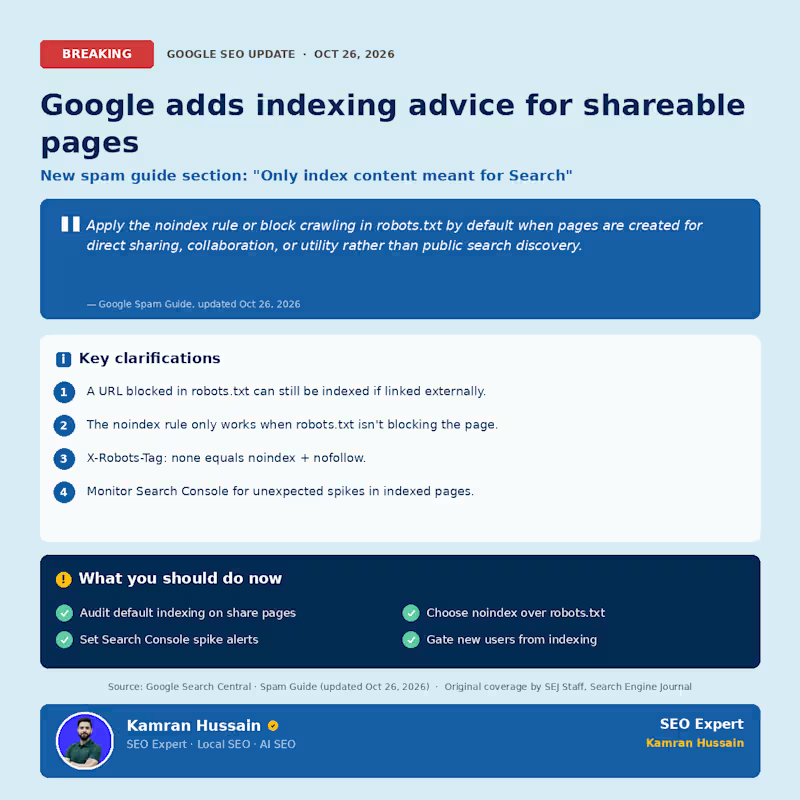
𝐆𝐨𝐨𝐠𝐥𝐞 𝐣𝐮𝐬𝐭 𝐮𝐩𝐝𝐚𝐭𝐞𝐝 𝐢𝐭𝐬 𝐬𝐩𝐚𝐦 𝐠𝐮𝐢𝐝𝐞 — 𝐚𝐧𝐝 𝐢𝐭’𝐬 𝐚 𝐛𝐢𝐠 𝐝𝐞𝐚𝐥 𝐟𝐨𝐫 𝐚𝐧𝐲𝐨𝐧𝐞 𝐫𝐮𝐧𝐧𝐢𝐧𝐠 𝐚 𝐦𝐨𝐝𝐞𝐫𝐧 𝐰𝐞𝐛 𝐩𝐥𝐚𝐭𝐟𝐨𝐫𝐦.
On October 26, Google added a brand new section titled “Only index content meant for Search” inside its official spam guidelines.
What changed?
Google now recommends that websites allowing users to create shareable pages, generated outputs, or interactive tools should apply noindex tags or block crawlers via robots.txt by default — if those pages aren’t meant for public search discovery.
𝐈𝐧 𝐆𝐨𝐨𝐠𝐥𝐞’𝐬 𝐨𝐰𝐧 𝐰𝐨𝐫𝐝𝐬:
“If your service lets users create shareable pages, generated outputs, or interactive tools, consider whether that content is meant to be found through search engines or only accessed directly by people with a link.”
Key clarifications you need to know:
A page disallowed in robots.txt can STILL appear in search results if other sites link to it (just without a description).
The noindex rule only works if robots.txt isn’t blocking the page — otherwise Google’s crawler never sees the directive.
Google treats the X-Robots-Tag: none value as equal to BOTH noindex and nofollow.
For images and videos, robots.txt applies. For everything else, noindex is the proper tool.
New Search Console monitoring advice:
Verify your platform/subdomain in Search Console to receive manual action and security alerts.
Monitor the Page Indexing report for unexpected spikes.
Track indexing at the platform level — watch for a small number of users generating a disproportionate share of indexable URLs.
My take as an SEO Specialist:
This update is Google quietly putting hosting platforms, SaaS tools, and AI-generated content apps on notice. For years, platforms that let users publish freely have been goldmines for spam at scale — and Google is tired of it.
If you run a SaaS, a sharing tool, a generative AI app, or any multi-tenant platform, this is your signal:
Audit what gets indexed by default. If a user’s “shared link” was never meant for Google, it shouldn’t be in the index.
Pick the RIGHT tool. noindex + crawlable is almost always better than robots.txt blocking when you want pages fully suppressed.
Set up Search Console alerts. Spikes in indexed pages = early warning for abuse.
Shift to “earn-your-way-in” indexing. New users and new share links default to noindex; only promote established, high-quality content to the index.
This is also a wake-up call for GEO (Generative Engine Optimization). As AI tools generate more shareable content, platforms that don’t gate indexing will drown their own quality signals — and get penalized sitewide.
Clean index = strong rankings. Bloated index = sitewide risk.
What’s your take — are you auditing your indexable URLs this quarter?
Original article by SEJ Staff – 𝐌𝐚𝐭𝐭 𝐆. 𝐒𝐨𝐮𝐭𝐡𝐞𝐫𝐧 on Search Engine Journal.
0
35
