
Introducing Beacon AI Beta: Get Cited by AI. Get Found by Customers.
We are thrilled to announce the launch of Beacon, our AI Search Visibility Platform, now available in beta.
As AI search engines like ChatGPT, Perplexity, Claude, and Google AI become increasingly central to how people find information, visibility across these platforms is critical. Beacon gives you the intelligence you need to own search — both traditional and AI.
Beacon doesn't just show you data — it tells you what to do with it. Our AI-powered recommendations provide specific, actionable insights to improve your presence across traditional search and AI platforms.
Get started free at hellobeacon.ai (http://hellobeacon.ai). No credit card required.
3
28
404

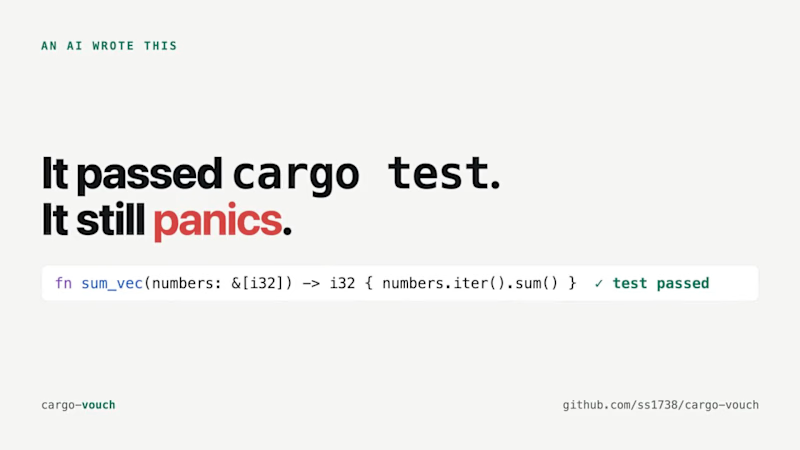
I just launched cargo-vouch, an open-source Rust tool that proves a function can't panic. No tests to write, no annotations to add.
Point it at a .rs file, and it builds a Kani proof harness for every function, then checks every input in bounds. Each function comes back with one of four verdicts:
🔴 BUG, with the exact input that triggers the panic
🟡 UNGUARDED, safe except at type extremes like i32::MAX
🟢 VERIFIED, provably panic-free
⏳ INCONCLUSIVE, when it cannot decide
Why I built it: AI writes Rust that passes cargo test, then panics on an edge input nobody tried. For example, numbers.iter().sum() looks fine until something hands it [i32::MAX, 1].
I ran it on 11 functions GPT-4o wrote and graded. GPT-4o's own grading got 4 of them wrong: it passed three that overflowed and failed one that was fine. cargo-vouch called all four correctly, with the triggering input for each real panic.
The honest limit: it is built for loop-light code. Parsers and loop-heavy functions return INCONCLUSIVE, never a false pass. I would rather say that than oversell it.
If you write Rust, I would like your feedback.
Repo - https://lnkd.in/eHirVFQq
(https://lnkd.in/eHirVFQq)cargo install cargo-vouch
#rustlang (https://www.linkedin.com/search/results/all/?keywords=%23rustlang&origin=HASH_TAG_FROM_FEED) #opensource (https://www.linkedin.com/search/results/all/?keywords=%23opensource&origin=HASH_TAG_FROM_FEED) #formalverification (https://www.linkedin.com/search/results/all/?keywords=%23formalverification&origin=HASH_TAG_FROM_FEED)
0
48

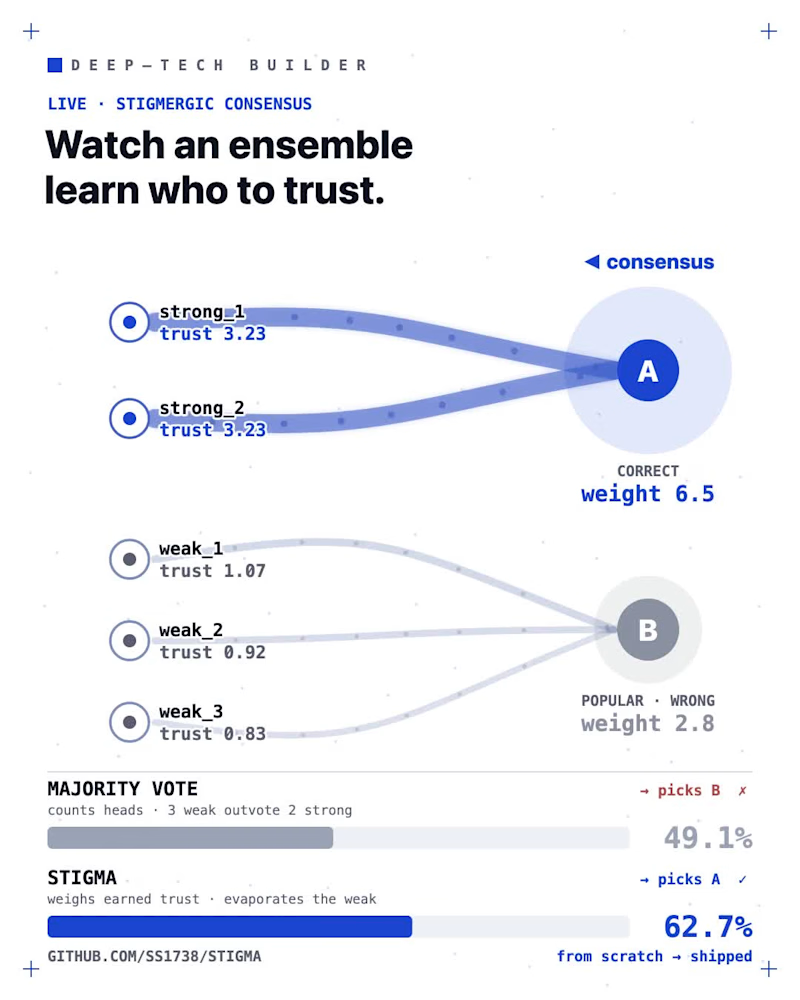
Stigmergic consensus for multi-agent / multi-model systems. A learned, stateful alternative to majority vote and self-consistency: agents deposit weighted signals into a shared pool, a short truth-discovery loop converges on consensus, and cross-run pheromone memory teaches the swarm which agents to trust. Pure Python, zero dependencies, provider-agnostic.
0
44

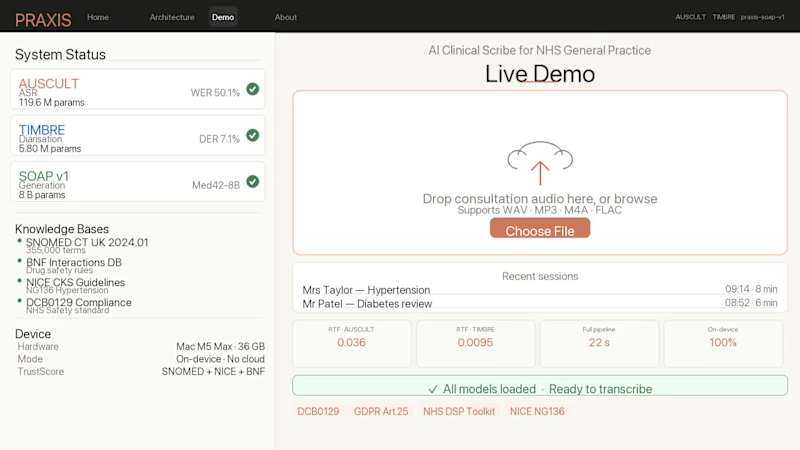
PRAXIS is my MSc dissertation project at the University of Leicester: an end-to-end deep-learning system for voice-based biomarkers, designed and built from scratch.
I architected and implemented the full pipeline: a self-supervised speech representation model plus a downstream biomarker system, and contributed multiple novel technical and methodological advances, documented in a 15,000+ word dissertation with full research rigour.
What I did:
Designed a custom deep-learning architecture for speech/audio
(self supervised learning + domain adaptation)
Developed several original contributions in [voice-biomarker modelling/representation learning] (kept high-level to protect the method)
Built a reproducible, rigorously evaluated pipeline end-to-end: data → model → results
0
82