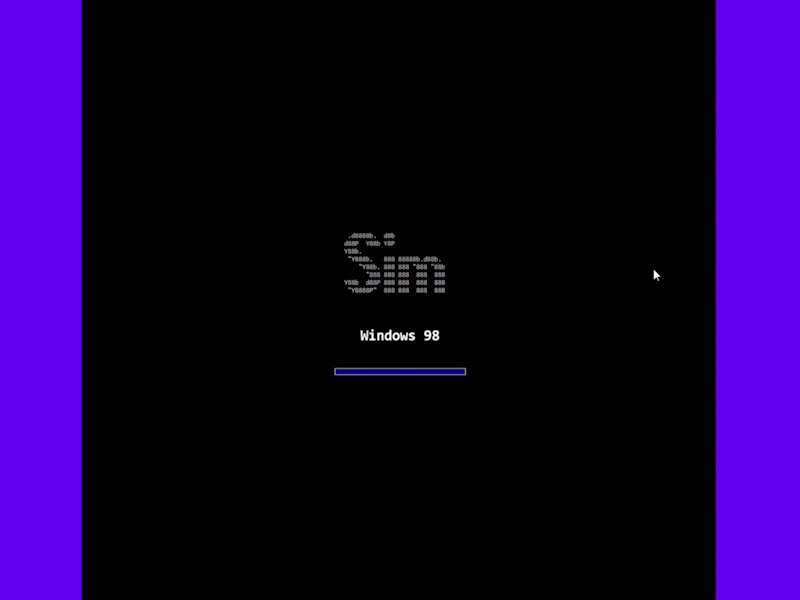
Retro Windows OS: Single-File Desktop Simulation (https://win95bysamin.netlify.app)
I built a retro Windows desktop simulation inside one single HTML file. It starts with a black "Sim" boot screen. Then it opens to a desktop with a working taskbar and Start menu. Everything runs on plain HTML, CSS, and vanilla JavaScript. The OS needs zero sound files and zero external libraries.
The OS includes several apps and a game. Users can play a full game of Minesweeper with real and clickable flags. It also has a running Calculator, a Notepad editor, My Computer, Recycle Bin, and Internet Explorer. Clicking Shut Down in the Start menu triggers a Blue Screen of Death(intensionally added as a humor statement).
You can open multiple apps at once and drag windows around. Minimizing a window drops it onto the bottom taskbar. All sounds use the Web Audio API. The browser starts with a the booting animation, click sounds, and error beep sound in real time. The styling uses classic gray bevels and navy blue title bars(much like the Real Win95 did).
Window dragging had one tricky bug. The iframe swallowed all the mouse events, and the applications UI got stuck. I fixed it by dropping an invisible layer over during drag movements. That kept the mouse tracking perfectly across the whole screen.😊 👍
14
1.8K
AetherOS: Single-File Web OS for AI Agents (https://aetherosbysamin.netlify.app)
AetherOS is a web desktop for AI agents. The entire project sits inside a single HTML file. It starts with a boot screen. Then it opens into a dark workspace. The background has black animated particles. Everything runs on plain CSS and vanilla JavaScript. The site loads zero external dependencies and zero sound files.
The bottom dock holds seven apps. These tools manage four AI agents: Atlas, Sage, Bolt, and Vega. The Agents app shows them chatting and passing tasks. Files lets you browse a drive. Memory shows a live graph of what the system knows. Users can also modify a history timeline. Studio lets you test prompts. Flows builds node pipelines, and Cost tracks token usage.
Every window can be moved, resized, minimized, or maximized. The top menu bar has a model switcher. It routes tasks to Claude Opus 4.7, GPT-5.2, Gemini 3 Pro, DeepSeek V4, or Llama 4. The OS also has Spotlight search, sound toggles, and local API key inputs. The interface uses dark glass panels with blue highlights.
Building the node graphs in one single HTML5 file was tough. At first, the physics nodes pushed apart too hard. They floated right off the screen. Dragging extra lines while getting zoomed in also threw off the precise positions. I fixed the center gravity math. Then I divided mouse positions by the zoom factor. That stopped the unnecessary movement and kept the OS stable.😊
14
1.7K