The network for creativity
Join 1.25M professional creatives like you
Connect with clients, get discovered, and run your business 100% commission-free
Creatives on Contra have earned over $150M and we are just getting started
Back to feedPost

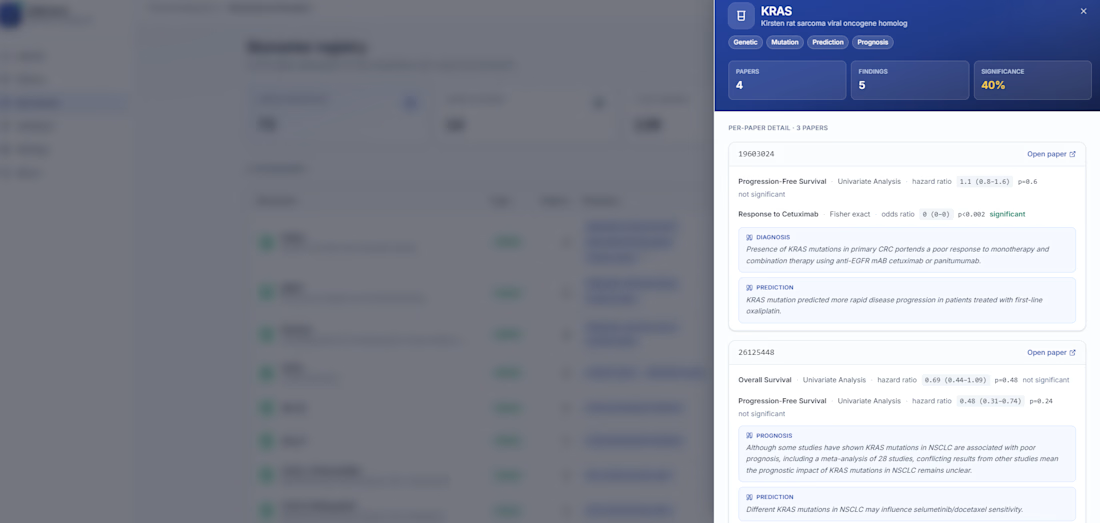
:An open-source pipeline that turns oncology research papers into structured, auditable biomarker data. Drop in a PDF, get back a 4-sheet workbook with study details, the biomarker catalog, statistical results, and author inferences — every row tagged with a verbatim source quote and the section it came from.
The problem
Pharma analysts and translational researchers spend hours hand-extracting biomarkers, p-values, hazard ratios, and cohort details from each paper. Existing tools either miss the statistical layer or hide the source, which makes the output un-auditable.
How it works
Local PDF parsing (pymupdf4llm + pdfplumber) — no Azure dependency, no cloud upload of your PDFs.
A study classifier detects disease, study type, and biomarker type, then composes a 4-level prompt (core + disease addon + study-type addon + biomarker-type addon).
Four specialized LLM agents run in parallel: Study Details, Biomarker Details, Results, Inferences.
Outputs: Excel (4 sheets), flat CSV (one row per finding, pivot-ready), and full JSON. A corpus-wide registry shows biomarker frequency across papers.
Disease coverage today: breast, lung, liver, colorectal, gastric, pancreatic, thyroid. Study types: longitudinal clinical, survival oncology, diagnostic, methylation, immune infiltration.
The network for creativity
Join 1.25M professional creatives like you
Connect with clients, get discovered, and run your business 100% commission-free
Creatives on Contra have earned over $150M and we are just getting started
Related posts


Is motion on a pricing page persuasive or distracting?
Genuinely don't know. Built one to find out.




I use Claude every day
I think I'm pretty good at it
I watch two Anthropic engineers for 2 HOURS
Claude's engineer explains Skills from scratch
the first 5 minutes
wait. Skills are just folders?
folders that hold onto your workflow?
your domain? your expertise?
pause. rewind. I watch again
I think about every prompt I've rewritten from scratch
every context I've explained 100 times
every session that forgot everything
this shouldn't have happened like that
16 minutes. everything changes
skill issue detected:

is there a video? can you share the link to it? i'd like to watch

Just shipped a full rebuild for Verona's Pizza here in Fairborn. Brand, site, SEO, AEO, the whole thing. Case study is up if you want to see how it came together.


You've done a great job bro






Trending

Claude
Claude has entered the design space. How are you using Claude Design?

Contra University
Learn from expert creatives how to earn more using next-gen AI tools.
creativeaiflow
Creative AI workflows are evolving. What tools do you use, and what are their strengths and weaknesses?
portfolioreview
The best portfolios tell a story, not just show a grid. Share yours for feedback.
freelancerlife
Freelancer life is wins, pivots, and everything in between. What’s yours right now?


